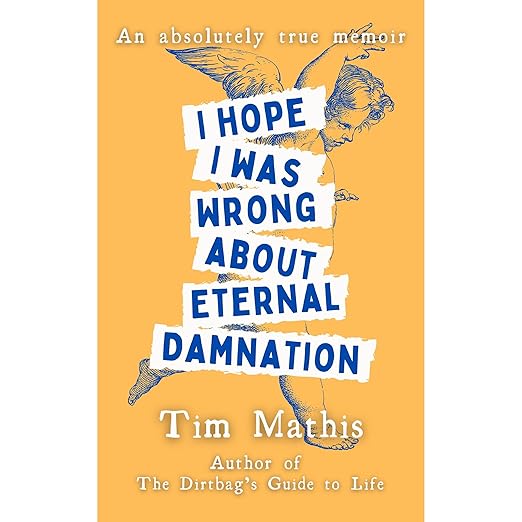
Quick Take
- Narration: AI-generated (Virtual Voice) narration. The humor and intimacy of Mathis’s prose lose something without a human voice, though the text itself carries.
- Themes: evangelical deconstruction, faith and identity, finding meaning outside organized religion
- Mood: Wry and searching, with flashes of genuine pain underneath the jokes
- Verdict: A funny and honest memoir that earns its place in the deconstruction literature precisely because Mathis never turns his former faith into a punchline.
I have a particular soft spot for memoirs that do not know exactly what they are trying to say until the final pages, because that uncertainty tends to produce honesty. Tim Mathis’s I Hope I Was Wrong About Eternal Damnation is that kind of book. He is not writing from a position of settled atheism looking back at a foolish past. He is writing from the middle of the thing, from the still-uncomfortable space between the faith he built his entire identity around and whatever comes after it.
A note upfront for listeners considering this title: the audiobook uses a Virtual Voice AI narrator rather than a human performance. This is worth knowing in advance, particularly for a memoir where tone and comic timing are central to the experience. Mathis’s writing has a distinct voice, dry, self-deprecating, and capable of landing a hard emotional truth in a sentence that reads like a joke. A human narrator who understood that register would have made this a different kind of listening experience. The text still holds, but some of the intimacy that memoir readers expect is filtered through the AI’s evenness.
Our Take on I Hope I Was Wrong About Eternal Damnation
The title is doing real work. It captures the book’s central tension precisely: Mathis spent his formative years not just believing in evangelical Christianity but becoming a leader within it, a man whose career, community, and sense of self were all structured by a faith he eventually recognized as disconnected from reality. The memoir traces that recognition as it arrived, slowly and not on any dramatic schedule. There is no single crisis of faith here, no road-to-Damascus reversal. There is instead a gradual accumulation of evidence, intellectual, experiential, and relational, that the framework he had built his life around did not actually describe the world.
Mathis is the author of The Dirtbag’s Guide to Life, and readers of that book will recognize his voice immediately: outdoors-adjacent, anti-pretentious, fond of puncturing his own seriousness with a well-placed absurdity. One reviewer compared the book to a reverse Pilgrim’s Progress, and that is exactly right. Where Bunyan’s Christian moves from doubt toward faith, Mathis moves from certainty toward honest uncertainty, and the book treats that as a legitimate and even hopeful destination rather than a tragedy.
Why Listen to I Hope I Was Wrong About Eternal Damnation
What Mathis does better than most deconstruction memoirs is refuse to make his former community a target. The 1990s evangelical culture he describes, the Christian ska concerts, the purity pledges, the megachurch youth group dynamics, is rendered with genuine affection alongside its absurdity. He is clearly still in relationship with people who hold beliefs he no longer shares, and the memoir reflects that complicated loyalty. One reviewer going through her own crisis of faith wrote that she wanted to hear from someone who would give it to her straight and remind her that it is possible to find meaning and community outside the church. That is precisely what the book provides, without claiming that the transition is easy or that the losses along the way are not real.
The humor is the book’s most reliable tool and its most disarming quality. Mathis can make you laugh in a sentence and leave you sitting with something genuinely heavy by the paragraph’s end. Several reviewers noted that the book was laugh-out-loud funny in parts, and that is accurate, but the laughs are never used to deflect from the hard material. They are used to make it bearable.
What to Watch For in I Hope I Was Wrong About Eternal Damnation
One reviewer, who otherwise gave the book four stars, noted that the occasional profanity felt unnecessary and diminished the author’s credibility in those moments. This is a matter of personal preference, but it is worth flagging for listeners who may find that register jarring in a memoir about faith and spiritual searching. The language is not gratuitous but it is present, and some listeners in the evangelical and post-evangelical communities this book will most interest may find it a sticking point.
The AI narration is the more significant limitation. Mathis’s prose depends on timing and on the sense of a particular human sensibility behind the words. Virtual Voice delivers the text competently but cannot replicate the quality of a skilled human narrator inhabiting this specific author’s perspective. Listeners who respond strongly to the memoir format and value narrator performance should factor this in.
Who Should Listen to I Hope I Was Wrong About Eternal Damnation
This book will find its most grateful audience among people who grew up within evangelical Christianity and are somewhere in the process of questioning or leaving it, particularly those who need reassurance that finding meaning outside institutional religion is both possible and legitimate. It also works well for readers who enjoy memoir-driven religious inquiry in the tradition of Rachel Held Evans, though Mathis arrives at a different destination. Listeners with no personal connection to evangelical culture can still enjoy the book as a portrait of a specific American subculture in the 1990s and 2000s, but the emotional resonance will be deeper for those who have been inside it.
Frequently Asked Questions
Does the AI narration significantly affect the listening experience for this memoir?
It does matter. Mathis’s writing relies on comic timing and a specific conversational voice that a skilled human narrator would have been able to inhabit more fully. The Virtual Voice narration delivers the text accurately but without the emotional texture that memoir typically benefits from. Listeners who are sensitive to narration quality may prefer the print version.
Does Mathis ultimately land on atheism, agnosticism, or something else?
The book resists a clean label, which is part of its honesty. Mathis moves away from evangelical certainty without arriving at a new ideological position with equal certainty. He is more interested in describing the process of deconstruction than in selling a replacement worldview, which reviewers found refreshing.
Is this book hostile toward Christianity or toward religious belief generally?
No. Mathis writes about his former evangelical community with genuine affection and complicated loyalty, not contempt. The critique is of certainty and institutional power rather than of faith itself. Reviewers from across the belief spectrum, including practicing religious listeners, found the book fair-minded and honest.
How does this book compare to other evangelical deconstruction memoirs like Rachel Held Evans’s Searching for Sunday?
Mathis arrives at a more secular destination than Evans, who remained within Christianity in a reformed form. His tone is also more darkly comedic and self-deprecating than Evans’s more devotional register. Both are worth reading, but they represent different endpoints of the same starting journey.