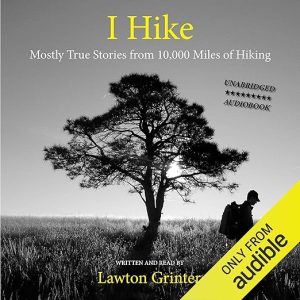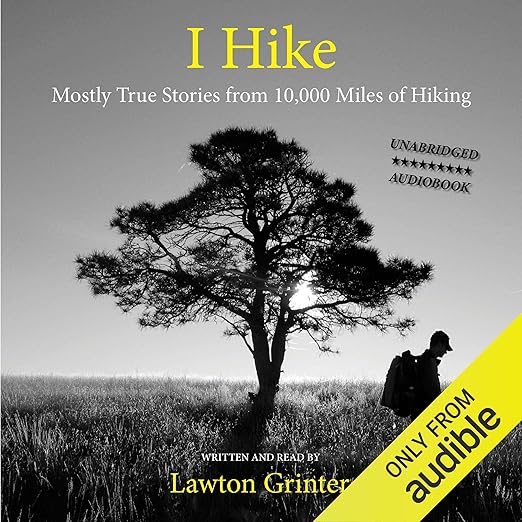
I downloaded this one before a camping trip to the White Mountains, figuring a collection of hiking stories was the appropriate soundtrack. I was somewhere on the Kancamagus Highway, not quite at the trailhead, when the first genuinely funny story about mosquitoes in South Oregon made me laugh out loud in the car. That is a good sign for a book narrated by its author: when the comic timing works in audio form, you know Grinter wrote these pieces with the spoken word somewhere in mind.
Lawton Grinter, known on the trail circuit as Disco, spent a decade walking approximately ten thousand miles across America's major long-distance trails. I Hike Again collects what he considers the best of those stories, and the result is something specific: it is not a single sustained narrative like Cheryl Strayed's Wild or Bill Bryson's A Walk in the Woods, but an episodic collection of vignettes, each more or less self-contained.
The Verdict, Briefly
The self-narration is the right choice for this material. Grinter is not a trained voice actor, and there are moments where that shows, but the authenticity of hearing the writer tell his own stories outweighs the minor unevenness. When he describes a close encounter with hypothermia or a particularly grim passage through what he calls mosquito hell, the firsthand quality of his delivery adds a layer of credibility that polished narration might actually undercut. You believe him more because he sounds like someone who actually did these things rather than someone performing them.
The collection is explicitly described as twelve mostly true stories, which sets the right expectations. Grinter is not claiming documentary precision. He is making the case that these experiences were funny enough, strange enough, or hard enough to be worth sharing, and on balance he makes that case. The stories about the kindness of strangers are the ones that linger longest for me, perhaps because they are the least expected in a genre that tends to emphasize solitude and self-sufficiency.
The Best Parts of I Hike Again
The primary reason to choose this audiobook is for the tone. Long-distance hiking writing tends toward the earnest and occasionally the self-serious, and Grinter's gift is a willingness to be genuinely funny about his own experiences without undercutting their emotional reality. One reviewer describes reading stories from the collection aloud to friends around a campfire in Maine, both of them laughing repeatedly. That social quality, the sense that these stories were built for sharing, translates well to audio.
There is also real value in the specificity of the subculture Grinter documents. The AT, PCT, and CDT communities have their own vocabulary, rituals, and social dynamics, and I Hike Again captures those with the affectionate accuracy of someone who knows them well. For listeners who have done any of these trails, the recognition factor is high. For those who have not, it functions as an engaging introduction to a world most people only know from the outside.
Points to Consider
A few reviews note that the collection fades slightly toward the end, with later stories feeling less fully developed than the earlier ones. That observation matches my experience. The opening stories have the sharpest sense of shape and timing; the book's energy is not perfectly even across its five-hour runtime. That is a common characteristic of short story collections, and it is not a fatal flaw here, but listeners expecting consistent peaks throughout may notice the unevenness.
One reviewer with extensive long-distance hiking experience found the stories unremarkable, arguing that the situations Grinter describes are simply common trail experiences that do not quite reach the threshold of being book-worthy. That critique is worth taking seriously. If you are a veteran thru-hiker who has spent multiple seasons on major trails, this collection may feel more familiar than fresh. It is aimed at a broad audience that includes people who have never set foot on the AT, and some of its sense of discovery depends on the reader not already knowing exactly what it describes.
Who Should Listen to I Hike Again
This is well-suited to hikers at any level who enjoy trail culture, as well as outdoor enthusiasts who have considered a long-distance trip but never taken the plunge. The book is honest about both the rewards and the physical misery of thru-hiking without tipping into either relentless positivity or misery memoir.
Skip it if you are looking for a deeply crafted narrative with literary ambitions, or if your background on major trails is extensive enough that the stories will feel familiar. For those audiences, Wild or Pacific Crest Trail literature with more structural complexity will be a better fit.
Frequently Asked Questions
Is I Hike Again suitable for people who have never done a long-distance trail?
Yes. Grinter writes with enough context that the trail culture is accessible to newcomers, and the humor and human moments work regardless of hiking experience. Several reviewers credit the book with inspiring them to consider a thru-hike for the first time.
Does the self-narration by Grinter work well, given that he is not a professional narrator?
For the most part, yes. His comic timing on the funnier stories is natural and effective, and the firsthand quality adds credibility. There are occasional rough edges in pacing, but the authenticity outweighs the unevenness for most listeners.
Is the collection better at the beginning or does it build as it goes?
Several reviewers and the broader consensus suggest the collection is strongest in its earlier stories. The pacing and sharpness of individual pieces is not perfectly even, with some later entries feeling less developed than the opening ones.