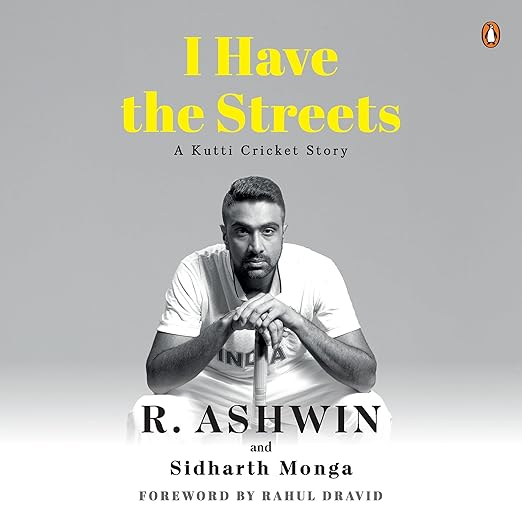
R. Ashwin opens his audiobook with a deceptively simple phrase - the streets, meaning the gully cricket lanes of Chennai where he grew up - and that framing never quite leaves you. The subtitle calls this A Kutty Cricket Story, and kutty means small in Tamil, a word that signals both literal childhood and a deliberate humility about a career that has been anything but small. Ashwin became the fastest man to 300 Test wickets, won the 2011 World Cup, collected two IPL titles and a Champions League T20, and spent twenty years as arguably the most analytically sophisticated cricketer India has produced. And yet the first substantial portion of this memoir lingers, with real patience, on the years before any of that mattered - the health struggles, the financial calculations, the specific texture of a cricket-mad gully in Chennai.
The memoir was written with journalist Sidharth Monga, and the collaboration shows in the best way. The prose is disciplined without being bloodless, and the cricket analysis is explained clearly enough that readers outside the sport can follow it without the book ever condescending to fans who know the game deeply. That balance - between insider knowledge and accessibility - is harder to maintain than it looks, and Ashwin and Monga pull it off through the full seven hours.
Crisp, Personal, and Full of Wit
What separates this from the standard sporting autobiography is Ashwin's refusal to treat his childhood as backstory to be cleared before the real narrative begins. The health struggles he faced early in life, the financial calculations his middle-class family had to make to support a professional cricket career, the particular pressure of being both gift and responsibility to a family that had invested everything in his potential - these are not preamble. They are the actual subject. The opening reviewer on the audiobook described his storytelling as crisp, personal, and full of wit, and that description is accurate - Ashwin's intelligence as a cricketer extends to his intelligence as a narrator of his own life. He does not flatter himself, and he does not settle the scores that would make a lesser memoir smaller and pettier. The professional relationships and selection controversies are present but handled with more reflection than resentment.
One aspect reviewers have responded to strongly is how Ashwin frames the relationship between a cricketer's interior life and the visible results of his career. How does a champion sportsman view the world? is one of the questions the synopsis poses, and the answer delivered across the book is more specific and more interesting than the generic motivational answer that question usually produces. Ashwin's curiosity about his own mental processes - how he solves problems, how he prepares opponents in his mind before meeting them on the field, how he has thought about the game since he was playing it in the gully - gives this memoir an unusual quality. It feels like it was written by someone genuinely interested in thinking, not just someone performing reflection.
Cricket Lives in Memory and Conversation
The audiobook format does this one specific favors. Cricket is a sport that lives in memory and conversation, and hearing Ashwin's reflections read aloud restores some of that quality. There is a difference between reading about a crucial Test over and having it described to you, the rhythms of the narration matching the rhythms of the game itself. Jeremy Francis maintains the pacing that the material requires - this is not a thriller or a narrative that builds to a single climactic moment, but a portrait that deepens as it accumulates. His handling of the Tamil names and the Indian cultural context is attentive without being self-congratulatory, and the result is seven hours that pass more like a long, engaged conversation than like a formal reading. The comedy is dry and surfaces without fanfare, which is the right call for Ashwin's particular register of humor.
The Intimacy of a Spoken Voice
Readers expecting a deep tactical breakdown of Ashwin's full bowling career across all formats and conditions may find the early sections slow-going. This is a book rooted in formation rather than in achievement, and Ashwin clearly cares more about explaining how he came to think the way he does than about recounting match results sequentially. The chapters dealing with his family's financial reality are particularly honest and carry weight precisely because he does not editorialize heavily - he simply describes what was spent, what was sacrificed, what was withheld and why. Those sections land harder in audio than on the page, because the lack of visual distance between reader and narrative is replaced by the intimacy of a spoken voice. Listeners should also note that the cricket sections assume some basic familiarity with Test match structure; if you have never watched a day of Test cricket, a few terms will float past without anchoring.
How Ashwin's Mind Was Formed
Cricket followers who want to understand how Ashwin's mind was formed - not just what it produced on the field - will find this essential listening. Sports biography readers drawn to stories of working-class athletic ambition will recognize the emotional architecture even if cricket itself is unfamiliar territory. This is not the right starting point for someone entirely new to the sport, but it is an unusually honest and intelligent account of what it actually costs to become exceptional at something, and those costs are recognizable regardless of the game being played. At seven hours, the commitment is proportionate to what the book offers.
Before You Listen
Does the audiobook cover Ashwin's full international career or focus mainly on early life?
The book is weighted heavily toward his childhood and formation years in Chennai, covering his family background, health difficulties, and the gully cricket culture that shaped him. The international career provides context throughout, but this is not a match-by-match career retrospective.
Do you need to be a cricket fan to enjoy this audiobook?
Basic familiarity with cricket helps, particularly with Test match terminology, but the emotional core of the story - a middle-class family's sacrifice, a child's health struggles, the pressure of making good on that investment - is accessible to anyone who grew up watching a parent work hard for a dream.