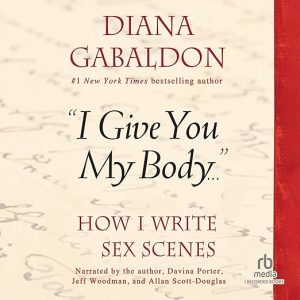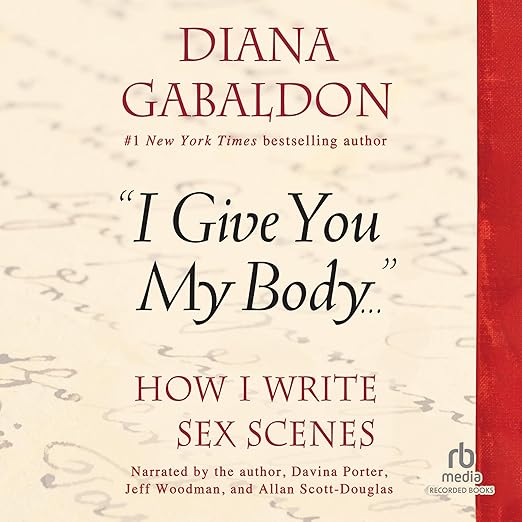
Writers should buy this and almost nobody else should. That is the verdict, and the three-and-a-half-hour running time is part of why: this audiobook is a craft seminar rather than a memoir or an Outlander companion, and Diana Gabaldon spends the whole of it teaching one narrow skill to people actively trying to acquire it. If you are not currently writing a scene you are nervous about, the thing will play as a curiosity.
Gabaldon Deconstructs Her Own Published Scenes
Craft instruction is the actual product, and the description is unusually precise about the contents. The Rule of Three for involving the senses. The difference between gratuitous sex and genuine encounters that move a story forward. How to handle acts a reader will find unpleasant when the narrative needs them anyway. Lists of euphemisms with instructions for use. And the argument that sex can be conveyed instead of described, which is the most useful idea in the book and the one most often ignored by people who should know better.
Gabaldon's method throughout is demonstration rather than assertion. Kara's five-star account puts it cleanly: the book supplies the how-to together with the reasons those techniques work, and Gabaldon deconstructs her own scenes to show a reader exactly how to apply them. Working from her own published pages is what separates this from generic advice, because the examples are things you can go and read in full, in context, at whatever length you like.
Dialogue opens the description before anything gets explained: a man asking to be invited, and promising "I shall come to ye." That is the entire thesis in miniature. Nothing physical occurs in those words. The charge comes from register, from the archaism, from the promise rather than the act, and a craft book that leads with restraint on this subject is already making its case before the first lesson.
Gabaldon's Pauses Carry Real Information
Gabaldon reads it herself, and on this particular book that is more than a marketing decision. A manual about how sentences land is a strange thing to hand to somebody else, because the author's own emphasis is part of the instruction. Where she pauses inside a sentence she wrote is information. The dialect in that opening line is information. Three hours and thirty minutes of a novelist reading her own prose and then explaining why she built it that way is a defensible reason to take the recording over the page.
Brevity works in its favor. One sitting will cover it, or two, and the material is organized as lessons rather than as an argument you have to follow cumulatively. Judimahl's five-star response describes it as interesting to read her thoughts on the subject, which is a modest claim and an accurate one. This is a working novelist thinking out loud about a specific technical problem, and that register suits being heard.
Humor runs through it, which the description signals and the pool confirms. Handy lists of naughty euphemisms with instructions for use is a joke and a real feature simultaneously. One five-star account observes that when Gabaldon writes about good sex it is very good and often lighthearted, a distinction most craft books on this subject never bother to make. Comedy and eroticism sit closer together than either genre likes to admit, and hearing that read aloud lands the point better than reading it does.
One Vote Cannot Explain a 4.4 Rating
Two separate things are wrong with the rating. A displayed 4.4 sits above a rating count of one, and a single vote can only land on a whole star, so that decimal came from somewhere other than the votes. Beneath it sit five written accounts. One rating, five people who took the trouble to write at length: the counter and the comment list are not counting the same thing, and neither figure tells you anything you can rely on. Read the accounts and treat the arithmetic as broken.
Three responses among the five predate the November 2016 recording, filed in August, September and October of that year. They are about the book. That matters more here than it usually would, because one of them arrived by an unusual route: Sarah R describes writing a first adult romance after two young adult novels, never having read Outlander, and being pointed toward a blog post on writing sex scenes by a mother who follows Gabaldon's blog. This author writes about craft in more than one place, and the page does not tell you how the compendium relates to any of it.
Sharpest of the five is the four-star account, and it is the one worth attention for its method rather than its verdict. That reader went through the existing reviews before purchasing, wanting to know whether an interest in dissecting Gabaldon's craft was a valid reason to buy, and came away finding those reviews plain and uneventful, closer to a shopping list of ingredients than to a description of the meal. Then bought it anyway. That is a careful buyer, and four stars from a careful buyer carries more information than the enthusiasm surrounding it.
Not an Outlander Companion or Memoir
Working writers with a specific problem are the audience, which the description states in its opening sentence: people who want their next physical scene to move a reader rather than embarrass one. Romance writers obviously. But the techniques generalize much further than the subject suggests, because the underlying lessons concern sensory detail, restraint, and letting emotion carry weight that description cannot. Anybody writing intimacy of any kind will find the time well spent.
Editors and teachers of writing are a quieter third audience. A short, specific, demonstrated treatment of the one scene type most workshops handle badly is a useful thing to be able to hand somebody, and at this length it can be assigned without apology. The frankness that will put some listeners off is exactly what makes it teachable, because the book never retreats into euphemism about its own subject.
Reading it for the Outlander material is a mistake, though several responses in this pool plainly came for exactly that. It is not a companion, not a memoir, and not a tour of the novels; the examples come from those books because they are the author's own work, not because the book is about them. Anyone who wants the Outlander story itself should buy the Outlander novels. And anyone uncomfortable with frank discussion of sex, including acts the description itself calls less than savory, should understand that discussing them plainly is the whole point.
Before You Press Play
- Read by: Diana Gabaldon reads her own craft manual, so her emphasis inside her own sentences becomes part of the lesson.
- At its heart: Writing craft, intimacy on the page, sensory detail, restraint and implication
- Vibe: Frank, wry, practical
- Short version: Specific and usable instruction for working writers, on a page whose two rating figures contradict each other.