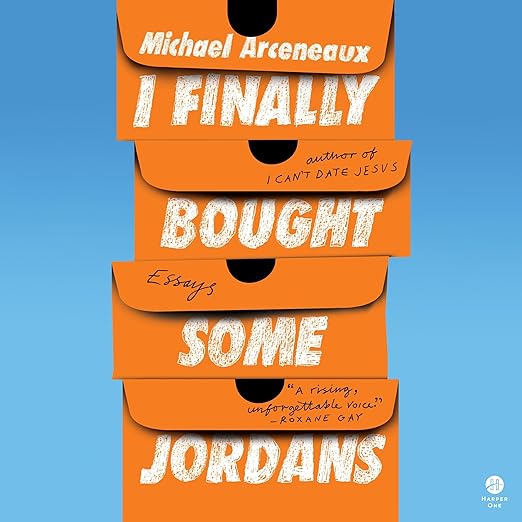
- Narrator: Arceneaux reads his own essays, so the file carries the same voice the byline promises.
- Subjects: Debt and its aftermath, Black creative labor, dating in the social media era, the pull of home.
- Tone: Funny, candid and quick on its feet.
- Bottom line: A short, sharp collection best heard in the author's own voice.
Voice is this book's subject and also the thing you are buying. Michael Arceneaux's third essay collection is about making your voice heard in an increasingly noisy and chaotic world, in the description's own phrase, and the audiobook hands you that voice directly, since he reads it himself across five hours and fifty-five minutes. What the page cannot tell you is how the reading lands. All five written responses grade the prose: being moved by his prose, laughing and crying, finishing the book a better person. Not one of them mentions the recording, on a title whose entire premise is a man speaking for himself.
A Financial Autobiography in One Pair of Sneakers
Arceneaux arrives with two collections behind him, both named in the copy, I Can't Date Jesus and I Don't Want to Die Poor, and the entry filed on release day maps the sequence neatly: religion and sex in the first, money and crippling debt in the second, and a third that keeps mixing humor with heavy issues. That reader also reports the title essay's answer to the obvious question, whether the debt is finally cleared: not yet, but close enough to treat himself. A whole financial autobiography compressed into one pair of sneakers is exactly the move this writer keeps making.
Essays this size suit audio better than almost any other nonfiction shape, and the full runtime supports it: discrete pieces, each with an argument and a payoff, which means a listener can stop after any one of them without losing a thread. The description lists the territory as race, class, sexuality, labor, debt, and what it calls paying homage to the power and wisdom of Beyoncé, plus the opportunities open to Black creatives against the doors that stay shut or barely ajar, dating in an era when social media has made everything both more accessible and less reliable, and the pull of home against the need to go where the work is.
Crawls Inside Your Head, Opens the File Cabinets
Debt gives the collection its spine and gives the comedy its edge. The second book was about crippling debt, according to that release-day entry; this one is about the moment you can finally treat yourself, and about what the moment costs. A five-star filed three weeks after release calls the writing smart, funny, insightful, heartfelt, and reports being deeply moved by the prose, the insight, the vulnerability, the humor. Another, filed five weeks out, compresses the whole experience into six words: I laughed, I cried, I enjoyed. A collection producing both of those reactions from the same pages is doing something harder than either separately.
Celebrities are the subject of one essay the release-day entry singles out, on the perils of writing about them, and that is a useful signal about register. This is a working writer's collection, about the labor of the job as much as about the life. The blurb the publisher leads with, from Shea Serrano, makes the same case from the reader's side, describing someone who crawls around inside your head, opens the file cabinets and tells you what the gibberish you have scribbled in them actually means. That is a claim about recognition rather than about jokes, and it is the strongest sentence on the page.
Forty-One Grades Nobody Can See Run Cooler
Launch week explains the entire shape of this column. The first response was filed the day the book went on sale, the second the day after, and the remaining three within five weeks of it. Every grade with text attached comes from that opening window, before any general readership could arrive, and four of the five award five stars. The badge reads 4.6 across 46 while those five average 4.8, so the forty-one grades nobody can see run slightly cooler than the ones you can read. None of that is suspicious. It does mean the page shows a launch reaction rather than a settled verdict.
Titles are where the page turns careless. One five-star recommends the book as I Finally Bought Myself Some Jordans, adding a word the title does not contain, which is trivial until somebody goes searching with it. That same response calls this its favorite book by the author, so the enthusiasm is not in question. The description, separately, arrives with doubled quotation marks wrapped around the Serrano blurb, a formatting artifact rather than a choice anybody made. Neither slip changes the book. Both are reminders that the column here is small enough for one mistyped title to matter.
The Voice Reading It Belongs to Him
Memoir readers who want their essays funny, followers of the earlier two collections, and anyone who wants a writer being candid about race, class, sexuality and money in a country that keeps certain doors ajar and no wider will get what they came for. The record files it under biographies and memoirs with an LGBTQ+ category and tag, which fits what the description promises. The copy also promises the collection works as both a corrective and a comfort, and the column, which spends more time on feeling than on argument, broadly agrees.
Brevity is the last thing to weigh. Under six hours means a single afternoon, which suits an essay collection and will disappoint anyone hoping for a continuous memoir with a narrative arc, because this moves by subject rather than by chronology. Readers who want the debt story told straight through should know it is distributed across three books instead of being told once. What five responses in five weeks do establish is that the writing rewards the hours. The voice reading it belongs to the person who wrote it, which on this book in particular is not a small detail.
Do I need the earlier two collections first?
No. The description names both and summarizes what each covered, so the context arrives in the first minutes. Essays stand alone by design, and the only running thread is a financial story that gets updated rather than continued from a cliffhanger.
Is the audiobook funny all the way through, or does it turn serious?
Both, deliberately. The publisher calls the collection hilarious and also a corrective and a balm for troubling times, and the written responses describe laughing and crying in the same breath. Expect jokes carrying weight rather than comedy set apart from the difficult material.
What does the record say about this audiobook edition?
HarperOne released it on March 12, 2024, at a shade under six hours, with the badge field empty and no companion material listed. It is a straightforward single-voice production of a text that reached print in the same season, and no abridgment or adaptation is claimed anywhere.
What is the LGBTQ+ tag doing on a book about sneakers and debt?
The categories place it in LGBTQ+ alongside biographies and memoirs, and the description supports that: sexuality sits in its list of subjects, dating gets a section of its own, and the copy names the heteronormative society the essays are pushing against.