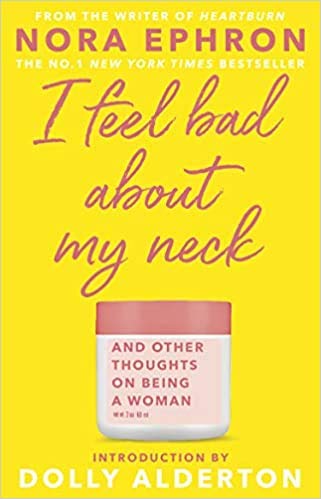
I Feel Bad About My Neck is the kind of audiobook that reminds you what the form is actually best suited for: a sharp, intimate, funny voice delivering essays directly into your ear, with the timing and cadence that make the jokes land exactly as they were intended. Nora Ephron narrates her own collection, published in 2006, and the experience is about as close as you can get to having a conversation with her. She died in 2012, which gives the essays a particular quality now, an awareness of the time they represent and the time that followed, but during the nearly four hours of the audio you are simply with her, in her New York apartment, being told things about being a woman of a certain age with remarkable candor and wit.
The collection covers a range of apparently disparate subjects: the horror of aging necks, the obsessive pleasures of cooking, the years she spent as a White House intern during the Kennedy administration, her relationship with Bill Clinton from a distance, and the rituals of maintenance and self-preservation that middle-aged women engage in and rarely talk about directly. What holds these essays together is not a single argument but a single voice, one that has the journalist's commitment to specificity, the screenwriter's sense of structure, and the memoirist's willingness to be mortifyingly honest about her own experience. Ephron wrote When Harry Met Sally, Sleepless in Seattle, and Heartburn before this collection, and the intelligence behind those works is entirely present in these shorter pieces.
Where This One Lands
The title essay is the one that established the book's reputation, and it earns that reputation. Ephron's examination of what it means to be a woman who can remember having a neck, and who now has to decide how much time, money, and energy to spend on the process of looking as though she still does, is funny in the way that things are funny when they are absolutely true and absolutely not discussed. The treadmill, the hair dye, the creams that promise more than they deliver: Ephron inventories all of it with the precision of someone who has done the math and found the math deeply unreasonable.
But the stakes underneath the comedy are real. Ephron is writing about visibility and time, about the specific experience of becoming less visible to a culture that values women primarily for their youth, and about what it costs to resist that process and what it costs not to. She does not resolve this tension because it cannot be resolved, but she examines it with more honesty than most writers are willing to bring to the subject. The comedy is not a defense mechanism. It is the form through which she can say things that would be either too sad or too angry if said straight. This is a more sophisticated use of humor than the genre typically produces.
Why Listen to I Feel Bad About My Neck
One of the essays I return to most in this collection is the account of Ephron's time as a White House intern during the Kennedy administration, which she characterizes with her signature understatement: she is probably the only young woman who worked there that the President did not make a pass at. That line is doing significant work. It places Ephron in a specific historical context, acknowledges the reality of Kennedy's behavior toward women in his orbit, and positions Ephron's experience of it as comic rather than wounded, all in a single sentence. The essay that follows is a meditation on the gap between how the Kennedy era looked and what it actually was, and it is one of the most compressed pieces of cultural criticism Ephron ever wrote.
Her reflections on the Clinton era have a different register: the fall from idealism, the specific betrayal of a president she had genuinely admired, the way that public figures occupy a relationship with their audience that involves genuine feeling even when it is never reciprocated. These are not light observations, and Ephron does not make them light. She makes them funny, which is different, and harder.
What Gives Us Pause
Ephron's background as a journalist, novelist, and screenwriter means that her prose already has the rhythm of a speaking voice, and hearing her read it collapses the already-thin distance between the written and the spoken. The timing on the comic essays is exactly right in a way that is very difficult to manufacture. She knows where the laugh is and she lands it without announcing it. The quieter essays, particularly the one about her friend who died, have the appropriate gravity without becoming heavy. At under four hours, the collection is perfectly proportioned for what it is: a set of essays, not a monologue or a lecture, and Ephron does not stretch her material beyond its natural length.
This is one of those clear cases in the audiobook catalog where author narration is definitively superior to any conceivable alternative. The essays are Ephron's voice on the page, and they are Ephron's voice in the air, and the distance between those two things is negligible. Readers who have never encountered Ephron's work have found a nearly perfect starting point: the collection is accessible, unified by a single sensibility, and funny enough to make the serious parts land harder by contrast.
Should You Listen to I Feel Bad About My Neck?
Anyone who enjoys essay collections, women's humor, New York cultural memoir, or simply well-crafted prose read by the person who wrote it will find this essential. The essays are brief enough that they can be listened to singly, during a commute or a lunch break, without losing the larger coherence of the collection. The subjects range from deeply personal to broadly cultural, which means there is almost certainly something here that will feel directly relevant to any given listener's life at any given moment. Ephron at this age was writing at the height of her powers, and this collection is evidence of that, as clear and funny and honest as anything she produced in a longer form.
- Voice: Nora Ephron reading her own essays is a complete pleasure, her comedic timing and conversational authority making this one of the most natural author-narrated audiobooks in the essay genre.
- Big ideas: Aging with clear eyes and dark humor, the gap between how women are expected to feel about growing older and how they actually feel, New York as identity and community
- Atmosphere: Wry and intimate, the feeling of being let in on a secret
- Worth it?: Ephron at her sharpest and most personal, and the audio format is the ideal way to experience essays this conversational.
Before You Listen
Does I Feel Bad About My Neck hold up as an audiobook despite being published in 2006, or does it feel dated?
The specific cultural references, including the Clinton era reflections, are historical rather than current, but the essays about aging, visibility, and the comedy of maintenance are timeless in the sense that they describe experiences that have not changed. The voice has not dated at all.
How does Ephron's background as a journalist and screenwriter affect the quality of these essays as audio?
Her prose already has the rhythm of spoken language, which is why the author narration works so completely. The structural precision of a journalist and the comedic timing of a screenwriter combine in essays that are built to be heard as much as read.
Is this collection primarily comedy, or does it engage with more serious subjects?
Both, and the ratio shifts across the essays. The title essay and the cooking essays are primarily comic. The Kennedy White House piece and the essay about a friend's death are more serious, though Ephron uses humor as a tool throughout. The comedy and the gravity coexist without one undermining the other.
At under four hours, does the collection feel too short or appropriately proportioned?
Appropriately proportioned. Ephron does not stretch her material, and the collection is complete as it is. The brevity is a strength: you can listen to it in a single sitting and feel genuinely satisfied rather than wishing for more, which is the correct response to a collection of essays.