Key Details
- Voice: Jesse Washington delivers Thompson's autobiography with exactly the respect AudioFile described; the narration does not imitate Thompson but channels the weight of his words with appropriate gravity.
- Big ideas: Race and power in American institutions, the education of Black men in a hostile system, love as a coaching philosophy
- Atmosphere: Measured and honest, with the quality of a final reckoning from someone who earned the right to have one
- Worth it?: One of the most substantive sports autobiographies of recent years, which is actually not a sports autobiography at all but an account of what it cost and meant to be Black in American institutions across six decades.
I started I Came as a Shadow on a flight home from a conference where I had sat through several panels on leadership and diversity in institutions. By the time the plane landed, I had listened to five hours and was considerably more educated about what those concepts actually mean in practice than any panel had made me. John Thompson was not talking about diversity initiatives. He was talking about power: who has it, how it moves, and what happens when someone without it builds enough to matter.
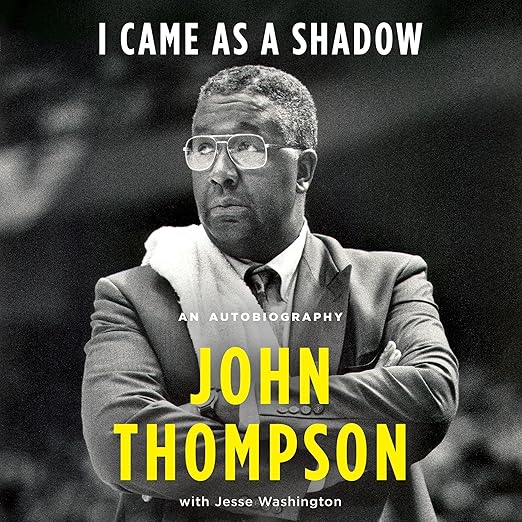
John Thompson spent thirty-one years as the head basketball coach at Georgetown University, during which he became the first Black head coach to win an NCAA championship, built a program with a 97 percent graduation rate, and navigated relationships with everyone from NBA Hall of Famers Patrick Ewing and Allen Iverson to a DC drug kingpin to the Nike board. I Came as a Shadow is his autobiography, completed before his death in 2020 and narrated by Jesse Washington, a journalist who covers race and sports.
First, the Big Picture
The book's great strength is Thompson's refusal to let his basketball career be its organizing principle. He uses Georgetown as a stage, but the real subject is the experience of being Black in America across the decades from Jim Crow to the racial reckoning of 2020. His father could not read or write, and identified different cements at the factory where he worked by taste. His mother was a teacher who could not teach because she was Black. His own life, from that origin to a building bearing his family's name on a campus that was once partly funded by the sale of enslaved people, traces an arc that Thompson refuses to call simple progress.
Reviewer J. Rodeck described the book as a treat for college basketball fanatics who remember the NCAA heydays of the 1970s and 1980s, but also emphasized Thompson's focus on the human elements of coaching: the cultural backgrounds his players came from, the specific vulnerabilities of young Black men navigating elite white institutions, the particular responsibility Thompson felt for the whole person rather than just the athlete. His love for his players inhabits every page, as Rodeck put it, and that love is Thompson's most consistent argument against every institutional force that would have reduced his players to their athletic output.
What Makes I Came as a Shadow Worth Hearing
Jesse Washington's narration is one of the audiobook's genuine assets. AudioFile's assessment, quoted in the synopsis, notes that Washington gives Thompson's words the respect they deserve and does not imitate Thompson himself. That restraint is the right choice; Thompson's voice and delivery were distinctive enough that imitation would have been both impossible and condescending. What Washington provides instead is a reading that carries the weight of the material without being heavy-handed about it.
The AudioFile review's description of this as essential listening for anyone whose mind is made up on Thompson is a careful phrase. Thompson was a polarizing figure in his time; the phrase Hoya Paranoia, which the book explains, emerged from critics who believed Georgetown's program was too closed, too aggressive in protecting its players from media access. Thompson addresses these critiques directly and on his own terms, and the result is a more complicated portrait than either his admirers or his critics produced about him.
A Few Reservations
Reviewer John Roberts noted that Thompson uses the N-word several times in the text, which surprised him. Thompson's use of the word is contextual and historically grounded, generally quoting the language of the environments he navigated rather than casual deployment, but listeners should be aware it is present. Roberts also noted that he bought the book after Charles Barkley's recommendation on an NBA pre-show, which is the kind of endorsement that suggests the book has found a broad audience outside Georgetown athletics specifically.
The book's basketball content is substantive but not technical. Thompson is not writing a coaching manual, and the game descriptions are in service of broader points about race, institutional power, and the responsibilities of mentorship. Basketball fans expecting detailed game accounts will find them less present than the title might suggest; readers interested in the social and racial history that basketball intersects with in America will find more than they expected.
The Right Listener for I Came as a Shadow
This audiobook is essential for anyone interested in the intersection of race, sports, and American institutional life across the second half of the twentieth century. It is equally valuable for listeners interested in coaching philosophy, not as a collection of tactics, but as an ethical and relational practice. Basketball fans who remember Georgetown's dominant era will find the insider accounts of the Ewing and Iverson years deeply satisfying. Listeners with no particular interest in basketball who want a first-person account of navigating American racism within elite institutions will find this among the most honest and artfully constructed such accounts available in audio form.
How does Jesse Washington's narration compare to Thompson narrating his own autobiography?
Thompson did not narrate the audiobook, and the choice of Jesse Washington, a journalist who covers race and sports, is a considered one. Washington does not perform Thompson but reads with appropriate gravity and understanding of the material's stakes. AudioFile's assessment that he gives Thompson's words the respect they deserve captures what makes the narration work.
Is the book a balanced account or does it read as primarily self-justifying?
Thompson is honest about his own difficult decisions and acknowledges moments where reasonable people could disagree with his choices. Reviewer Shawn Hamilton, who described disagreeing with how Thompson handled some situations, also praised his honesty and his willingness to stand up for his beliefs. It is Thompson's perspective, clearly, but it is not hagiography.
What does the title I Came as a Shadow mean?
The title references a poem that Thompson discusses in the book, one that moved multiple reviewers enough to mention it specifically. It speaks to arriving quietly, without full visibility, and to the way Thompson describes his early presence in American basketball: not as a figure who announced himself, but as one who gradually became undeniable. The poem provides the book's emotional frame and its closing resonance.