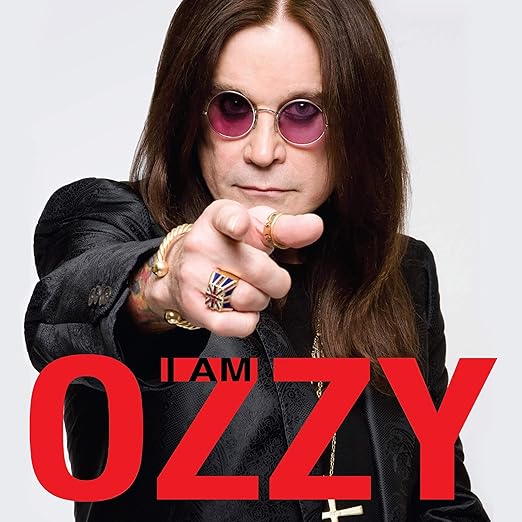
Rock memoir as a genre has a particular problem. Too many of them are told by professional writers who smooth the chaos into coherent narrative arcs with clean emotional takeaways. The subject's actual voice, which is usually the thing you came for, ends up sanded down until what remains sounds like every other memoir on the shelf. I Am Ozzy sidesteps this almost entirely because Ozzy Osbourne narrates his own audiobook, and the effect of hearing him tell his story in his own Black Country accent, with his own rhythms and his own particular brand of profane philosophical bewilderment, is something no ghostwriter or professional narrator could replicate.
How Is He Still Alive, Ozzy Wonders
The memoir covers Aston to arena, factory floor to Black Sabbath, the biting of the bat to the reality television second act. Ozzy frames all of it through the fundamental question that animates the book: how is he still alive? It's not posed as a boast. He is genuinely puzzled by his survival, and that puzzlement gives the memoir an unusual quality. Most rock memoirs are triumphalist even when describing failures. Ozzy's version of his own life reads more like a man taking stock of damage and luck in roughly equal measure.
The 2009 interview included at the end of the audio edition is a useful addition. It provides a different conversational register than the narrated memoir and lets you hear Ozzy responding to questions rather than delivering prepared material. The contrast is interesting. In the memoir sections he is more composed, more structured; in the interview he is more digressive and immediate. Both are valuable.
Sharon Osbourne's presence in the memoir is significant. Ozzy's account of their relationship, including its most difficult periods, is honest in ways that feel costly. He does not cast himself favorably in every scene. The admissions of addiction, infidelity, and absence are delivered without the kind of narrative redemption scaffolding that memoir convention usually demands. That willingness to remain complicated is one of the book's genuine virtues.
A Better Sounding Audiobook, a Worse One
Self-narrated memoir is always a gamble on the subject's ability to sustain a long audio performance. Fourteen hours is substantial, and not every celebrity narrator has the vocal range or technical consistency to carry that length. Ozzy's narration is imperfect in the technical sense. His pacing varies, his delivery occasionally trails off, and the Brummie accent requires some acclimatization if you didn't grow up with it. None of this is a problem. The imperfection is exactly what the memoir's honesty requires. A polished narrator would have produced a better sounding audiobook and a considerably worse one.
The material is funny with the kind of specificity that Black Sabbath history generates. Stories about Geezer Butler, Tony Iommi, and Bill Ward are told with obvious affection and obvious exasperation in equal parts. The early Birmingham sections, covering Ozzy's childhood in a council house in Aston and his early encounters with music, are among the best chapters. He writes about class without calling it class, which is very much how that generation discussed economics.
The Absence of a Ghostwriter's Smoothing Hand
Listeners who expect a comprehensive Sabbath history will need to temper those expectations. This is Ozzy's memoir, told from Ozzy's perspective, and the early Sabbath years receive coverage proportional to his memory of them rather than their historical significance. Tony Iommi's own memoir covers the band's story from a very different angle and fills gaps that this book leaves open. The two are worth reading alongside each other.
The substance abuse periods are described with enough specificity that listeners in recovery may want to approach those sections with some care. Ozzy does not glamorize the addiction, but he also doesn't omit the detail. The accounting is honest and occasionally harrowing.
The 2009 interview included with this audiobook edition is a small but significant addition. Conducted after the memoir was completed, it gives Ozzy a chance to respond to his own story from a slight distance, and that meta-quality adds a dimension that pure memoir narration cannot achieve. He disputes a few details, emphasizes different moments, and occasionally sounds genuinely surprised by what he said in the written text. The interview also captures his voice at a different energy level from the narration proper, which is useful for understanding how much he modulates even within his own recognizable register. Ozzy Osbourne's biography spans Aston in the 1950s through decades of Black Sabbath, a solo career, addiction, and an improbable late-life reinvention as a reality television figure, and none of those phases sounds like anything other than the same person telling his own story his own way. The absence of a ghostwriter's smoothing hand, which is usually what gets removed in the editing process of celebrity memoir, is palpable here in the best possible sense: the anecdotes do not have clean endings, the pacing is slightly unpredictable, and the emotional register shifts without warning in ways that feel genuinely human.
Genuine Personality Over Professional Performance
The primary audience is Sabbath and Ozzy fans who want to hear the story in his own voice, and for that audience this audiobook is essentially definitive. But the memoir has broader appeal than its rock biography category suggests. Listeners interested in working-class British cultural history from the 1960s onward will find the early Birmingham sections illuminating. Anyone who watched The Osbournes and found the family dynamic fascinating will find the memoir a more honest version of that story. Self-narrated celebrity memoir listeners who want a genuine personality rather than a professional performance will find exactly that here.
Key Details
- Narration: Ozzy narrates his own memoir in his actual Black Country accent and voice; imperfect technically, irreplaceable experientially.
- Themes: Working-class roots, rock excess, survival against odds, and the ongoing bewilderment of a man who outlived most of his own life choices.
- Mood: Candid, profane, funny, and occasionally harrowing; closer to a long conversation than a polished production.
- Verdict: The only audiobook version of this memoir that could possibly matter, because no hired narrator could substitute for the man himself.
Does Ozzy Osbourne actually narrate this audiobook himself?
Yes. Ozzy narrates the full memoir in his own voice and Aston accent. The audio also includes a bonus 2009 interview. Self-narration is what makes this edition the definitive one.
Do I need to be a Black Sabbath fan to enjoy this audiobook?
No, though Sabbath knowledge enriches it. The memoir covers Ozzy's full life, including pre-Sabbath Aston childhood, family history, and post-Sabbath career. It reads well as a working-class British memoir even outside the rock context.