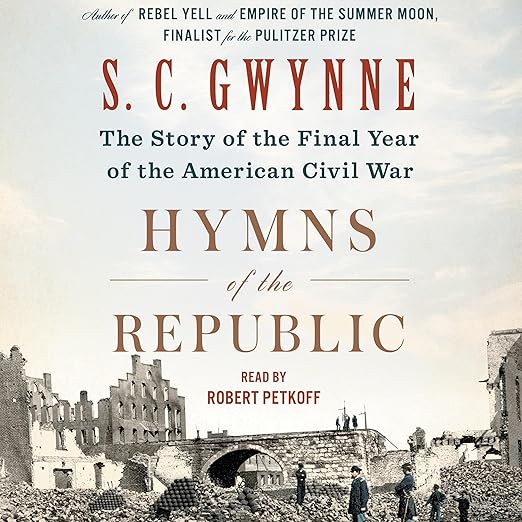
By the winter of 1864, Robert E. Lee had all but stopped believing his own army could still win the war, and that private collapse is where S. C. Gwynne's audiobook finds its real story. Hymns of the Republic covers the fourth and final year of the Civil War, and instead of racing toward the familiar ending, Appomattox, the assassination, it slows down to examine the people living through a war whose outcome nobody involved could actually see coming yet. Gwynne, the author behind Empire of the Summer Moon and Rebel Yell, applies the same close-focus method here: fewer sweeping generalizations, more individual figures forced to reckon with what the war had already cost them.
First, the Big Picture
The book's sharpest move is reversing the standard mythology around its two most famous generals. Lee, the legendary Southern hero, appears here as a man worn down by frustration, failure, and loss, not the marble-statue tactician of popular memory. Grant gets an even stranger treatment: Gwynne argues his field command in this final year was largely a failure, and that his most remarkable achievements as a public figure only began once the fighting actually stopped. It's a genuinely uncomfortable reframing of two men most listeners think they already understand.
Sherman gets the most provocative line in the whole account. Gwynne calls him a lousy general but probably the single most brilliant man in the war, and spends real time making that paradox stick, following the March to the Sea not as pure military strategy but as a case study in psychological warfare waged by someone who understood the South's morale better than its army.
Clara Barton and the roughly 180,000 Black soldiers who joined the Union army, most of them formerly enslaved, get the attention Gwynne clearly believes they've been denied elsewhere. Barton in particular emerges as one of the book's most compelling figures, a redefinition of wartime medical care built from scratch under fire, not a footnote to the men commanding armies around her.
The Missouri guerrilla war gets a similarly unglamorous treatment, presented not as a footnote skirmish but as a genuinely violent, chaotic front that doesn't fit neatly into the Virginia-versus-Georgia framing most popular Civil War narratives default to. Gwynne's willingness to give it real space signals a broader commitment throughout the book to messiness over tidy narrative arcs.
Why Hymns of the Republic Works as an Audiobook
Reviewer JNH's account of reading this while touring World War I museums in France adds a useful lens: that reviewer noticed the same theme Gwynne keeps circling, that a war's final year is often where any lingering romance about combat gets burned out of the people fighting it. Hymns of the Republic makes a similar case for 1864 to 1865, tracking how soldiers, generals, and civilians alike arrived at the war's end with illusions the earlier years hadn't yet stripped away.
The narrative also refuses to stay in one theater. Lee and Grant's stalemate in Virginia, Sherman's Georgia campaign, the closely contested election of 1864 that Lincoln nearly lost, and a genuinely violent guerrilla war in Missouri all get woven together, which keeps the account moving even across nearly fourteen and a half hours.
Narrator Robert Petkoff brings real prior credentials to this exact subgenre. His work on Legends and Lies: The Civil War already demonstrated the specific skill this book needs, real energy and authority for a docudrama-adjacent popular history format, natural pacing at episodic break points, and the ability to shift register cleanly for eyewitness-account passages without losing momentum or turning breathless.
It's useful to read this alongside Gwynne's earlier Rebel Yell, his biography of Stonewall Jackson, since both books share a method: take a figure or period the popular imagination has already flattened into myth, and rebuild the human complexity underneath. Where Rebel Yell worked at the scale of one general's life, Hymns of the Republic applies the same instinct across an entire year and a dozen major figures at once, a genuinely more ambitious structural challenge that mostly pays off.
The title itself rewards a pause. Hymns of the Republic echoes Julia Ward Howe's Battle Hymn of the Republic, the Union marching song built from the same period, and a hymn is a genuinely double-edged word to build a war history around: it implies both praise and lament, celebration of a cause and mourning for its cost. Gwynne's book earns that ambiguity rather than borrowing it as decoration, since almost every figure it follows ends the war changed by loss even where the outcome favors them.
A Few Reservations
One reviewer, David DeVore, raises a fair structural complaint: Gwynne devotes a full chapter to the horrors of the Confederate prison at Andersonville but gives no comparable attention to the Union's own Camp Douglas in Chicago, which by many accounts was nearly as brutal. It's worth going in aware that the book's moral reckoning, while more balanced than older Lost Cause-adjacent Civil War histories, still isn't perfectly symmetrical in where it applies its harshest scrutiny.
Listeners expecting a tidy, chronological march toward Appomattox should also adjust expectations. Gwynne jumps between theaters, which means the narrative can feel less like a single forward-moving story and more like several interlocking ones, Virginia, Georgia, Missouri, Washington, all developing at once.
This is popular history built for narrative momentum rather than academic completeness, and that's a deliberate choice worth naming plainly. Readers wanting exhaustive troop-movement detail or a purely academic treatment of 1864 to 1865 may find Gwynne's character-driven approach lighter than expected, even at this length.
The election of 1864 also deserves specific mention as a thread many general audiences underestimate: Gwynne treats Lincoln's near-loss to George McClellan as a genuine turning point, not a historical footnote, since a McClellan presidency would very plausibly have ended the war on different terms entirely. Listeners who think of Lincoln's reelection as inevitable will find that assumption directly challenged here.
Should You Listen to Hymns of the Republic?
Civil War readers who already know Gwynne's earlier work, or who want a character-forward account of the war's final act rather than a battle-by-battle chronicle, are the clear audience here. Listeners drawn to complicated, myth-puncturing portraits of famous historical figures will find plenty to chew on in how differently Lee, Grant, and Sherman are treated compared to the standard textbook version.
Skip it if you need scrupulously even-handed treatment of Union and Confederate wartime atrocities specifically; the Andersonville-versus-Camp-Douglas imbalance a reviewer flagged is real and worth knowing before you start. Listeners who prefer a single unbroken narrative line over a braided, multi-theater structure may also find the constant scene-shifting less satisfying than a more conventional chronological history.
Common Questions
Do I need to have read Gwynne's earlier books before this audiobook?
No. Hymns of the Republic stands on its own; familiarity with Empire of the Summer Moon or Rebel Yell isn't assumed, though fans of either will recognize the same close-focus, character-driven approach here.
Does this audiobook cover Lincoln's assassination in detail?
Yes, it's among the dramatic final events covered, alongside Lee's surrender at Appomattox, though the book's real emphasis sits on the year's buildup rather than treating the assassination as its sole climax.
How does Robert Petkoff's narration handle the large cast of historical figures in this audiobook?
Petkoff shifts register cleanly between narrative history and eyewitness-account passages, a skill already demonstrated on his Legends and Lies: The Civil War work, which keeps figures like Lee, Grant, Sherman, and Barton distinct without resorting to exaggerated character voices.
Is this audiobook balanced in how it treats Union and Confederate wartime conduct?
Mostly, though one reviewer notes a real imbalance: a full chapter covers the Confederate Andersonville prison's horrors, with no equivalent treatment of the Union's Camp Douglas in Chicago.