Quick Take
- Narration: Mike Chamberlain is a reliable narrator for military nonfiction – clear, paced for comprehension, and appropriately measured with material that carries significant emotional weight.
- Themes: The rise and military defeat of ISIS, US special operations and strike cell methodology, civil-military coordination in modern counterterrorism
- Mood: Taut and operational – the perspective of decision-makers inside the fight rather than observers outside it
- Verdict: A dual-perspective account of America’s war against ISIS from a JTAC and his commanding general – valuable for readers who want the senior military and political texture alongside the ground-level experience.
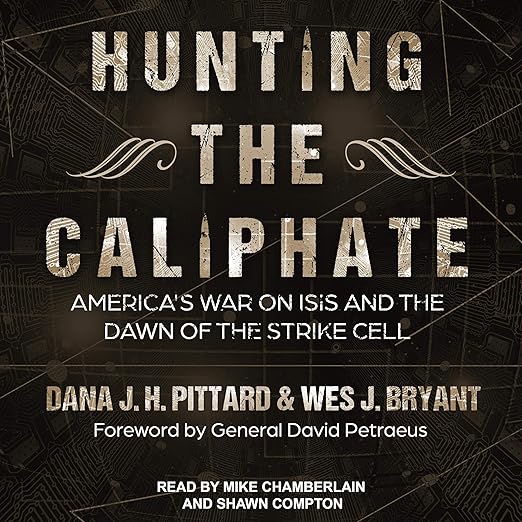
In the summer of 2014, I was following the news from Iraq with a particular sense of dread. The videos coming out of territories that ISIS had seized were unlike anything I had seen from previous conflicts in the region, and the speed of the territorial gains – Mosul falling in a matter of days – made it clear that something qualitatively different was happening. Hunting the Caliphate tells the story of what America did in response from two perspectives that rarely appear together in the same book: the Special Operations Joint Terminal Attack Controller on the ground, and the Major General commanding the operation from above.
Dana J.H. Pittard was the general in question, and his perspective on the senior military and political interactions that shaped the campaign gives the book a layer of institutional analysis that straightforward ground-level accounts of the ISIS war often lack. The decision to return a small task force to Baghdad in August 2014 – three years after the full US withdrawal from Iraq – was made under enormous political pressure in both directions, and Pittard’s account of the internal debates is candid about the constraints that shaped what was militarily possible.
The Strike Cell and How It Worked
The operational heart of the book is the formation and employment of what the authors call the strike cell – the integrated command structure that coordinated American airpower, intelligence assets, and the limited ground presence in a way designed to avoid the large-scale troop deployments that the Obama administration was committed to not repeating. The methodology was genuinely unprecedented in several respects: the degree of reliance on air-ground coordination, the integration of partner force capabilities, and the pace of the targeting cycle that eventually dismantled the caliphate’s military infrastructure.
For readers who came to the ISIS story through journalism, this account will fill in what the public record largely missed. The book covers the operational decisions that produced results the news cycle reported as discrete events – the retaking of Tikrit, the defense of Erbil, the campaign to sever the caliphate’s supply lines – and shows how those events were connected by a campaign logic that wasn’t publicly visible at the time.
Civilian Accessibility and the Ground Truth
One reviewer who described herself as having no military background praised the book specifically for making the material accessible to non-military readers – the authors do not assume familiarity with military organizational structure or terminology, and the civilian accessibility appears to be deliberate. That said, another reviewer noted that the book is not exactly a page turner in the narrative-thriller sense, which seems accurate. This is operational history with human texture, not a suspense narrative. Readers expecting the pacing of a combat memoir will need to calibrate expectations toward the analytical end of the genre.
The dual-author structure – alternating between the JTAC’s ground perspective and Pittard’s command perspective – works better in theory than in practice for some listeners. The transitions are clear, but the two registers are different enough that listeners oriented primarily toward one perspective may find the other less engaging. The general’s chapters carry more institutional detail; the JTAC chapters carry more physical immediacy. Together they make a more complete picture of the campaign than either would alone.
Mike Chamberlain Carrying the Weight
Chamberlain handles both registers with the reliability that characterizes his work in military nonfiction. He doesn’t dramatize the combat material beyond what the prose demands, and he keeps the organizational and political material clear without letting it flatten. Ten and a half hours moves at a steady pace throughout. For listeners who have found his narration of similar material effective in other titles, this will feel consistent with those performances.
The Audience for This Account
Readers who want the inside view of how America fought ISIS from a senior military and operational perspective will find this one of the more complete accounts available in audiobook format. General readers wanting a broader understanding of the ISIS war and its aftermath will benefit from pairing this with journalist accounts that cover the civilian cost more directly – this book is focused on the military campaign rather than on the human consequences of the caliphate’s brutality for the Iraqi communities it controlled. Both perspectives are necessary for a complete picture.
Frequently Asked Questions
Does Hunting the Caliphate cover the political dimensions of the anti-ISIS campaign, or only the military operations?
Both, though with more depth on the military side. Pittard’s chapters are specifically concerned with the senior political-military interactions – including the constraints imposed by the Obama administration’s political commitments on troop levels – that shaped what was operationally possible. The book engages the political context more directly than a purely operational account would.
How does this book compare to first-person special operations accounts of the ISIS war?
The perspective here is more command-level than individual-operator. The JTAC co-author provides ground-level perspective, but the dual structure means the book spends significant time at the operational and strategic command level. Readers wanting a purely first-person ground combat experience should look at unit-level memoirs from the ISIS war.
Does the book cover the full defeat of ISIS, including the fall of Raqqa?
The book’s focus is on the initial campaign phase – the defense of Baghdad and Erbil, the reconstitution of Iraqi forces, and the early strikes against the caliphate’s infrastructure. The full territorial defeat of ISIS, including Raqqa, falls outside the book’s primary timeframe.
Is the book sympathetic to the Obama administration’s approach to the ISIS campaign?
Pittard is measured in his criticism of the political constraints he operated under, but the book is candid about the ways in which the prohibition on large-scale troop deployments shaped and limited the military response. It is not a partisan critique, but it doesn’t pretend that those constraints had no operational consequences.