Quick Take
- Narration: Nish Kumar is sharply cast, his comedian’s timing and BBC credentials making the book’s satirical history feel exactly as absurd as it should.
- Themes: Human error as a species-wide pattern, the gap between intelligence and wisdom, finding humor in catastrophe
- Mood: Irreverent and fast-moving, with enough genuine learning to justify the laughs
- Verdict: Tom Phillips and Nish Kumar make for a natural pairing, and the result is popular history at its most disarmingly funny.
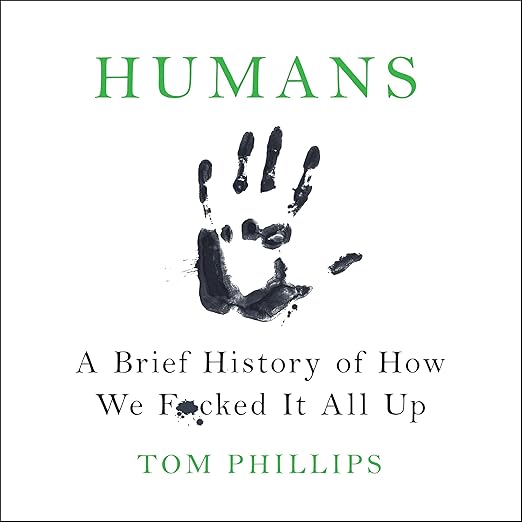
I started listening to Humans on a train journey I’d been dreading for logistical reasons, the kind of trip where every connection is tight and the weather has opinions. By the time I reached my first stop, I had laughed audibly three times and missed my anxiety entirely. Tom Phillips has written a book that functions as an act of cultural therapy: here is everything our species has done wrong, catalogued with wit and genuine research, so that your own bad day might feel appropriately minor.
The conceit is simple. Phillips surveys seventy thousand years of human civilization and identifies the moments where we, as a species, have managed to catastrophically misread a situation, ignore obvious evidence, or simply blunder into disaster with tremendous confidence. Chairman Mao’s Four Pests Campaign. The American Dustbowl. The Austrian army that attacked itself one confused and intoxicated night. Each chapter is a case study in the gap between human ambition and human judgment.
Our Take on Humans
What Phillips does well is resist the temptation to be smug about it. He is not writing from a position of evolutionary superiority. The book’s implicit argument is that these failures are not aberrations but patterns, and that recognizing them is the first step toward not repeating them. He writes with the affection of someone who genuinely finds our collective fumbling more fascinating than infuriating, which keeps the book from curdling into misanthropy. Reviews comparing it to a timely, irreverent gallop through human stupidity capture the energy accurately, but Phillips’s research is solid enough that the wit lands on a foundation rather than floating free of one.
The selection of historical episodes is well-curated across eras and geographies. Phillips doesn’t confine himself to the familiar failures of Western history. He ranges widely, which both broadens the book’s appeal and strengthens its central argument that the capacity for spectacular error is a human universal rather than a regional specialty.
Why Listen to Humans
Nish Kumar is the right person to read this material. He is a working comedian with genuine intellectual range, and his delivery gives the text a timing that a more neutral narrator would lose. When a reviewer noted that he is a critically acclaimed comic and human, they were flagging something meaningful: Kumar brings the material alive not by performing it but by inhabiting it. One listener noted they laughed out loud many times and that the audio version was particularly good, which reflects how completely the reading and the writing work together.
At six and a half hours, the runtime is appropriate for the format. Phillips writes in self-contained, episodic chapters, each covering a different historical debacle, which makes Humans ideal for listening in segments without losing continuity. You can dip in and out without the narrative anxiety that longer continuous works demand, which makes it practical for commutes or household tasks.
What to Watch For in Humans
At least one reviewer found the humor insufficient to sustain their interest, noting that the book occasionally reads as an exercise in pessimism rather than a genuinely illuminating perspective on human nature. That is a fair read. If you come to this looking for a systematic theory of why humans fail, you will find something more episodic and anecdotal than analytical. Phillips is a journalist and editor, not a cognitive scientist or evolutionary biologist, and the book reflects that. It is observational and entertaining rather than diagnostic.
Some of the historical episodes are more familiar than others. Readers already well-versed in twentieth-century catastrophes will find certain chapters covering ground they know. The book rewards listeners who come from a general rather than specialist background in history.
Who Should Listen to Humans
Listeners who enjoy popular history with a comedic edge, think Bill Bryson’s structure applied to human failure rather than natural history, will find this book deeply satisfying. Anyone who has recently made a significant error of judgment and needs the comfort of historical perspective will also benefit. Those looking for rigorous academic history or a systematic philosophical argument about the nature of human folly should look for a denser text.
Frequently Asked Questions
Is Nish Kumar also the author, or just the narrator?
Nish Kumar is the narrator only. Tom Phillips is the author. Kumar is a British comedian and television host whose timing and delivery are well-matched to the book’s satirical tone.
How does this compare to other popular history books like those by Bill Bryson?
The tone is similar in its accessibility and humor, though Phillips focuses specifically on human failure rather than natural history or science. The episodic chapter structure also resembles Bryson’s approach. Fans of that style of popular nonfiction will find Humans comfortable territory.
Is this a pessimistic book?
One reviewer found it tilted toward pessimism, but the majority experience the book as therapeutic rather than demoralizing. Phillips’s intent appears to be recognition rather than despair, framing the catalogue of failures as evidence that our mistakes are shared and therefore survivable.
Do the chapters have to be listened to in order?
No. Each chapter covers a distinct historical episode and can stand alone. This makes it particularly well-suited for interrupted listening, such as commutes or short listening sessions.