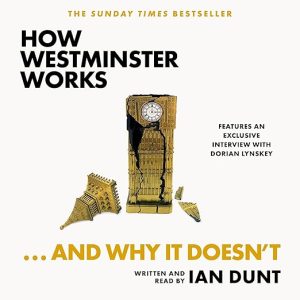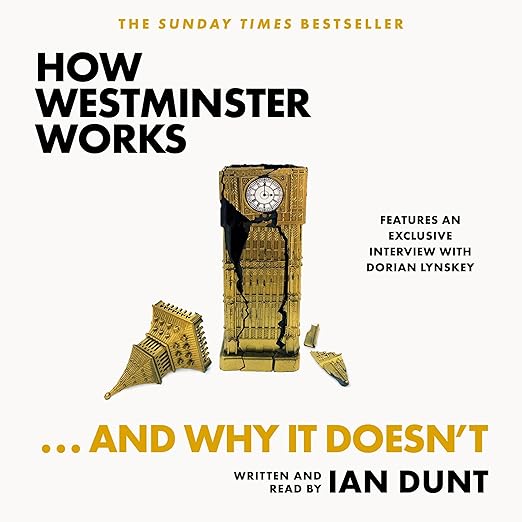
Ian Dunt's How Westminster Works . . . and Why It Doesn't opens with a question that most British people would answer in the negative and cannot quite explain why. The political system does not seem to work. The reasons are genuinely hard to articulate, which is precisely the diagnostic gap Dunt fills across ten and a half hours of the most useful political journalism turned into audiobook form that British nonfiction has produced in years. Dunt self-narrates, and the choice is correct: this is a book whose argument benefits from the author's own precision and urgency, and from the clear frustration of someone who has spent years watching the machinery fail.
Dunt is one of Britain's most incisive political journalists, the editor of Politics.co.uk and the author of books on Brexit and political ethics that established his capacity for making structural analysis accessible without sacrificing rigor. This book is his most ambitious and most useful: a systematic dismantling of every major component of the British political system, from Downing Street's internal culture to Whitehall's bureaucratic dynamics, from the Commons' procedural architecture to the Lords' unexpectedly functional role in the legislative process. It is the guide that university politics departments should be assigning but frequently are not.
Depressing Detail, Then a Reform-Minded Hope
Reviewer Jeremy Knight captures the book's emotional register precisely: "informative and fascinating insight into our democracy. Frankly depressing at times, but the final message is one of hope." That sequencing matters. Dunt spends the book's substantial middle sections documenting failure, the cult of the special adviser, the prime ministerial dependence on personal loyalty over institutional knowledge, the way parliamentary procedure can be weaponized to prevent scrutiny, in enough detail that the cumulative effect is genuinely sobering. The hope at the end is not naive optimism; it is the specific, reform-oriented hope of someone who understands what has gone wrong precisely enough to imagine what going right might look like.
Reviewer Davey Family identifies what makes the book distinctive in the crowded field of British political commentary: Dunt manages to make a topic "generally seen as boring" feel "interesting and even, in places, exciting." The institutional architecture of Westminster is not dramatically compelling material by default. Dunt makes it so through two methods: specificity and consequence. He does not describe how the Cabinet Office works in the abstract; he shows what happens when it works badly, and names what that costs. The result is political analysis that reads with the tension of investigative journalism.
The audio-exclusive interview with Dorian Lynskey, mentioned in the synopsis, adds genuine value. Lynskey is a sharp cultural journalist and his conversation with Dunt extends the audiobook's arguments into territory the main text does not cover. It is a meaningful bonus for audio listeners rather than a marketing addition.
Dunt's Frustrated Edge Comes Through Clearly
Dunt's self-narration gives the audiobook an authority it might not have with a professional narrator. His delivery is measured and clear, as you would expect from a journalist who communicates complicated policy analysis daily. The slightly frustrated edge in his voice when describing the more egregious institutional failures, the special adviser culture, the Cabinet's drift from collective responsibility, the way archaic terminology obscures accountability, is not performative anger but genuine professional frustration that has been refined over years of watching these systems operate. That specificity of tone is not reproducible by someone who has not spent a career documenting the institution.
The book is also structured to reward non-specialist listeners. Dunt does not assume prior familiarity with Westminster's procedural history. He begins with foundational questions, what is a special adviser actually for, why does the House of Lords still exist, what does the Cabinet actually do versus what it is theoretically supposed to do, before building toward the diagnostic argument. The result is a book that works as an introduction and as a deepener, depending on what the listener already knows.
At 10 hours and 35 minutes, the runtime is substantial but the density justifies it. Dunt covers enough ground that the audiobook functions as a reference alongside its entertainment value, the kind of listen that sends you back to specific sections when a relevant political event occurs. The section on the Lords, in particular, challenges the assumption most people carry that the upper chamber is a constitutional embarrassment, and does so with enough historical and functional detail to be genuinely persuasive.
Reformist by Design, Pegged to 2024
The book's framing is explicitly reformist. Dunt is not a constitutional conservative defending the system on grounds of tradition; he is a liberal democrat (with a small d) who believes the system is failing and can be fixed. Listeners who approach British political analysis from a more traditionalist perspective, who find the uncodified constitution and its adaptive flexibility a feature rather than a bug, will find Dunt's diagnostic framework consistently pointed in one direction. The analysis is rigorous but the underlying politics are not neutral, and that positioning is worth naming.
The book was published with the July 2024 UK general election in mind (the synopsis notes it explicitly as essential reading before voting on July 4). The structural analysis is durable beyond that specific context, institutional dysfunction does not resolve with a change of government, but some of the contemporary examples are pegged to the final years of Conservative governance, and a new Labour government's early performance is necessarily absent. The framework holds regardless, but listeners coming to this in 2025 or beyond will need to apply the analysis to changed circumstances.
Voters and Students Get a Working Map
Any British voter who wants to understand what they are actually voting for, and against, when they enter a polling station will find this invaluable. Political science students at any level will find it a more useful map of the territory than most academic texts. International listeners trying to understand why British politics produces the specific forms of dysfunction it does, why Brexit happened, why certain prime ministers failed despite good intentions, why accountability is so difficult to enforce, will find Dunt's systematic dissection answers those questions more directly than political journalism typically does.
Skip this if you want political storytelling or political history rather than political analysis. Dunt is diagnosing a system, not narrating its events. Listeners who want the drama of specific Westminster moments rather than the structural reasons those moments recur will find this audiobook more clinical than they need. But for anyone who wants to actually understand British democracy, how it works, why it often does not, and whether it could, this is the audiobook to reach for.
Key Details
- Narration: Ian Dunt self-narrating his own political analysis is an obvious but excellent choice, his journalist's precision and genuine frustration with the system come through in ways a third-party narrator could not replicate.
- Themes: British constitutional opacity, institutional dysfunction, the gap between democratic ideal and political reality
- Mood: Frankly depressing in diagnosis, but driven by genuine reformist hope
- Verdict: The most useful audiobook for understanding British politics written in the last decade, essential listening for any UK voter or anyone trying to make sense of Westminster from the outside.
Does the audiobook include any content exclusive to the listening format?
Yes. The audiobook includes an audio-exclusive interview between Ian Dunt and journalist Dorian Lynskey that is not available in the print edition. Reviewers have found it a genuinely substantive addition rather than a brief marketing extra.
Is this audiobook relevant for listeners outside the UK who want to understand British politics?
Yes. Dunt builds the system from foundational explanations, what each institution actually does, why it exists, and how it has drifted from its original purpose, which means international listeners can follow the analysis without prior knowledge of Westminster conventions. The diagnostic framework also has relevance for understanding how parliamentary democracies more broadly can fail.
Does Ian Dunt's self-narration work for an audiobook of this analytical density?
Very well. His journalist's delivery is measured and clear, and the genuine frustration that surfaces when discussing the system's failures adds an authentic edge that a professional narrator could not replicate. At over ten hours, the voice sustains attention through patient precision rather than theatrical variation.
Is this audiobook still relevant after the 2024 UK general election it was originally framed around?
Yes. The structural diagnosis of Westminster's institutional problems is durable beyond any specific electoral cycle. Some contemporary examples are pegged to the final Conservative years, but the framework Dunt develops for understanding prime ministerial power, Cabinet accountability, special adviser culture, and parliamentary procedure applies regardless of which party holds government.