Quick Take
- Narration: Olivia Darnley brings a composed, unhurried quality to Pema Chodron’s teachings that suits the material precisely; the pacing encourages reflection rather than passive consumption.
- Themes: The Tibetan bardo teachings applied to everyday transitions, working with uncertainty and difficult emotions, preparing for death without fear
- Mood: Calm and spacious, with an undercurrent of profound urgency
- Verdict: One of Pema Chodron’s most direct engagements with mortality and transition, and it reads as a complete course in living rather than a niche Buddhist text.
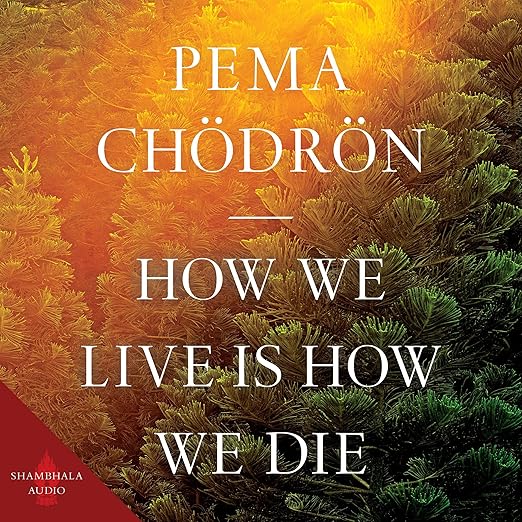
I finished How We Live Is How We Die on a quiet Sunday evening after a week that had felt unusually full of endings: a project wrapped up, a friendship shifted, a conversation that closed something I had not realized needed closing. I had not planned to listen to a book about death and transition that particular week, but the coincidence felt less like accident and more like the kind of thing Pema Chodron herself would recognize as precisely the right moment for these teachings.
Chodron opens with a deceptively simple observation: endings are happening in every moment. The breath ends. The day ends. The version of ourselves we inhabited yesterday ends. What Tibetan Buddhism calls the bardo, the transitional state between one thing and the next, is not only what happens after death; it is the texture of experience itself, constantly dissolving and reconstituting. In How We Live Is How We Die, Chodron uses this framework to argue that learning to meet the small deaths of daily life with openness is the same practice as learning to meet the final one.
The Bardo Framework Made Accessible
The bardo teachings are among the most technically elaborate in Tibetan Buddhism, associated primarily with the Bardo Thodol, known in the West as the Tibetan Book of the Dead. Chodron does not present them as exotic doctrine. She brings them directly into the register of ordinary experience: the jolt of waking from a dream, the disorientation of a relationship ending, the gap between one thought and the next. Her translation of these concepts into contemporary, psychologically recognizable terms is the book’s central achievement.
Reviewer Carol Judd described the key insight well: we all have propensities, habitual ways of reacting that pull us away from who we want to be, and the bardo teachings offer tools for catching those patterns and loosening their grip. This is Chodron at her most practical. The tonglen meditation practice, which involves breathing in difficulty and breathing out relief for others, appears several times as a specific technique rather than an abstract aspiration. The book is built for application, not just appreciation. One reviewer noted that, as an American, it is not entirely natural to simply adopt the theory of further lives and the mechanics of Tibetan rebirth cosmology. Chodron is aware of this. She does not demand metaphysical commitment to the bardo in its traditional sense; she consistently brings the teaching back to what is verifiable in direct experience.
Olivia Darnley and the Right Kind of Stillness
The decision to have Olivia Darnley narrate rather than Chodron herself is worth noting. Chodron has narrated several of her own titles, and her voice carries its own earned quality. But Darnley’s performance on How We Live Is How We Die has a different virtue: she is unhurried in a way that creates space around each sentence. The material benefits from this. When Chodron writes about sitting with uncertainty rather than immediately filling it with distraction, a narration that breathes allows that instruction to actually land in the body. This is a book where the pace of the delivery is itself part of the teaching, and Darnley understands that intuitively.
At just over six hours, the runtime is compact for the scope it covers. Chodron does not overexplain or circle back needlessly. The density is the appropriate density for a teacher who has spent decades learning to say essential things briefly. Listeners who prefer Chodron’s longer workshop recordings may want to treat this condensed version as a starting point for further practice rather than a comprehensive treatment of the bardo teachings.
Between Grief and Opening
What distinguishes this book from Chodron’s earlier work, particularly the widely read When Things Fall Apart, is the explicit confrontation with death as its central subject rather than its backdrop. The grief listener and the philosophy-of-impermanence listener are both addressed, but the book ultimately orients toward something more active than either grief processing or philosophical acceptance. Chodron argues, with considerable force, that the freedom we develop in life, the willingness to let experiences arise and pass without clinging, is precisely the capacity that will allow us to meet death without collapsing into fear. This is not a comforting premise in the sentimental sense. It is demanding. It asks something of the reader that most books about mortality do not.
Reviewer Silvia Jackson described using tonglen through years of hardship and finding in Chodron’s voice a resource that helped her survive particular days. That kind of testimony points to something the book genuinely offers: a set of practices that are tested rather than theoretical, and a teacher who is herself aging and facing what she is writing about. Listen if you are navigating a significant life transition or simply want Chodron’s most direct engagement with mortality. Skip if you are looking for a linear grief guide with clear stages; this is teachings-based material that rewards sitting with, not moving through quickly.
Dying Well by Living Fully
What distinguishes this book from Chodron’s earlier work, particularly the widely read When Things Fall Apart, is the explicit confrontation with death as its central subject rather than its backdrop. Chodron argues, with considerable force, that the freedom we develop in life, the willingness to let experiences arise and pass without clinging, is precisely the capacity that will allow us to meet death without collapsing into fear. This is demanding rather than comforting in the sentimental sense.
Reviewer Silvia Jackson described using tonglen through years of hardship and finding in Chodron’s voice a resource that helped her survive particular days. That kind of testimony points to something the book genuinely offers: a set of practices that are tested rather than theoretical. Listen if you are navigating a significant life transition or want Chodron’s most direct engagement with mortality. Skip if you are looking for a linear grief guide with clear stages; this is teachings-based material that rewards sitting with, not moving through quickly.
Frequently Asked Questions
Do I need a background in Buddhism to understand Pema Chodron’s bardo teachings in this book?
No. Chodron consistently translates the bardo framework into terms grounded in everyday psychological experience. While familiarity with basic Buddhist concepts like impermanence and tonglen helps, the book is designed to be accessible to listeners with no prior Buddhist study.
How does How We Live Is How We Die compare to Chodron’s earlier book When Things Fall Apart?
When Things Fall Apart is a broader introduction to working with difficulty and groundlessness. This book is more explicitly focused on death and transition, with the bardo teachings as its organizing framework. Readers who loved the earlier book will find this one more technically specific and, in some ways, more demanding.
Is Olivia Darnley’s narration a good fit for this material, given that Chodron has narrated her own books before?
Darnley’s narration works very well here. Her unhurried delivery creates the kind of stillness the material actually calls for. The choice to use a narrator rather than the author gives the listening experience a slightly more formal quality that suits this particular subject.
Is this audiobook relevant to listeners who do not believe in reincarnation or Tibetan Buddhist cosmology?
Yes. Chodron explicitly addresses Western listeners who may not share the metaphysical framework of the traditional bardo teachings. She focuses consistently on what is directly verifiable in experience, making the book useful for secular listeners, Christians, and practitioners of other traditions willing to engage the practice dimension without adopting the full doctrinal structure.