At a Glance
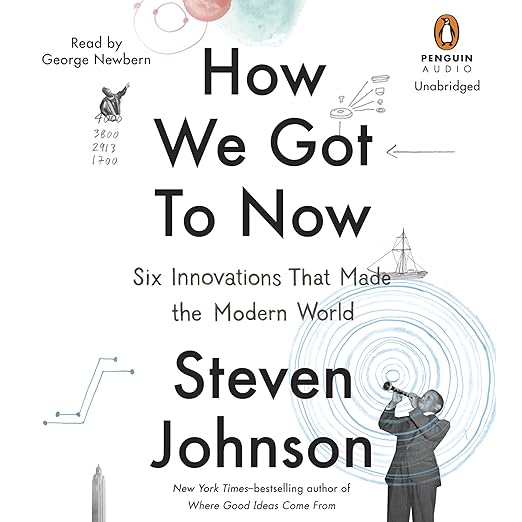
- Read by: George Newbern delivers Johnson's lateral-thinking prose with excellent pacing and clear diction throughout.
- At its heart: Innovation, unintended consequences, coevolution of technologies, and the hidden networks behind everyday objects.
- Vibe: Curious, energized, slightly disbelieving at the audacity of some of these historical connections.
- Short version: A sharp, entertaining intellectual history that makes you see refrigerators and WiFi completely differently.
Steven Johnson's signature approach to intellectual history gives this audiobook its particular charge: the conviction that no invention arrives alone, and that the most consequential technologies in human civilization were enabled by something else entirely. How We Got to Now, narrated with steady clarity by George Newbern across six hours and eleven minutes, delivers a series of linked case studies that keep rewriting your sense of what caused what. Johnson is the author of Where Good Ideas Come From and Everything Bad Is Good for You, and this book belongs comfortably in that tradition of popular intellectual history where ideas about one thing illuminate everything else.
A Closer Look at How We Got to Now
Johnson's central argument is deceptively simple: when a new technology emerges, it rarely does what its inventors imagined, and its real effects cascade in directions no one predicted. He calls these cascades "the hummingbird effect," borrowing from biology's concept of coevolution. When flowers evolved, hummingbirds evolved beaks to match them. In the same way, when Gutenberg's press created a mass reading public, it turned out that millions of Europeans had never realized they needed eyeglasses. Suddenly opticians were in demand, and the lens-grinding industry took off. Those lenses, refined over generations, eventually produced the microscope and the telescope. Which led to germ theory. Which led to modern medicine. Refrigeration, clocks, glass, clean water, artificial light, sound recording: Johnson traces six such networks of consequence, and each one lands like a small intellectual grenade.
What separates this from a standard science-history survey is Johnson's eye for the story behind the story. The French publisher Charles Cros conceptualized the phonograph before Thomas Edison, complete with a formal paper submitted to the French Academy of Sciences in 1877. He never built a working model; he forgot to include a playback mechanism. Edison did build one, got the credit, and the rest is the history most of us learned. But Cros's near-miss opens a more interesting question about why simultaneous invention happens so often, and what conditions make a given moment ripe for a particular technology. Johnson is deeply interested in this, and he marshals his evidence with the enthusiasm of someone who genuinely cannot stop finding this stuff fascinating.
The Hollywood angle is one of the book's best moments. Hedy Lamarr, Austrian-born film star and one of the most photographed women of the 1930s and 1940s, co-invented a frequency-hopping radio communication system during World War II to make torpedo guidance signals harder for enemies to jam. The patent she and composer George Antheil filed was ahead of its time; the military didn't adopt it immediately, and the patent expired before anyone profited. Decades later, the underlying principle became the foundation of spread-spectrum technology, which is what Bluetooth and WiFi run on. Your wireless headphones are, in a real sense, Hedy Lamarr's invention. Johnson delivers this kind of revelation with the timing of someone who has told it many times and still enjoys watching the reaction.
What Makes How We Got to Now Worth Hearing
George Newbern's narration is a genuine asset. His voice sits in a comfortable mid-register that suits the material, neither too dry nor too theatrically enthusiastic. He handles the technical vocabulary without stumbling and paces the longer explanatory sequences so the listener has time to process what Johnson is saying before the next layer arrives. For a book full of surprising pivots and lateral connections, that pacing matters. You need a narrator who gives you a beat between the setup and the reveal, and Newbern does this consistently well.
The audiobook format is well suited to Johnson's style. His chapters are built around single innovations and structured as a series of revelations, each one earning the next. The oral rhythm of the prose is already there on the page; Newbern simply delivers it. Listeners who bounced off denser popular science books will find this one much more approachable. Johnson writes with genuine conversational energy, and in audio, that energy transmits well.
The companion PBS television series covers the same territory with visual support, but the audiobook stands completely on its own. Johnson writes so specifically about what things look like, how mechanisms work, and what places felt like that you don't need diagrams to follow him. If anything, listening without images forces a kind of active imagination that gives the ideas more traction.
Johnson also benefits from the research of real historians, and he credits them generously. This is not a book of received wisdom and Wikipedia summaries. It is a book by someone who read the primary sources and corresponded with specialists, and that shows in the quality of the detail. When he tells you that pendulum clocks didn't just measure time but forced an entire industrial labor culture to synchronize around time as a shared resource, he has the receipts to back it up.
Things to Know Before Starting How We Got to Now
The book's structure is a double-edged feature. Each of the six sections is more or less self-contained, which means you can listen to the refrigeration chapter without having listened to the glass chapter. That modularity is useful but also means the book doesn't build to a single culminating argument. Johnson's thesis is that all these innovations are connected by the hummingbird effect, but he doesn't spend a great deal of time demonstrating the connections between, say, refrigeration and sound recording. The linking framework is stated at the beginning and then somewhat taken for granted. Listeners who want a tightly unified argument may find the chapter-by-chapter structure a little loose.
The book is also weighted toward North American and Western European examples. Johnson is not unaware of this, and he nods occasionally toward the global dimensions of the stories he tells, but the geography of his innovation history is limited. This is worth noting if you're looking for a truly global intellectual history rather than one centered on the Atlantic world.
Some listeners have found the second half of the book slightly less electric than the first. The clean water and artificial light chapters are excellent, but they lack the personal drama of the Hedy Lamarr story or the philosophical provocation of the glass chapter. This is a minor observation; no chapter is weak. But the book does front-load some of its best material.
Who Steven Johnson Is Writing For
Readers who have enjoyed Johnson's earlier books will find exactly what they came for: the same intellectual playfulness, the same gift for unexpected connection, the same readable prose. But this audiobook also works well as an entry point for listeners new to popular intellectual history. Johnson makes no demands on prior knowledge and rewards curiosity without punishing those who come in without technical backgrounds.
Science and technology enthusiasts will get the most out of the innovation tracking, but the book is equally rewarding for anyone interested in economic history, social history, or the sociology of knowledge. Teachers and educators who want to show students that the history of technology is not a story of lone geniuses will find rich material here. The Hedy Lamarr section alone is worth assigning.
Six hours and eleven minutes is a very approachable runtime for a book this wide-ranging. If you've been meaning to think more carefully about how the modern world came to be the way it is, this audiobook gives you a structured, entertaining framework for doing exactly that.
Is the How We Got to Now audiobook worth choosing over the print or TV version?
The audiobook format suits Johnson's conversational style very well, and Newbern's narration handles the material smoothly. The PBS series adds visual support, but the audio stands completely on its own.
Do you need a background in science or technology to follow along?
Not at all. Johnson writes for general audiences and explains technical concepts in plain language. The emphasis is on historical consequence and human story, not engineering detail.
Which innovation chapter is the strongest in the audiobook?
The glass chapter and the sound chapter tend to generate the most discussion. The Hedy Lamarr WiFi story in the sound section is a particular highlight that listeners consistently mention.
How long is the How We Got to Now audiobook and can it be listened to in sections?
The runtime is 6 hours and 11 minutes. Because each of the six chapters covers a distinct innovation, it works well as a chapter-by-chapter listen rather than a single sitting.