Quick Take
- Narration: Lisa Reneé Pitts brings an authoritative warmth to these essays and interviews, handling both the historical distance of the original statements and the contemporary interviews with equal engagement.
- Themes: Black feminist organizing, intersectionality as lived practice, the gap between movement rhetoric and material liberation
- Mood: Intellectually charged and historically grounded, with an urgency that the decades have only sharpened
- Verdict: A necessary document of a movement whose ideas have quietly shaped more of contemporary politics than most people realize, made newly accessible through this collection.
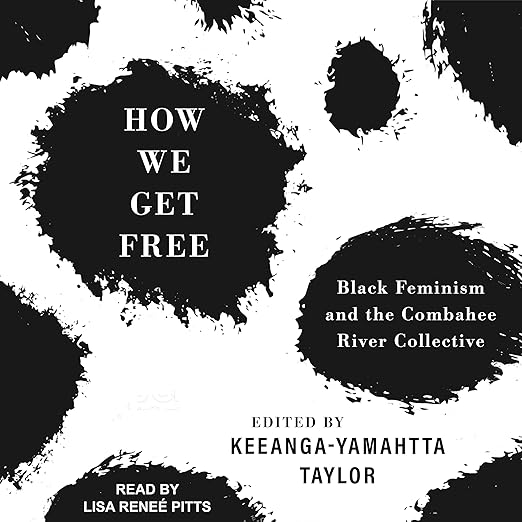
I came to this one in a week when I had been reading a lot of theory, the kind of dense academic work where you have to stop every few pages to check whether you are still on solid ground. How We Get Free was a different experience. Keeanga-Yamahtta Taylor’s editorial work is careful and generous, and what she has assembled here is a collection that holds theory and testimony in the same hand without letting either diminish the other. I finished the six-plus hours feeling like I had spent time with ideas that had been doing real work in the world for decades, mostly without attribution.
The Combahee River Collective was a Boston-based organization of radical Black feminists active primarily in the 1970s. Their 1977 statement, which articulated what would come to be called intersectionality before that term existed, argued that race, gender, class, and sexuality are not separate struggles but inseparably linked systems of oppression that must be confronted together. The statement was radical in 1977 and in many ways remains radical today, in the sense that its full implications have not been absorbed even by movements that cite it.
The Statement and Its Aftermath
Taylor’s introduction provides essential context for the Combahee River Collective Statement. She situates the organization in the broader landscape of the women’s liberation movement and the antiracist movements of the 1960s and 70s, noting where those movements succeeded in creating space for Black women’s voices and where they failed. The founding members of the CRC, including Barbara Smith, Beverly Smith, and Demita Frazier, did not develop their framework in the abstract. They developed it in response to concrete experiences of being rendered invisible by both white feminism and male-dominated Black liberation politics.
The interviews Taylor conducts with surviving founding members are the book’s most powerful material. These women speak with a clarity and directness that comes from having spent decades explaining the same things to audiences that were sometimes willing and sometimes resistant. There is no bitterness in the tone, exactly, but there is a frank accounting of what the organizing cost and what it built. One reviewer described the book as rich with historical references and truth, and the founding member interviews are where that richness is most concentrated.
The contemporary activist voices Taylor includes, representing movements from Black Lives Matter to prison abolition, provide the connective tissue between the 1977 statement and the present. These conversations are structured not as retrospective appreciation but as ongoing argument. The contributors disagree with each other about tactics, about the relationship between electoral politics and movement work, about what liberation actually demands. That disagreement is intellectually honest and keeps the collection from becoming an exercise in hagiography.
What Intersectionality Actually Meant Before It Was a Curriculum Word
There is a version of intersectionality that circulates in institutional contexts as a framework for diversity programming, and there is the version in this book, which is considerably more demanding. The CRC’s formulation was not primarily about acknowledging multiple identities. It was about understanding that systems of oppression are mutually reinforcing and that any liberation politics that addresses only one of them will reproduce the others. This means that fighting racism without fighting patriarchy, or fighting sexism without fighting capitalism, is not a partial victory but an active reinforcement of what remains.
Taylor presents this argument without softening its edges. She is herself an activist-scholar, and the book reflects that dual position. She is not primarily interested in introducing the CRC to a general audience; she is interested in making its argument available to people who are doing political work now and need to understand where certain frameworks came from and what they were originally designed to do.
Lisa Reneé Pitts and the Collection’s Range of Voices
Lisa Reneé Pitts is a narrator with both the vocal authority and the range to hold a collection of this kind together. The material moves between Taylor’s scholarly introduction, the historical CRC statement, interviews with founders in their seventies, and conversations with contemporary organizers in their twenties and thirties. Each of these voices requires a different register, and Pitts handles the shifts without making the transitions feel jarring. Her pacing through the more theoretically dense sections is patient, which is what the material needs.
At six hours and thirty-nine minutes, the audiobook is long enough to develop its argument without overstaying. The interview format means the density varies, and the longer stretches of theoretical analysis are broken up by the more conversational texture of the founding member interviews.
Who Should Listen and Who Might Want Different Entry Points
This audiobook is essential for anyone who wants to understand the intellectual history of Black feminism and the specific contributions of the Combahee River Collective to contemporary political thought. It is also valuable for listeners engaged in social movement work of any kind, particularly those who have encountered intersectionality as a term without knowing its origins and what it originally demanded.
Listeners who are new to the political traditions this collection engages with may find some sections require additional context. Taylor assumes a degree of familiarity with the landscape of 1970s left organizing that not all general readers will have. One reviewer who came to the book without that background found it a great education; others may want to read a broader history of the women’s liberation movement before or alongside this collection.
Frequently Asked Questions
Do you need prior knowledge of the Combahee River Collective to get value from this audiobook?
No, though prior knowledge deepens the experience. Taylor’s introduction provides enough historical context for a listener coming in cold to follow the argument and understand why the organization mattered. The founding member interviews also function as their own form of context, since the founders themselves explain the circumstances that shaped the collective’s politics.
How does the book handle the relationship between the 1970s Combahee River Collective and contemporary movements like Black Lives Matter?
Taylor structures the collection specifically to draw that connection. The contemporary activist voices she includes are not simply paying tribute; they are working through how the CRC’s framework applies to current conditions and where it needs to be extended or complicated. The conversations are analytical rather than commemorative.
Is How We Get Free relevant to readers outside the United States?
Yes. The theoretical framework the CRC developed has influenced feminist and antiracist movements internationally, and several reviewers from outside the US have engaged with the book as a historical and political resource. The specific contexts it addresses are American, but the structural analysis is applicable more broadly.
Does Lisa Reneé Pitts differentiate between the founding member voices in the interview sections?
The interviews are presented in a way that requires attention to follow which contributor is speaking, since Pitts is delivering the words of multiple different women rather than performing them as distinct characters. Listeners who find it useful to have the print edition open to track who is speaking in the multi-voice sections may want to consider having both formats available.