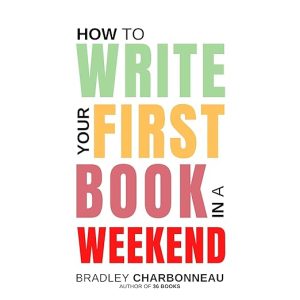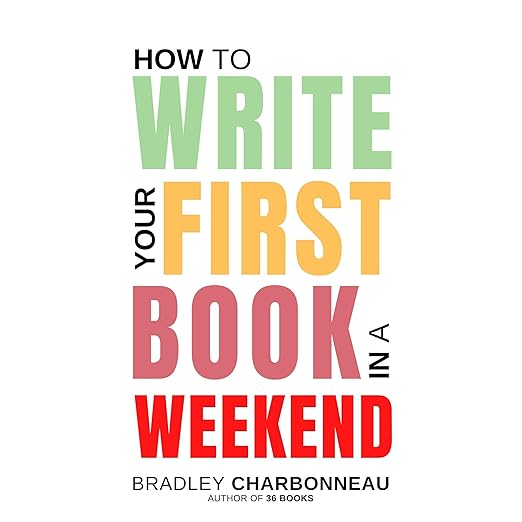
Bradley Charbonneau's How to Write Your First Book in a Weekend makes a promise in its title that the book itself immediately revises: you are not going to write your 317-page masterpiece by Sunday evening. What you are going to write is a short, focused, confidence-building breakthrough book, and Charbonneau argues, with some conviction, that completing something small is the prerequisite for eventually completing something large. This audiobook runs 2 hours and 37 minutes and is the sixth entry in the Authorpreneur: Create the Next Chapter of Your Life series. It is narrated via Virtual Voice, meaning the delivery is AI-generated rather than performed by a human narrator, a distinction that matters for a coaching title relying on personal energy and encouragement to carry listeners through creative resistance.
Charbonneau is a prolific practitioner of what he preaches: short, focused books finished quickly. The reviewers who love his work describe a consistent experience, inspiration, momentum, a feeling of being encouraged into action. One reviewer describes this as the fifth book he has read from Bradley, and says that each time it is an adventure. That loyalty speaks to the appeal of his approach even when the craft execution is debatable, and the series has built a committed readership across its six volumes on the strength of that motivational consistency.
Small Enough to Finish, Charbonneau Insists
The structural premise of the book is built around the tortoise-and-hare logic Charbonneau applies to writing: tiny daily action beats the fantasy of the single heroic effort. His three-phase framework, Clarity, Courage, Confidence, is simple enough to be actionable, and the idea of laser-focusing an idea and removing the fluff before writing is sound creative advice regardless of your experience level. The honest assessment is that the book's actual instruction density is lower than the title implies. A one-star reviewer put the criticism plainly: the book is a random stream of consciousness with rambling anecdotes rather than a set of transferable instructions. That assessment is specific enough to be credible, and it signals that the book's value depends significantly on whether Charbonneau's personal style resonates with you as a coaching companion rather than a methodology manual. The book is honest about its own scale: this is not about writing the book you have been putting off because it feels too large. It is about writing a book that is small enough to finish in a weekend, and using the confidence from that completion to approach the larger project afterward. Whether you find that framework liberating or frustrating will determine most of your experience.
Virtual Voice as a Robot Masseuse
At 2 hours and 37 minutes, the audiobook is short enough that the commitment risk is low. The Virtual Voice narration is the primary limitation: AI-generated delivery applied to motivational writing coaching is something like a robot masseuse applied to physical therapy, technically functional, emotionally absent. If the warmth of a human narrator coaching you through creative resistance matters to you, the audio format here is not optimized for that experience. The content can still work at the idea level, the permission-to-start framework, the emphasis on completion over perfection, the explicit acknowledgment that you will feel overwhelmed and scared, but the delivery mechanism does not help those ideas land with maximum force on a format that relies so heavily on tone and encouragement to do its work. The Authorpreneur series context also matters for calibrating expectations. This is book six in a series built around rapid output and iterative improvement, which means Charbonneau's own practice embodies the advice he gives. Whether that embodies authenticity or thinness depends on what you came looking for in a writing coach.
An Easter Egg Hidden Inside the Create Chapter
The split in reviewer responses is wider than the 4.0 average might suggest at this review count. Enthusiastic fans and a pointed critic exist in direct tension, and the difference seems to be whether readers came looking for personal inspiration, Charbonneau as a motivational companion on the writing road, or a structured methodology they could apply systematically regardless of his personal style. The Easter Egg mentioned in the synopsis, a secret gift in the chapter titled Create, is a characteristic Charbonneau touch, adding a sense of play to what is otherwise a direct-address coaching format. Series readers already familiar with the Authorpreneur catalog will know exactly what to expect. Newcomers should factor the mixed reviews into their decision before purchasing. The Virtual Voice limitation is worth returning to because it is not merely a technical footnote, for a book that argues the personal story and voice are the core of meaningful writing, being delivered via an AI-generated narrator creates a specific irony that listeners may find either amusing or grating, depending on their investment in the material.
For Anyone Paralyzed Before the First Page
The natural audience is someone sitting on a book idea who has allowed the size of the theoretical masterpiece to paralyze any start at all. Charbonneau's core argument, that writing something short and complete is more valuable than planning something long and unfinished, is correct, and if hearing that argument delivered as a personal coaching session is what you need to get moving, this audiobook may do its job despite the Virtual Voice limitation. Where it works less well is as a technical craft guide: if you want writing instruction in the tradition of established books on the subject, this is not that book. For Charbonneau's existing readers, this sixth entry in the Authorpreneur series will feel consistent with the rest of the catalog. For new listeners, the most honest recommendation is to treat the 2 hours and 37 minutes as a motivational push rather than a comprehensive course, approach it as permission to start, and it will likely deliver on that specific promise. The book will serve well as a starting point for anyone who has never written anything and finds the entire prospect of beginning paralyzing. Charbonneau's permission-to-start energy is genuine regardless of the execution debates, and sometimes what a first-time writer needs is not a comprehensive methodology but simply someone telling them it is okay to write something imperfect and short.
Good to Know
Does this audiobook actually teach you how to write a book in a weekend, or is it primarily motivational?
Reviewers are divided. Fans describe it as genuinely inspiring and actionable around a specific framework. A critical reviewer calls it a stream of consciousness with anecdotes rather than transferable instructions. The value depends largely on whether Charbonneau's personal coaching style resonates with you.
Is this audiobook narrated by a human or AI voice, and does that matter for the content?
The credited narrator is listed as Virtual Voice, meaning this is AI-generated narration. For motivational coaching content that relies on warmth and encouragement, this is a meaningful limitation, the ideas can still land but the delivery lacks the emotional presence a human narrator would provide.
At under 3 hours, does this audiobook feel complete or does the brevity limit its usefulness?
The brevity is intentional and consistent with the series philosophy of short focused books. Whether 2 hours and 37 minutes feels complete or thin depends on what you came looking for, motivation and permission to start, or detailed craft instruction. It delivers the former more reliably than the latter.