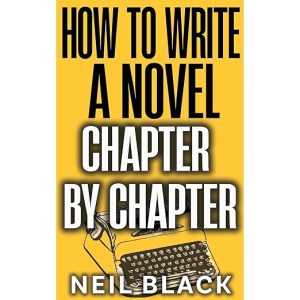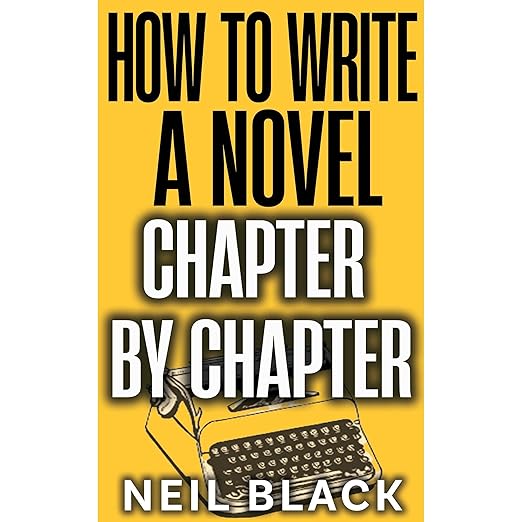
Neil Black's How To Write A Novel Chapter By Chapter, the first entry in the How To Write series, solves a specific problem that most craft books on fiction fail to address: not what makes a novel good in the abstract, but what you write when you sit down for the next chapter. As an audiobook, it arrives with one significant caveat that listeners should know before purchasing: the narrator is a Virtual Voice, an AI-generated synthetic reader rather than a human performer. The content itself is a practical, structured guide built around what Black calls the Classic Novel Structure system, and it has attracted strong reviews from working writers who found its chapter-by-chapter blueprint genuinely clarifying. Whether those merits survive the Virtual Voice delivery is a separate question that depends on how tolerant a given listener is of synthetic narration over nearly four hours of instructional prose.
Black Answers What to Write Next
Black's primary argument is that most writers who stall do so not because they lack imagination but because they lack a concrete answer to the question "what do I write next?" The book addresses that directly. Rather than offering inspiration or abstract craft advice, it provides a structural blueprint that specifies what belongs in every chapter, every major turning point, and every act of the novel. This is prescriptive rather than exploratory teaching, and it will suit some writers more than others. For those who have started and stopped multiple projects because the middle became formless, the chapter-level clarity that Black provides is exactly the intervention the problem calls for.
Endorsements From Novelists Who Write Literary Crime
The book covers outlining, the architecture of opening chapters, inciting incidents, subplots, character development, climax construction, and editing with enough specificity to function as a reference rather than a motivational read. Black also provides a downloadable 20-chapter Master Document that listeners can use to plan their own projects, though this is a companion resource rather than something integrated into the audio itself. Reviewer JHaun, a nonfiction author approaching fiction for the first time, found the three-act structure explanation genuinely useful. Reviewer Skyfox described the book as slowing the process down "enough for me to make sense of it, rather than feeling scattered and inept."
Emma Flint, author of Little Deaths, says Black knows "everything worth knowing" about structure and character development. Anna Mazzola, who wrote The Clockwork Girl, credits him with helping her construct and edit her novels. These endorsements come from novelists working in literary crime, which shapes what they value in structural thinking. Writers working in literary fiction that deliberately resists conventional three-act structure may find the Classic Novel Structure system more constraining than freeing, though Black positions it as applicable to any genre.
Virtual Voice Cannot Signal What Matters Most
The Virtual Voice narration is competent in the narrow sense that it reads the text accurately and without the flat affect of earlier AI readers. But instructional prose depends heavily on pacing, emphasis, and subtle tonal shifts that signal which points are primary and which are supporting. A skilled human narrator of craft writing uses voice to create hierarchy in dense informational content. Virtual Voice does not do this reliably. The result is that listeners absorbing Black's structural system must supply their own mental hierarchy rather than having the narration guide it. This is a meaningful limitation for an audiobook about a complex, multi-stage process with considerable sequential dependency between its concepts.
The print version, or a Kindle edition, may serve most writers better for active reference. The book includes exercises based on real novels, and following along with those exercises as an audio listener requires either pausing frequently to take notes or accepting that the exercises will be absorbed passively rather than practiced in real time. For writers who want to use this as study material during commutes or other activities, the trade-off between convenience and engagement is real and worth considering before purchasing.
Twenty-Eight Chapters Built on Three-Act Theory
Black's Classic Novel Structure system is primarily built around the three-act framework familiar from screenwriting tradition. Writers who have already engaged with books like Blake Snyder's Save the Cat, John Truby's The Anatomy of Story, or K.M. Weiland's structural work will find significant conceptual overlap, though Black's execution is often more accessible in presentation. The book does not claim to reinvent structural theory. Its value is in how clearly it applies established principles at the chapter level rather than the scene level or the act level alone.
The book's reviewer Neptune noted twenty-eight chapters distributed across three parts, which gives a sense of how granularly Black structures the material. That granularity is the book's primary asset. Where other craft guides describe the midpoint or the second-act break in broad terms, Black tells you what should be in the chapter that delivers that turning point and what the chapters surrounding it need to accomplish. For a new novelist trying to build a usable outline rather than a theoretical understanding, that specificity is the difference between a craft book they can use and one they merely admire.
First-Time Novelists Need This Concrete Framework Most
This audiobook is best suited to first-time novelists who need a concrete, step-by-step framework rather than abstract craft inspiration. It will also serve writers who have stalled on previous projects and need structural clarity rather than another motivational push. Experienced writers with an established process and strong structural instincts are unlikely to find much new here. Given the Virtual Voice narration, listeners who are sensitive to AI-generated reading may want to access the print edition for active study and use the audio only as secondary exposure. The How To Write series positions this as Book 1, so readers who find the system useful have a broader catalog available for continuing their study.
- Performance: Virtual Voice narration is adequate for basic comprehension but lacks the emphasis and pacing that instructional prose needs; the print edition is recommended for active study.
- What it covers: Novel structure and the three-act framework, chapter-level plotting, overcoming the blank page
- Feel: Practical and prescriptive, aimed at first-time novelists who need a blueprint
- Our call: A clear and accessible structural guide for aspiring novelists, though the Virtual Voice narration limits its usefulness as an active learning tool compared to the print edition.
Common Questions
Is the How To Write A Novel Chapter By Chapter audiobook narrated by a human or an AI voice?
It is narrated by a Virtual Voice, an AI-generated synthetic narrator. The delivery is competent but lacks the pacing and emphasis that a skilled human narrator would use to guide listeners through dense instructional content. Writers who plan to use the book as active study material may prefer the print edition.
Does the audiobook include access to the 20-chapter Master Document mentioned in the synopsis?
The Master Document is a downloadable companion resource that comes with the book, not something integrated directly into the audio. Listeners who want to use it alongside the audiobook will need to access it separately, which adds a layer of friction for those listening in a non-screen context.