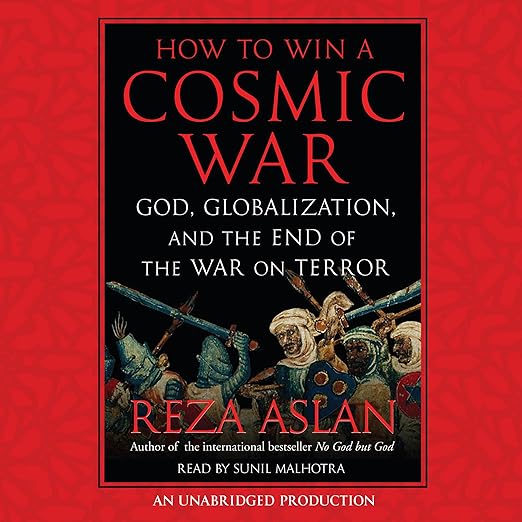
Quick Take
- Narration: Sunil Malhotra brings calm authority to Aslan’s academic-but-accessible prose, matching the book’s tone of scholarly urgency without sacrificing clarity.
- Themes: Religious violence and its political exploitation, the jihadist versus Islamist distinction, secular grievances beneath theological framing
- Mood: Urgent and analytical, with flashes of genuine moral clarity
- Verdict: A rigorous, accessible argument that holds up remarkably well despite the passage of time since its 2009 release.
I listened to this one over a long weekend in a year when the concept of cosmic war was not exactly a theoretical abstraction. I came to it knowing Reza Aslan’s work from No God but God, his history of Islam, and I was curious whether the argument in How to Win a Cosmic War held up across the years since its release. It does. Not without caveats, and not without the reader needing to supply some updating of their own, but the conceptual architecture is sound in a way that many geopolitical books from 2009 simply are not.
The core argument is precise and uncomfortable: a cosmic war, as Aslan defines it, is a conflict framed as a battle between the forces of good and evil in which God is understood to be actively engaged on one side. The key insight is that this framing makes wars unresolvable by conventional political means, because no political settlement can satisfy a mandate from God. And Aslan’s provocative secondary argument is that the United States, by adopting the same Manichean vocabulary and worldview in its War on Terror, entered the cosmic war on the enemy’s terms and thereby guaranteed that it couldn’t be won on those terms.
Our Take on How to Win a Cosmic War
What distinguishes Aslan from the average post-9/11 commentary is his insistence on precision. One reviewer makes exactly the right point: if you don’t understand the difference between a jihadist and an Islamist, you can’t understand the ideology you’re trying to counter, let alone address it. Aslan spends real time on this distinction, and it pays off throughout the rest of the argument. The book covers religious violence in Judaism and Christianity as well as Islam, which prevents the analysis from sliding into the kind of religion-specific framing that would undermine its own thesis.
The survey of the global landscape, from Israel to Iraq to New York to the Netherlands, gives the book breadth, but Aslan manages it without losing coherence. The central argument, that stripping earthly grievances of religious framing is the only way to address the conditions that produce radical movements, is stated clearly early and then demonstrated with specific examples throughout the seven hours. For a scholarly book, it reads with considerable urgency.
Why Listen to How to Win a Cosmic War
Sunil Malhotra is the right choice for this material. His narration style is measured and clear, with the kind of composed authority that allows complex arguments to land without feeling like a lecture. He doesn’t sensationalize the content, which is the correct call for a book that is fundamentally asking the listener to think carefully rather than react emotionally. The audio format works particularly well here because Aslan’s prose builds arguments across chapters, and the continuity of listening without visual chapter breaks helps the cumulative logic take hold.
At 7 hours and 5 minutes, the book is tightly packed. This isn’t a survey text. Aslan makes an argument and stays on it. Listeners who want broad historical context will find the book rewards them anyway, because the argument requires that context, but those looking for an encyclopedic treatment of Islamic history or radical movements should look elsewhere.
What to Watch For in How to Win a Cosmic War
The book was published in 2009 at the end of the Bush administration, and several reviewers note this creates a datedness issue. The specific policy landscape Aslan critiques has shifted considerably, and the geopolitical actors he identifies have evolved in ways the book couldn’t anticipate. One reviewer noted they’d like an updated edition, and that is a reasonable wish. The conceptual framework holds. The specific examples are historical artifacts. Listeners should approach the book as a rigorous argument whose implications remain current even when some of its specifics have dated.
Aslan’s position is also worth noting: he argues that the cosmic war framing serves the radical movements he’s critiquing, because it elevates earthly political grievances into something that seems non-negotiable. Some listeners find this argument uncomfortably sympathetic in its insistence on understanding the ‘earthly grievances’ behind violent movements. Aslan’s point is analytical, not apologetic, but listeners who want condemnation rather than analysis will find the book frustrating.
Who Should Listen to How to Win a Cosmic War
This is essential listening for anyone trying to develop a coherent framework for understanding religious violence, particularly in the context of Islam and American foreign policy post-9/11. It works for general educated listeners without specialized knowledge; Aslan is consistently accessible. It also rewards listeners who already have grounding in the subject, because the argument is sophisticated enough to engage rather than summarize. Skip it only if you’re looking for a contemporary foreign policy analysis rather than a foundational conceptual argument, in which case the book’s 2009 vintage will require significant mental updating.
Frequently Asked Questions
Does How to Win a Cosmic War require prior knowledge of Islamic theology or Middle Eastern history?
No. Aslan is unusually good at building the necessary context within the argument itself. Readers who came to this without specialist knowledge consistently describe the book as accessible and clear. The distinctions he makes between jihadists and Islamists, for example, are explained from the ground up.
How much has the book’s argument dated since its 2009 release?
The conceptual argument, that framing conflicts as cosmic wars makes them unresolvable by political means, remains fully relevant. The specific policy examples and geopolitical actors Aslan references have evolved considerably, and some passages read as historical. Listeners should treat the book as providing a durable analytical framework while supplying their own updated examples.
Is Reza Aslan arguing that the United States caused Islamic radicalism, or is the argument more nuanced than that?
More nuanced. Aslan’s argument is that by adopting the Manichean ‘good versus evil’ framing in the War on Terror, the United States entered the radical movements’ rhetorical territory, making the conflict harder to resolve. He’s not assigning moral equivalence, he’s arguing that cosmic war logic is self-sustaining and that engaging on its own terms is strategically counterproductive.
What does Aslan mean by ‘refusing to fight’ a cosmic war as the path to winning it?
His argument is that cosmic wars are unwinnable on their own terms, because they define winning as the annihilation of evil, which is an impossible political outcome. The practical corollary is that governments should address the specific material and political grievances that radical movements recruit from, rather than treating those movements as purely ideological problems requiring ideological defeat.