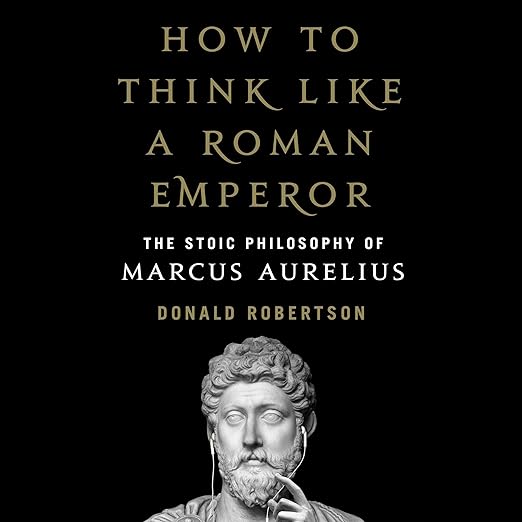
Quick Take
- Narration: Donald J. Robertson reading his own work is one of the better author-narrator matches in the self-help space, measured, authoritative, and emotionally present without being performative.
- Themes: Stoic philosophy in practice, emotional resilience, cognitive behavioral therapy’s ancient roots
- Mood: Thoughtful and grounding, with a biographical undertow that keeps the philosophy from feeling abstract
- Verdict: The strongest audiobook treatment of Stoicism currently available, Robertson earns the Ryan Holiday blurb rather than just repeating it.
I came to How to Think Like a Roman Emperor during a difficult stretch of months when Marcus Aurelius was already on my nightstand, the Gregory Hays translation, annotated to the point of illegibility. Robertson’s book arrived at exactly the moment when I needed someone to build a bridge between the ancient text and what I was actually dealing with, and it did that with a precision I did not expect from a popular philosophy title.
Published by Macmillan Audio and narrated by the author, this eight-hour-and-forty-seven-minute audiobook weaves together biographical storytelling about Marcus Aurelius, from his early education under Hadrian’s court philosophers through to his reign at Rome’s height, with an account of Stoic philosophical practice drawn from Robertson’s background as a psychotherapist. The combination is what distinguishes this from the many Stoicism-adjacent titles that have proliferated since Ryan Holiday’s work found its audience.
Our Take on How to Think Like a Roman Emperor
Robertson’s central argument is that Stoicism and modern cognitive behavioral therapy share deep structural roots, and he develops that case with genuine rigor. This is not a book that merely gestures at the connection, Robertson knows CBT from the inside out, having practiced it for over twenty years, and the philosophical genealogy he traces between ancient therapeutic practices and modern psychological methods holds up to scrutiny. One reviewer who had been reading the Meditations for fifty years called this book among the very best recent works on Stoicism, which is a meaningful endorsement given how saturated that space has become.
The biographical framing is what keeps the philosophy from floating away into abstraction. Following Marcus from the court of Hadrian through the plague years and the pressures of empire gives the Stoic practices their stakes. It is one thing to read about enduring adversity with equanimity as a philosophical exercise. It is another to track how Marcus actually deployed these tools against political intrigues, military campaigns, and grief. Robertson gives you both levels simultaneously.
Why Listen to How to Think Like a Roman Emperor
Robertson’s self-narration is exactly right for this material. He brings a therapist’s steadiness to the delivery, calm, present, neither rushed nor self-important. The audio format is particularly well-suited to the meditative quality of Stoic practice writing. You could read this book, but listening to it creates a slightly different relationship with the material, closer to the oral philosophical instruction Marcus himself received. That is probably over-reading the format choice, but the effect is real.
The practical exercises woven into the text translate well to audio. Robertson does not assume you are sitting at a desk taking notes, and the techniques he describes, for managing anger, irrational fears, pain, and loss, are explained conversationally enough that you can hold them without a pen. Several reviewers noted this as one of those rare books that genuinely changed their thinking, and that response is consistent with what the book is actually doing: not just explaining Stoicism but transmitting a way of practicing it.
What to Watch For in How to Think Like a Roman Emperor
Listeners who come to this already deeply versed in the Meditations and Stoic philosophy more broadly may find the introductory sections move slowly. Robertson is building from the ground up, and the early biographical chapters assume no prior familiarity with Marcus or the philosophical school. That is the correct choice for a general audience title, but it means the first two chapters have a textbook quality that the later sections shed once the biographical and philosophical threads are fully integrated.
The CBT framing, while handled with care, occasionally flattens the philosophy. Some of the techniques Robertson describes are genuine Stoic practices; others are closer to modern adaptations that use Stoic vocabulary. The distinction matters less if you are reading for practical application and more if you are interested in historical accuracy. Robertson is transparent about this throughout, which helps.
Who Should Listen to How to Think Like a Roman Emperor
This is an ideal listen for anyone who has tried and bounced off the Meditations directly, Robertson’s biographical framing provides the context that makes Marcus’s journal entries meaningful rather than cryptic. It also works well for people familiar with CBT who want to understand the philosophical tradition behind the techniques they practice. Readers already deep in Stoic literature may find the early sections slow, but the integration of psychology and philosophy in the later chapters rewards patience. Anyone navigating sustained adversity, illness, loss, professional pressure, will find this more practically useful than most self-help titles currently on offer.
Frequently Asked Questions
Do you need to have read Marcus Aurelius’s Meditations before listening to this?
No, and Robertson explicitly builds from the beginning. If anything, this book is an excellent preparation for the Meditations, it provides the biographical and philosophical context that makes the original text much more legible.
How does Robertson connect Stoicism to cognitive behavioral therapy?
Robertson is a practicing psychotherapist with over twenty years of CBT experience, and he traces the historical and structural connections between Stoic therapeutic practices and modern CBT with genuine precision. This is not a casual analogy but a developed argument.
Is this book better suited to audio than to reading in print?
Reviewers and Robertson himself have noted that the material has a natural fit with audio. The meditative quality of Stoic practice writing translates well to listening, and Robertson’s steady narration is well-calibrated for that experience.
How does this compare to Ryan Holiday’s books on Stoicism?
Holiday’s books are more aphoristic and motivational in register. Robertson’s work is more historically and psychologically grounded, engaging with the primary sources and the therapeutic tradition in greater depth. Both are useful but they serve different purposes.