In Brief
- Narration: Kennedy self-narrates with Louisiana cadence and genuine comedic timing; the pauses before punchlines are earned rather than scripted.
- Themes: Washington dysfunction, common-sense governance, political wit, and the gap between institutional presentation and institutional reality.
- Mood: Sardonic and energizing; Kennedy is amused rather than outraged, which makes the criticism land without exhausting the listener.
- Verdict: A consistently funny political audio memoir that rewards listeners who know Kennedy's clips and want the full eight-hour version of that voice.
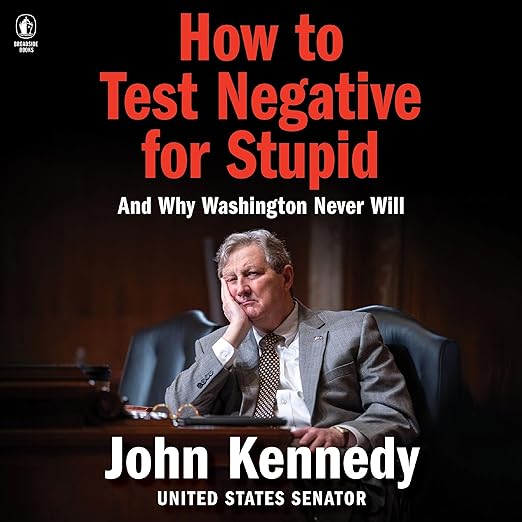
Senator John Kennedy of Louisiana narrating his own audiobook is an arrangement that could easily produce self-congratulatory monotone, but 'How to Test Negative for Stupid' lands differently because Kennedy's comedic timing is as developed as his policy instincts, and the combination of plain-spoken wit and genuine political intelligence makes this audiobook more surprising than the title might lead you to expect.
Founded by Geniuses, Run by Idiots
Kennedy has cultivated a specific public identity as the Senate's most quotable member, and the clips of his committee hearing exchanges have accumulated millions of views precisely because he phrases institutional absurdity in language that feels simultaneously Southern, classical, and completely unimpressed. The audiobook extends that voice across eight hours, which is a long time to sustain a persona, and Kennedy does it with fewer dips than you might predict.
The structure loosely follows Kennedy through Washington as a satirical guide to how the city actually operates versus how it presents itself. The observation that common sense is illegal in Washington functions as both a recurring joke and an organizing thesis; Kennedy returns to it throughout the book not as a rallying cry but as a diagnosis delivered by someone who has watched the disease progress from inside the institution for long enough to describe its symptoms precisely.
One reviewer compared Kennedy to Will Rogers meeting Abraham Lincoln, which captures both the comedian and the moralist elements of his public voice. The Rogers analogy is apt because Will Rogers made his sharpest observations from inside the cultural mainstream rather than from a position of opposition, and Kennedy operates similarly. He is not an outsider mocking Washington from the steps; he is a participant who has chosen honesty as his strategic posture and found that it resonates because almost no one else in the building is doing it.
The self-narration is an asset in specific ways. Kennedy's Louisiana cadence gives the one-liners a rhythmic landing that a professional narrator could approximate but not replicate. When he delivers the line 'I believe that our country was founded by geniuses, but it's being run by idiots,' the pause before 'idiots' is not written into the text; it comes from decades of reading rooms. That kind of timing is earned rather than directed, and it shows.
Kennedy's Voice Is the Product Here
The honest answer is that Kennedy's voice is the product. The political observations in the book are not groundbreaking in their analysis, and readers of Washington journalism will recognize most of the institutional pathologies Kennedy describes. What the audiobook offers that a policy essay cannot is Kennedy himself delivering these observations with the confidence of someone who has survived Washington long enough to find it genuinely funny rather than merely frustrating.
For listeners who enjoy political humor in the tradition of P.J. O'Rourke or Calvin Trillin, this audiobook scratches a specific itch: the pleasure of watching someone articulate exactly what everyone around a table is thinking but no one is saying. Kennedy's gift is not originality of insight but originality of phrasing, and phrasing is something that audio format rewards far more than print.
The book also works as an entry point for listeners who know Kennedy only from Senate clips and want more context on how his worldview was shaped, including his years in Louisiana politics before arriving in Washington. Those sections are more revelatory than the Washington-focused chapters because the Louisiana political environment Kennedy describes is its own kind of case study in institutional dysfunction, and his experience navigating it explains why he reads the Senate with such unsentimental clarity.
A Vernacular Knockout After Elevated Vocabulary
Kennedy's comedic structure relies on the juxtaposition of elevated vocabulary and extremely plain conclusions. He builds a sentence in a register that sounds like it is heading toward a considered policy recommendation, then lands on a vernacular knockout that resets your expectations. That structure is effective in short bursts, and the viral format of his Senate clips is optimized for it. Over eight hours, you will notice the pattern, and whether that awareness enhances or diminishes the jokes depends on your tolerance for a signature style rather than stylistic range.
The political observations in the book are Kennedy's own and reflect his positioning as a small-government conservative skeptical of institutional complexity. Listeners who share that framework will find the book energizing; listeners who disagree with the underlying premises will find some chapters frustrating regardless of how well the jokes land. Kennedy does not argue for his positions so much as assert them with wit, which is a mode of persuasion that rewards prior agreement more than skepticism.
I Would Listen to That Man for Hours
Fans of Kennedy's Senate hearing clips who want more of the same voice at greater length will get exactly what they are looking for in this audiobook. Political humor enthusiasts who appreciate the Will Rogers tradition of insider comedy delivered with populist instincts should find the eight hours comfortable and frequently sharp.
Listeners who come primarily for policy analysis rather than comic observation should adjust expectations; this is not a serious legislative treatise and does not present itself as one. But for anyone who has ever watched a Kennedy committee exchange and thought 'I would listen to that man for hours,' this audiobook is the direct answer to that thought.
A Few Questions About How to Test Negative for Stupid
Is this audiobook a serious policy book or primarily political comedy?
Primarily comedy with political observations woven through. Kennedy makes real points about institutional dysfunction, but the mode is satirical rather than analytical. Readers expecting a legislative policy treatise will find something lighter and funnier than that description suggests.
How does Kennedy perform as an audiobook narrator of his own work?
Better than most author-narrated political books. His Louisiana cadence is inseparable from the wit of the material, and his timing in delivering one-liners reflects decades of political speechmaking rather than a first attempt at narration. The self-narration is a genuine asset, not a compromise.
Will listeners who disagree with Kennedy's politics still enjoy this audiobook?
Partially. The comedy often works independently of the political framework, and Kennedy's linguistic gifts are real regardless of your policy agreement. But several chapters assert conservative positions without arguing for them, which may frustrate listeners who come to be persuaded rather than to enjoy a voice.