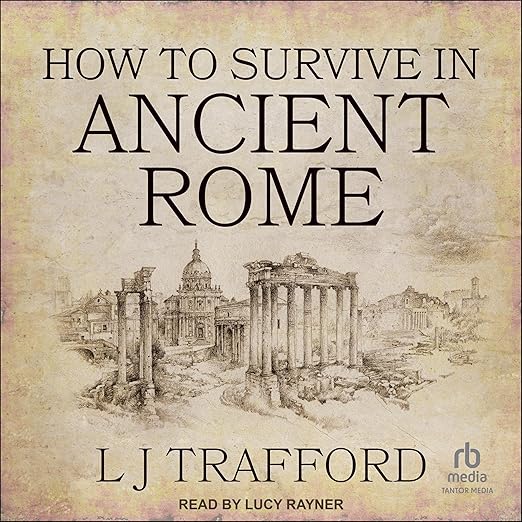
Quick Take
- Narration: Lucy Rayner delivers Trafford’s wit with light, conversational energy that keeps the material breezy without losing substance.
- Themes: Daily life in antiquity, class and gender in Roman society, survival and adaptation
- Mood: Playful and informative, like a very knowledgeable guide who refuses to be dull
- Verdict: A genuinely entertaining entry point into Roman social history, best suited to listeners who want their ancient world served with a side of deadpan humor.
I had a three-hour drive ahead of me one Saturday morning, and I wanted something that would teach me something without feeling like homework. That is exactly the problem L.J. Trafford’s How to Survive in Ancient Rome was apparently designed to solve. By the time I pulled off the highway, I had learned that Romans kept eels as pets and sometimes adorned them with jewelry, that Roman public toilets were a genuine social venue, and that the gap between the Rome of popular imagination and the Rome of everyday reality is wide enough to drive a quadriga through.
Trafford is a novelist who has written extensively about the Julio-Claudian court, and that fiction-writing background shows here in the best possible way. She does not approach the material as an academic building toward a thesis. She approaches it as a storyteller who finds people interesting and who suspects you will too, if she can just stop you from scrolling past.
A Time-Traveler’s Orientation Package
The conceit is simple and it works: imagine you have been deposited in late first-century Rome and must figure out how to live there. Where do you sleep? What do you eat and how do you pay for it? What happens if you get sick? What does religion look like from the inside when you cannot pick and choose? Trafford walks through each of these domains with the confidence of someone who has spent years living alongside these people in her fiction, and the result feels less like a survey course and more like a very specific briefing from a well-read friend.
The structure is self-help parody, and Trafford commits to the bit. Headers like guides to household management or public conduct are treated with the earnestness of modern productivity literature, which creates a low-level comic irony that runs through the whole book without ever becoming exhausting. A three-star reviewer on Audible noted that the format sometimes felt constraining, and that is a fair observation. The self-help frame occasionally forces the material into a shape that does not quite fit. But that is a minor friction in a listening experience that is otherwise consistently entertaining.
What the Four Hours Actually Cover
At four hours and forty-seven minutes, this is a short audiobook, and the scope reflects that. Trafford is explicit that she is offering an overview, not a comprehensive history. The book covers religion, travel, dress, food, medicine, legal recourse, and social hierarchy, but it does not go deep on any of them. Readers already familiar with Mary Beard’s SPQR or Adrian Goldsworthy’s more detailed accounts will recognize the territory and may find themselves wanting more footnotes than Trafford provides.
That said, the book earns its brevity. A five-star reviewer noted discovering details they had never encountered despite years of reading Roman history, which speaks to Trafford’s skill at finding the specific and the strange rather than retreading the standard narrative. The eel jewelry is a real detail. The habit of some wealthy Romans drinking perfume is real. These are not fabrications for effect. They are the kind of things that get filtered out of serious history because they do not advance an argument, and they are exactly the things that make a civilization feel like it was inhabited by actual human beings.
Lucy Rayner in the Driver’s Seat
Narration of this kind of book can go wrong in several directions. The humor could be played too broadly, or the informational passages could become flat and recitative. Lucy Rayner threads the needle well. She reads with a light touch that matches Trafford’s prose tone without adding additional comedic embellishment that might tip the balance. The listen feels conversational rather than performed, which is the right choice for material that is trying to approximate a knowledgeable friend’s advice rather than a lecture.
At 4.1 stars across 282 ratings, the book has not been universally adored. The most critical responses focus on its brevity and its lack of depth on any given topic. That is a legitimate critique, but it depends entirely on what you are asking the book to do. As a gateway into Roman social history, delivered with warmth and wit, it does its job. As a comprehensive reference, it was never trying to be one.
Who Should Listen and Who Should Skip
Listen to this if you have some curiosity about the ancient world but find academic histories heavy going. It works well for commutes, road trips, or as a companion to a fiction project set in Rome. It also pairs naturally with Trafford’s novels if you want to follow the social history with characters who lived inside it.
Skip this if you are already well-read in the period and looking for new scholarship. The book has been written for general audiences, and specialists will find the depth insufficient. Also worth noting: at least one review identified as a NetGalley copy, which may account for some of the more critical responses in the mix.
Frequently Asked Questions
Does L.J. Trafford cover the whole of Roman history or a specific period?
Trafford focuses on the late first century CE, roughly the era of the Flavian emperors, which aligns with the period she covers in her Roman fiction. This is not a broad sweep from Republic to fall of the empire but a targeted look at one specific era of Roman daily life.
Is this appropriate for younger listeners or students?
Yes, with some caveats. The content is accessible and the tone is family-friendly, but some topics, such as Roman public hygiene, social stratification, and religious practice, require a bit of background to fully appreciate. It works well for motivated high-school-age students and above.
How does this compare to Mary Beard’s SPQR as an introduction to Rome?
They serve different purposes. Beard’s book is a serious work of scholarship that rewards close reading and re-reading. Trafford’s is lighter, shorter, and funnier, built around the self-help conceit rather than sustained historical argument. They complement each other rather than compete.
Does the audiobook feel complete given the short runtime?
It feels complete for what it sets out to do. The book explicitly frames itself as an overview rather than a comprehensive study, and Trafford delivers on that promise. Listeners expecting the depth of a full history course will be disappointed, but those expecting an entertaining orientation will not.