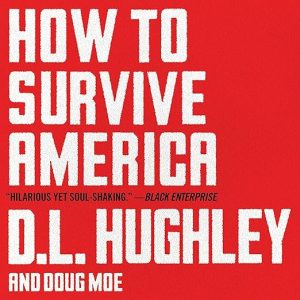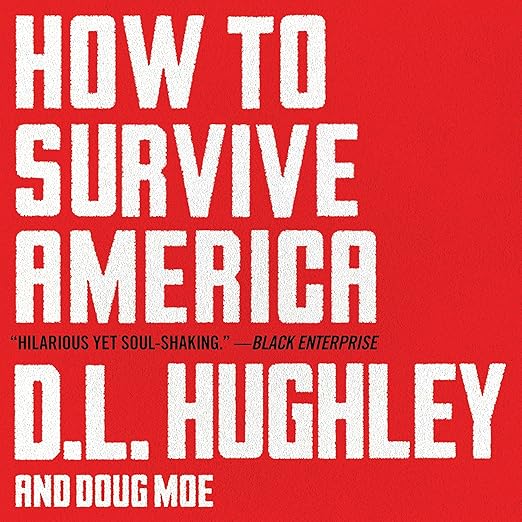
D.L. Hughley opens this audiobook by pointing out that white people love survival guides, guides about avalanches and jungle survival that have nothing to do with actual American life for the people who need a survival guide most. That inversion, turning the survival-guide genre back on the country itself, is the entire premise of How to Survive America, and it's a sharper opening move than the title alone suggests. Hughley narrates his own material, and the choice matters more here than in most comedy memoirs, since so much of the audiobook's effect depends on hearing the joke land in his own cadence before the policy argument underneath it registers.
The subject is racism's measurable toll on Black health and safety in the United States: life expectancy gaps, polluted water and air in Black neighborhoods, inadequate health care access, and incarceration rates Hughley cites at five times the white rate. He backs the satire with real statistics, including a Cigna finding that Black Americans report higher rates of psychological distress while receiving mental health treatment at half the rate of the general population.
Avalanche Jokes Aimed at an Involuntary Risk
Comedy is the method here, not a delivery mechanism wrapped around otherwise dry material. Hughley's stand-up timing does the structural work of making an argument about generational health disparities land as clearly as any straightforward policy book might, and arguably lands harder, since the jokes keep a listener present for material that could otherwise turn into a lecture. One reviewer wished Hughley would trade comedy for public service entirely; that reading undersells what the satire is actually doing, using humor not to soften the argument but to make it stick.
A second reviewer traced Hughley's argument back through the 1950s and 60s to show how racism 'still exists but in a different form,' which gets at the book's real structural ambition. This isn't a collection of loosely connected bits; it's an argument with a through-line, using COVID-19's disproportionate impact on minority communities as a recent, visible case study layered onto a much longer historical pattern.
Hughley's platform for this argument didn't start with this book. Decades in stand-up, plus television and radio work that put him in regular conversation with news and politics, gave him both the comic reflexes and the factual grounding the book depends on. That dual background is worth naming specifically, since How to Survive America only works if both halves are credible at once, a comedian without genuine reporting instincts couldn't back up statistics this specific, and a policy writer without Hughley's timing couldn't make the material land as entertainment rather than a lecture.
The book also takes up voting rights specifically, describing the very mechanism Americans have for addressing systemic injustice as perennially under assault, a claim Hughley connects directly to the health and safety statistics that dominate the rest of the book. That link, between political disenfranchisement and physical survival, is one of the more pointed arguments in a book full of them, and it's worth knowing going in that the scope extends beyond health care into the electoral system as well.
The parody survival-guide titles Hughley invokes, a mock 'How to Survive an Avalanche,' a mock 'How to Live on Bugs in the Jungle,' aren't just a joke device to open the book; they're doing real genre-critique work, pointing at an entire publishing category built around recreational danger for people who choose to encounter risk, set against a book built around danger that isn't optional for the people actually living it. That contrast, chosen risk versus involuntary risk, is the joke's whole engine, and Hughley returns to variations of it throughout rather than spending it all in the opening chapter.
Four Hours, Four Minutes, No Filler Chapters
At four hours and four minutes, the audiobook moves fast, closer to an extended stand-up set than a sprawling memoir, and that brevity works in its favor. Hughley doesn't pad the argument with filler chapters; he makes the case, backs it with data, and gets out, which suits both the comedic pacing and a listener's patience for a subject this heavy.
Self-narration is close to essential for comedic memoir generally, and it's especially true here, where so much of the effect depends on delivery: a pause before a punchline, the exact weight Hughley puts on a statistic right after a joke. A professional narrator reading this same script, however skilled, would lose the specific comic rhythm that makes the more painful material land instead of just landing flat.
Satire That Sits Beside Voter Suppression Data
This is satire built on real anger, and listeners expecting a straightforwardly funny comedy album should recalibrate going in. The laughs are real and frequent, per every review attached to this listing, but they sit beside material about maternal mortality, environmental racism, and voter suppression that doesn't get softened for the joke's sake. One reviewer put it plainly: 'sometimes you have to laugh to keep from crying,' a fair summary of the book's actual emotional register.
The short runtime means the book covers a lot of ground quickly rather than dwelling deeply on any single policy area. Listeners wanting exhaustive statistical rigor on any one topic, health care access, criminal justice, environmental policy, should treat this as a starting argument rather than the definitive text on any single issue it raises.
Structurally, the book moves loosely across decades; one reviewer specifically traces Hughley's argument from the 1950s and 60s forward to the present, which gives listeners a historical throughline rather than a purely present-tense complaint. That structure rewards listeners willing to sit with the historical context rather than skipping straight to contemporary statistics; the throughline is part of the argument, not just scene-setting.
Listeners who know Hughley primarily from his stand-up specials or television work should expect a slightly different register here: still funny, still built on his specific comic voice, but organized around a sustained argument rather than a loose set of observational bits. The throughline matters more in this book than in a typical stand-up hour, which rewards listening start to finish rather than sampling chapters out of order.
Skip It If Satire Isn't Your Entry Point
Listeners who appreciate comedians willing to do real reporting alongside the jokes, in the tradition of stand-up-turned-social-commentary work, are the clearest audience here. Anyone who followed Hughley's television and radio career already knows his voice; this audiobook gives that same persona a specific, focused argument to make rather than a loose grab bag of observations.
Skip it if satire isn't your entry point into serious subject matter, or if a book mixing comedic timing with public-health statistics feels like tonal whiplash rather than a deliberate choice. Readers wanting Hughley in a purely policy-analyst mode, as one reviewer wished for, won't find that version of him here; the comedian voice is the whole point.
Does D.L. Hughley narrate this audiobook himself?
Yes. Hughley self-narrates the entire audiobook, and his stand-up comedy timing is central to how the material lands, particularly in passages mixing jokes with hard statistics.
Is this audiobook more comedy or more social commentary?
Both at once, deliberately. Hughley uses satirical framing and stand-up delivery as the method for making a documented, statistics-backed argument about racial health disparities, not as a separate layer on top of it.
How long is the How to Survive America audiobook?
Four hours and four minutes, a brisk runtime closer to an extended comedy set than a full memoir, which keeps the argument moving without padding.
Does this audiobook address COVID-19's impact on Black communities specifically?
Yes, the pandemic's disproportionate impact on minority communities is used as a recent case study within a much longer historical argument about systemic health disparities.