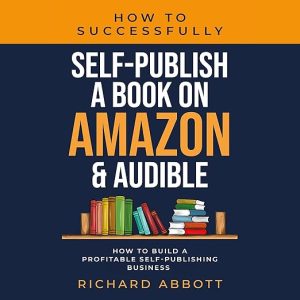
Thirty to sixty minutes a day is the entire time commitment Richard Abbott promises will get a self-published book off the ground, and this two-and-a-half-hour audiobook is built to match that same lean, no-wasted-motion energy. The synopsis leans hard into passive-income language, but underneath the side-hustle framing sits a genuinely structured walkthrough of book and audiobook publishing, covering everything from outsourcing content to running keyword-driven ad campaigns.
An A-to-Z Course Built Around Audiobook Royalties
Abbott organizes the material as an A-to-Z course rather than a loose collection of tips, which shows in how the audiobook moves: keyword research and content strategy first, then the mechanics of getting a book live for sale, then a dedicated stretch on turning that same book into an audiobook, including how to find narrators at an affordable rate and bundle titles for better discoverability. A reviewer calls it excellent for having all the elements explained simply and practically, and that assessment holds up against the book's actual structure.
The audiobook-specific chapters are where this book earns its keep for listeners who care about audio production specifically, since most self-publishing guides treat audio as an afterthought. Abbott instead frames audiobook royalties as his personal favorite income stream precisely because the production work happens once and the royalties keep arriving, and he walks through that pipeline with enough specificity, keyword selection, narrator budgets, bundling strategy, that a first-time audiobook publisher has an actual starting checklist rather than vague encouragement.
Abbott's outsourcing chapter is more specific than the term usually implies in self-publishing content: rather than a vague suggestion to hire help, he walks through which parts of the process are worth outsourcing first, cover design and manuscript formatting typically before narration or marketing copy, and roughly what a reasonable budget looks like at each stage. That sequencing matters for a beginner trying to figure out where a first few hundred dollars should actually go.
Bundling strategy gets a real dedicated stretch of attention as well, Abbott's own described favorite tactic, packaging several related short titles together to increase perceived value and improve advertising return, and he grounds this in the specific logic of how a retail platform's search and ad auction system rewards bundled listings over single thin titles competing alone.
The side-hustle framing that runs through the marketing copy taps into a broader cultural moment, self-publishing as one of several accessible paths to supplemental income alongside dropshipping, print-on-demand merchandise, and freelance content work, and Abbott's specific advantage over more generic side-hustle content is that self-publishing, unlike most of that broader category, produces an actual creative asset the author fully owns going forward.
Khalil Delivers This as an Efficient Briefing
One reviewer specifically praises the concrete links to the various platforms authors need, and notes the guidance applies across the US, Canada, and the UK rather than assuming a single national market, a detail that matters more than it sounds for a self-publishing guide, since platform mechanics genuinely differ by region.
Khari Khalil's narration keeps pace with the book's practical, checklist-driven tone, moving through the material without unnecessary flourish, which suits a short-form instructional audiobook a listener is more likely to reference than to sit with start to finish. Given the runtime, this is closer to an efficient briefing than a leisurely listen, and the pacing respects that.
The book's insistence that a few hundred dollars is enough to start, rather than the thousands some self-publishing courses imply are necessary, is a genuinely useful corrective for a genre prone to overselling both the required investment and the guaranteed return. Abbott keeps the entry cost honest, which builds real credibility for the income claims that follow later in the book.
For AudiobookDaily readers specifically curious about the production side of the industry, this book offers a rare glimpse from the other side of the microphone: the economics and decision-making an independent author goes through before a narrator is ever hired, which adds useful context to understanding why some self-published audiobooks sound more polished than others.
Passive-Income Marketing Language Oversells a Solid Primer
The synopsis itself leans heavily on passive-income marketing language, thousands of dollars a month, minimal time investment, that reads more like a sales page than a book description, and prospective listeners should calibrate expectations accordingly before pressing play. The actual instructional content inside is more grounded than the framing suggests, but the packaging is worth naming honestly rather than pretending it is not there.
At two and a half hours, this is a primer, not a comprehensive publishing education, and it will not replace dedicated resources on any single piece of the pipeline, cover design, developmental editing, royalty contract negotiation, in real depth. A companion PDF is included alongside the audio, and listeners who want to actually follow the specific website links and campaign steps mentioned throughout should plan on having that PDF open rather than relying on audio alone.
Listeners should also know that narrator sourcing, the specific process of finding and paying a voice actor at an affordable rate, moves quickly in this book and will benefit from being paired with direct research on current going rates, since per-finished-hour narrator costs shift over time in ways a static audiobook cannot update in real time.
The book's genre classification here as education and writing craft is reasonable but slightly narrow: this is as much a marketing and small-business operations guide as a writing-craft resource, and listeners expecting deep instruction on the actual writing process itself, plotting, editing, voice, should look elsewhere and treat this strictly as the publishing-and-marketing half of the equation.
At this runtime, expect a fast pace throughout; Abbott does not linger on any single step long enough for a listener to feel the full weight of tasks like ad campaign optimization, which in practice take considerably more trial and error than a brief overview chapter can fully convey.
For Authors Who Just Need the Mechanics
First-time independent authors who already have a manuscript or a content plan and need the practical publishing mechanics, not motivation, are the clear audience here, and reviewers who describe themselves as independent writers preparing to self-publish consistently found real, usable value in the specific steps Abbott lays out.
Authors who already have a finished or nearly finished manuscript and are specifically stuck on the publishing mechanics, not the writing itself, will get the most direct value, since the book assumes content already exists and focuses entirely on what happens after the last chapter is done.
Skip this one if the goal is deep technical mastery of any single stage of the process, or if the passive-income framing itself is a dealbreaker; the marketing language up front is a fair preview of the book's overall sales-adjacent tone, even though the instructional core underneath is more substantive than that framing suggests.
Frequently Asked Questions
Does this audiobook cover both ebook publishing and audiobook production?
Yes. Richard Abbott walks through book publishing first, then dedicates real time to the audiobook production pipeline specifically, including finding narrators and pricing bundles.
Is the passive income promise in this audiobook realistic?
Approach it skeptically. The marketing language leans hard into passive-income framing, but the actual instructional content is more grounded and practical than that framing suggests.
Do I need the companion PDF to follow this audiobook?
It helps a lot. Several specific website links and campaign steps mentioned in the audio are easier to actually use with the included PDF open alongside it.
Is this audiobook enough on its own to successfully self-publish a book?
It is a solid starting primer, not a complete education. At two and a half hours, it covers the mechanics well but will not replace dedicated resources on cover design, editing, or contract negotiation.