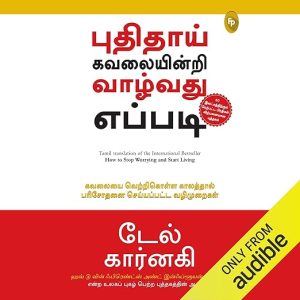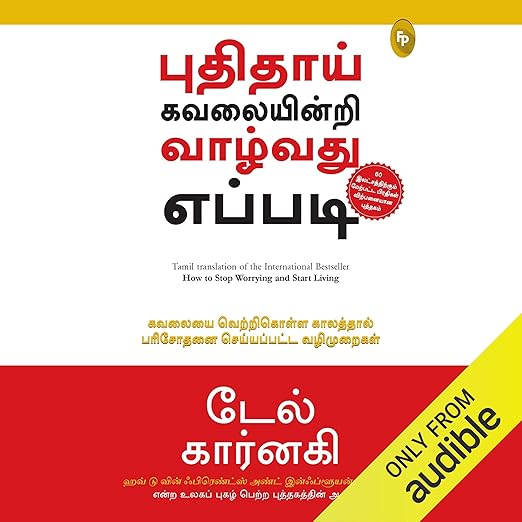
Sudharsan Lingam narrates the Tamil-language edition of Dale Carnegie's How to Stop Worrying and Start Living, and that fact needs to sit at the top of this review rather than buried in a caveat near the end. Carnegie's 1948 self-help classic has sold in the millions across dozens of languages since it first taught readers to separate real problems from imagined ones, and this particular audiobook production brings that material to Tamil-speaking listeners specifically. English-only shoppers who land on this listing expecting the familiar English-language reading will be lost within the first few minutes, since both the narration and the synopsis text on record run entirely in Tamil. For the audience it's actually built for, Tamil speakers wanting Carnegie's anxiety-management classic in their own language, this is a legitimate, deliberate market edition, not a mistake worth dismissing.
A Magic Formula Carnegie Never Quite Promises
Carnegie's original argument hasn't changed for this edition: worry is a habit that can be analyzed and broken down into fundamentals, and the book moves from diagnosing why people worry toward specific techniques for defusing it, aiming to replace anxious rumination with something closer to a repeatable formula for peace of mind. It's instructional rather than narrative nonfiction, built around numbered techniques a listener can actually apply rather than abstract philosophy to admire from a distance.
The handful of reviews attached to this specific edition are brief but consistent in a useful way. Readers describe leaning on the book's real-life examples and coming away calmer, and one reviewer specifically notes how accessible and 'light weight' the material feels, meaning approachable rather than dense or academic. That tracks with Carnegie's own reputation: this was never meant to be difficult reading, in any language.
Carnegie built his career on this same instructional method well before this book, most famously in How to Win Friends and Influence People, and How to Stop Worrying and Start Living applies the same case-study-driven approach to anxiety specifically. Carnegie was known for collecting real accounts from ordinary readers and students rather than working purely from abstract theory, and that grounded, example-first habit carries through clearly even in translation, based on how directly this edition's reviewers describe relating to the material.
Carnegie's influence didn't stop at the page. Dale Carnegie Training, the organization built on his methods, has operated globally for decades since, running courses on communication and stress management that trace directly back to the same core principles this specific book lays out. That institutional afterlife is a useful signal of how durable the underlying framework has proven to be, well beyond any single edition or translation of the original text.
Translated Western self-help is its own quietly significant publishing category, and a Tamil edition of a book this foundational fits a real, ongoing pattern of readers worldwide wanting access to influential English-language self-improvement writing without English being a barrier to entry. That broader context is worth remembering whenever a review like this one leads with a language flag: the flag isn't a defect, it's evidence of exactly the kind of cross-market demand that keeps a 1948 book selling nearly eighty years later.
The synopsis's own language promises 'a magic formula for solving worry situations,' and that phrase is worth a small critical pause: real psychological change is rarely as tidy as a formula implies, and Carnegie's actual technique, breaking worry into named, addressable pieces, works better as disciplined practice than as the one-time magic trick the marketing language suggests.
391 Ratings and Fourteen Hours in Tamil
A 4.4 rating from 391 ratings is a genuinely substantial number for a single-language regional edition, larger than most foreign-language audiobook editions manage, and it suggests a real, engaged Tamil-speaking audience rather than a niche afterthought release. That audience-size signal matters more than usual here, since it's effectively the only quality evidence available for an edition with no narrator-specific performance commentary in its reviews.
Carnegie's instructional, technique-based structure likely travels across languages more cleanly than literary prose would, since the value sits in the clarity of the method rather than in stylistic flourish that's harder to preserve in translation. A self-help book built on repeatable formulas is, in that specific sense, a better candidate for a strong foreign-language edition than a novel leaning on voice and rhythm would be.
Worth remembering too: Carnegie wrote this in 1948, in a very different world of postwar anxieties than the ones a listener carries today. What's held up is the underlying mechanism, breaking a diffuse, overwhelming feeling into specific, nameable problems that can actually be addressed one at a time, even where the specific period detail in his examples has aged. That durability is likely part of why a technique-based book like this one translates as cleanly as it appears to across a Tamil-speaking audience decades later.
A real fit between genre and format is also worth naming directly: calming, anxiety-focused self-help content often lands more effectively spoken aloud than read silently, since a steady human voice walking through a worry-reduction technique can itself have a soothing effect that black text on a page simply cannot replicate. That format advantage likely matters as much as the translation itself for how this edition actually gets used by listeners working through real anxiety in real time.
Confirm the Tamil Edition Before You Buy
The language barrier is the single most important purchase consideration here, full stop. Confirm you're getting the Tamil edition before buying if you're an English-language listener, since this listing gives no indication that an English audio version sits alongside it.
None of the attached reviews comment on Sudharsan Lingam's specific delivery, pacing, or tone, so this audiobook has to be assessed on genre fit rather than confirmed performance. At just over fourteen hours, the production commits to the full, unabridged scope of Carnegie's text rather than a condensed digest, which is a meaningful signal of production seriousness on its own.
Books built around named, repeatable steps rather than a single narrative arc also tend to reward more than one pass, and listeners working through a genuine anxious stretch often get more out of returning to a specific chapter than out of a single start-to-finish listen, a real practical use case worth keeping in mind when deciding how to approach the audiobook.
The Right Audience for a 4.4 Rating
Tamil-speaking listeners wanting Carnegie's foundational approach to worry in their own language, and newcomers to Carnegie generally who prefer audio over print, are the clear audience this edition serves well.
Worth adding for anyone weighing the purchase: a 4.4 average holding steady across 391 ratings is a consistent showing rather than a handful of enthusiastic outliers, which adds real weight to the recommendation for the specific audience this Tamil edition serves.
English-only listeners searching for the familiar version of this Dale Carnegie classic should look for a separate English-language edition instead, since this specific production won't be usable for them regardless of how strong the underlying material is.
Frequently Asked Questions
Is this How to Stop Worrying and Start Living audiobook in English or Tamil?
It's entirely in Tamil, both the narration and the synopsis text on record. English-only listeners should seek a separate edition.
Does this Tamil-language audiobook follow Dale Carnegie's original 1948 text closely?
The synopsis describes the same core structure as Carnegie's original: fundamentals of worry, techniques for analyzing it, and a formula-based approach to building peace of mind, translated for this edition.
How long is the Tamil edition of How to Stop Worrying and Start Living?
It runs 14 hours and 7 minutes, a full, unabridged-scale treatment rather than a condensed version.
Does an English-language audiobook edition of this Dale Carnegie classic exist separately?
This listing doesn't include one. Given how widely translated and reissued this title has been, listeners wanting an English narration should search specifically for an English-language edition rather than assume this one includes it.