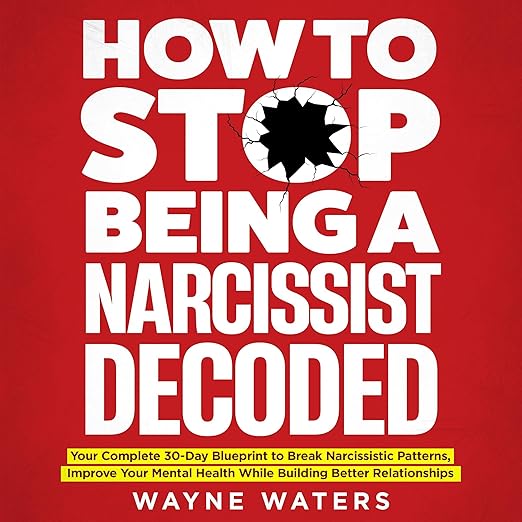
Quick Take
- Narration: Taj Zillner delivers a steady and composed reading that suits the self-help material, avoiding the overly motivational tone that can undermine this genre.
- Themes: Self-awareness as the prerequisite for change, the spectrum of narcissistic behavior, empathy as a practice rather than a fixed trait
- Mood: Structured and direct, with enough compassion in the framing to prevent the material from feeling accusatory
- Verdict: A clearly organized guide that approaches narcissism with more nuance than the genre usually allows, though experienced self-help readers will recognize most of the tools.
Self-help books about narcissism occupy a peculiar position in the genre. The vast majority are written for people who live with narcissists, offering strategies for protection, exit, or management. How to Stop Being a Narcissist Decoded is written for a rarer and arguably more courageous reader: someone who suspects they may have narcissistic tendencies and wants to understand and change them. I listened to it on a quiet Sunday morning, the kind where you have given yourself permission to sit with uncomfortable material, and I found Wayne Waters to be a writer with genuine empathy for the difficulty of that particular self-examination.
The book opens by refusing to demonize narcissism, which is a smart and necessary first move. Waters establishes grandiose and vulnerable narcissism as distinct patterns with different origins and different presentations, which immediately gives the reader a more nuanced framework than the monolithic cultural image of the narcissist as purely predatory. One reviewer noted that the book guided them to self-discover through a series of questions whether they themselves exhibited narcissistic traits, and that process of self-assessment runs throughout the book rather than being front-loaded and then abandoned.
Our Take on How to Stop Being a Narcissist Decoded
The book’s organizing structure is a 30-day blueprint divided into four weekly segments, each focused on a different dimension of change: building accountability systems, shifting entitlement patterns, stress management, and empathy cultivation. Reviewers who responded most positively to the book cited this practicality as the distinguishing feature, particularly the chapter on integrity and the reflective questions distributed across the program. A reviewer who read this to assess a partner’s accusation found the framework clear, even as they concluded the assessment suggested their partner rather than themselves had the relevant patterns. That is an interesting test of a book: it worked well enough as a diagnostic tool to produce a reasoned conclusion, whatever that conclusion turned out to be.
The seven stress-management techniques, the four key narcissistic patterns, the five communication tactics for healthier relationships, these numbered frameworks are very much in the self-help tradition of quantified steps. Waters deploys them with enough contextual explanation that they don’t feel like a listicle, though experienced self-help readers will recognize the underlying approach as familiar.
Why Listen to How to Stop Being a Narcissist Decoded
Taj Zillner narrates with a tone that is measured and clear without being clinical or cold. This matters particularly for a book that asks the listener to engage in ongoing self-assessment. An overly performative narrator would introduce false energy into a process that benefits from stillness. Zillner understands this, and the result is a reading that creates space for the listener to actually think alongside the material rather than being swept along by it.
At just over five hours, the book is appropriately compact for a program structured around daily practice. It is not a comprehensive clinical text on narcissistic personality disorder. It is a practical guide for someone who wants to engage seriously with their patterns and has five hours to build a framework before the real work of application begins. That scope is honest, and the book keeps to it.
What to Watch For in How to Stop Being a Narcissist Decoded
One review captured a real tension in the self-help genre with the observation that if you have read one self-help book, you have essentially read them all. The tools Waters recommends, self-awareness, journaling, meditation, breathwork, building accountability relationships, are the same tools most personal development books prescribe. The value of this book lies less in the novelty of its prescriptions and more in the specificity of its application to narcissistic patterns and the compassion with which it frames that application.
Listeners looking for a clinical deep-dive into the psychology of narcissism will need to look beyond this book. Waters is not writing as a therapist presenting case studies or research. He is writing as someone who has thought seriously about these patterns and wants to offer a structured path toward changing them. That distinction matters when calibrating expectations.
Who Should Listen to How to Stop Being a Narcissist Decoded
People who have received feedback suggesting they exhibit narcissistic behaviors and want a structured framework for self-examination and change will find this book more compassionate and practically useful than most alternatives in the space. Readers looking for clinical research or academic treatment of narcissism should look elsewhere. Those who find numbered frameworks and 30-day programs helpful as organizing structures will get more from this than readers who prefer more discursive approaches to personal development.
Frequently Asked Questions
Is this book intended for narcissists themselves or for people who live with narcissists?
It is explicitly written for people who suspect they may exhibit narcissistic tendencies and want to change those patterns. This is the opposite of most narcissism books, which address people in relationship with narcissists rather than the narcissists themselves.
How does the 30-day blueprint work in practice?
The program is divided into four weekly segments, each focused on a different dimension of change: building accountability structures, overcoming entitlement patterns, stress management, and empathy development. The weeks build on each other, though each section can also function as a standalone focus area.
Does the book distinguish between different types of narcissism?
Yes. Waters addresses both grandiose and vulnerable narcissism as distinct patterns with different presentations and different origins. This framing gives the reader a more nuanced diagnostic framework than a single monolithic definition of narcissism would allow.
Is Taj Zillner’s narration suitable for a book that involves active self-reflection exercises?
Yes. Zillner’s measured and unhurried delivery creates space for the listener to process the material and engage with the self-assessment questions rather than simply being carried through the content. The pacing suits the reflective nature of the exercises.