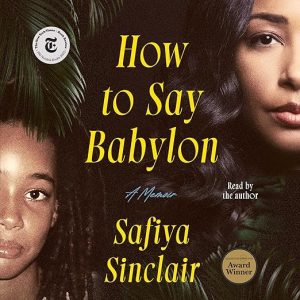
Safiya Sinclair spent a childhood being told that her voice was a liability, and she reads the audiobook of the memoir that answers back. That single fact does more work than a credit line usually does. The book is about a father who held that a woman's highest virtue was her obedience, about a mother who smuggled in books and an education conjured almost out of thin air, and about the moment poetry gave a daughter something to say with. Close to seventeen hours of it come out of the same throat the story is about.
Poetry Awakened the Voice That Collided With Her Father
Sinclair is a poet, and a memoir written by someone whose instrument is the sentence carries a risk in audio as much as an advantage. Prose that rewards rereading can slide past at speed. Two responses register exactly that density without agreeing on what it costs: one, writing in January 2024, calls the sentences soaring and metaphorical before the text cuts off inside a word, and another describes a lyrical, intricate memoir written with lacerating precision. Sixteen hours of density is what you are committing to, and the author holding the microphone is the strongest argument that it will land.
The story itself is not decorative. Sinclair's father was a volatile reggae musician and a militant adherent of a strict sect of Rastafari, convinced that the Western world outside their home was corrupting and that womanhood would make Safiya and her sisters morally weak and impure. Her mother, loyal to him, handed over the one gift that would carry her daughter past that stretch of beach and mountains in Jamaica: books, knowledge, education. Poetry awakened the voice; the voice set up the collision with the father. The publisher's copy states the arc plainly enough that nobody needs a warning about where it goes.
Whether a Poet Can Sustain a Long Performance
Jamaica here is a stretch of coast and mountain the family called home, not a postcard, and the geography shapes how the memoir sounds. A. Thomas, who files the page's only four-star response, places the hardest passages in Montego Bay and finds most of the book moving, enlightening and appalling in roughly that order. The objection that follows is specific: once it became apparent that Safiya was an exceptional writer, why does she keep returning to the town where her abusive father lives? That is a real question about the shape of a memoir, and the only one on this page pushing against the consensus.
Sixteen hours, forty-six minutes is long for a memoir and about right for this one, since it covers an entire childhood and the education that broke it open. The reader slot and the byline name the same person, with no foreword reader and no co-narrator listed. Where an author reads her own book the usual casting question disappears and a different one replaces it: can a writer sustain a performance at this length? That is a question the name alone poses and cannot settle, and a preview clip is the only place a buyer can go looking for one.
Obama's Name Sits in a List of Magazines
Three lines into the description and you have still not reached a sentence about the book. It opens with the National Book Critics Circle Award, then a New York Times Notable Book listing, then a run of best-of-the-year credits: The Washington Post, The New Yorker, Time, The Atlantic, the Los Angeles Times, NPR, Harper's Bazaar, Vulture, Town and Country, the San Francisco Chronicle, the Christian Science Monitor, Mother Jones, Barack Obama. A former president's name sits in a list of magazines as if it were a masthead. Then a Jenna Today Show Book Club Pick, then a pull quote from People. The memoir itself arrives in the fourth block.
Thomas's four-star response is the longest one here that reaches its own final full stop. Three others do not. The account of the father's Rastafari convictions by the reader signing as carilynp breaks off at a comma, anapurna's praise of the sentences cuts out inside the word metaphor, and psusanh's line about lacerating precision and honesty on the page simply stops. Whatever this page does to review text, it is doing it to the three most substantial responses while leaving intact the one that runs to three words of unqualified enthusiasm, filed in March 2026.
Two other books get named before this one gets described. The copy positions the memoir as carrying echoes of Educated and The Glass Castle, which is publisher shorthand for a young woman escaping a controlling household through education. The shorthand is accurate and reductive at once. What it omits is the specific material here, and that material is language itself: Rastafari doctrine, the word Babylon standing in for the corrupting modern world, and a daughter learning that the vocabulary used to police her can be dismantled. Anyone expecting the escape-memoir template gets something stranger and considerably better.
She Earned This Reading More Than Most Authors
Memoir buyers who care about prose above incident are the natural audience, and a poet reading her own lines is the reason to choose audio over print in this particular case. People who work through award-winning nonfiction at length will find sixteen hours manageable enough. Where it gets harder is the content: carilynp opens by admitting uncertainty about having the stomach for it and calls stretches of it very difficult, a fair warning about a book concerning a father who policed his daughters' bodies and futures as a matter of doctrine.
Hold off if you want a family story that resolves warmly, because Thomas's objection points at a book that keeps returning to the source of its own damage and refuses to apologize for doing so. The same caution applies if you need a narrator's polish: an author reading is an author reading, and Sinclair is a poet, not a trained performer, which usually produces conviction and occasionally produces something less even. That trade is the whole proposition of this edition.
Poetry is the hinge of this book and the reason the recording exists in this form. A mother conjured an education out of nothing, a daughter turned it into a voice, and the voice is now most of a working day's worth of finished sentences delivered by the person who fought for the right to speak them. The prize stack heading this listing is noise; the National Book Critics Circle citation is the only line up there that tells you anything about the writing. Sinclair earned the reading of this book more thoroughly than most authors who take a microphone.
At a Glance
- Voice: Safiya Sinclair reads her own memoir, which puts a working poet in charge of sentences built to be spoken aloud.
- Big ideas: Rastafari patriarchy and rebellion, a mother's improvised education, poetry as escape, Jamaica and the idea of Babylon
- Atmosphere: dense, controlled, quietly furious
- Worth it?: The strongest possible case for author narration, buried under a description that spends four blocks listing prizes.
Before You Listen
Why does Safiya Sinclair narrate the How to Say Babylon audiobook herself?
The listing never explains the decision, but the book makes the case on its own. This is a memoir about a girl forbidden to speak freely who becomes a published poet, so the voice doing the reading is the thing the story is about. Practically, it also means the cadences arrive exactly as written.
Is How to Say Babylon a difficult listen?
In places, yes. One reviewer, carilynp, opens by questioning whether the stomach was there for it and calls stretches very difficult, an honest signal about a book built around a father who treated obedience as a daughter's highest virtue. The prose stays controlled where it could be sensational, but the weight accumulates.
What does the audiobook add that the printed memoir cannot?
The author's own delivery of her own line breaks. Two responses filed in January 2024 describe soaring metaphors and lacerating precision, and both of those are qualities of timing as much as of meaning. Hearing a poet pace her own sentences is a real difference, and it is the argument for this format.
Why does the review column on this listing keep breaking off mid-sentence?
Three of the five responses stop mid-sentence, one of them inside a word, and the page gives no explanation for it. What survives intact is the shortest note, three words long, plus A. Thomas's four-star objection about the author returning to her father's town. Read that one, since it argues rather than applauds.