Quick Take
- Narration: Laurel Lefkow brings a clear, professional delivery that suits the interview-based format, keeping twenty distinct expert voices distinct and accessible without sacrificing the material’s density.
- Themes: Retirement income planning, psychological adjustment to non-work identity, spending for happiness versus wealth preservation
- Mood: Practical and reassuring, occasionally sobering but never alarmist
- Verdict: Christine Benz has assembled something more useful than a standard retirement guide by asking better people better questions and trusting listeners to absorb the answers.
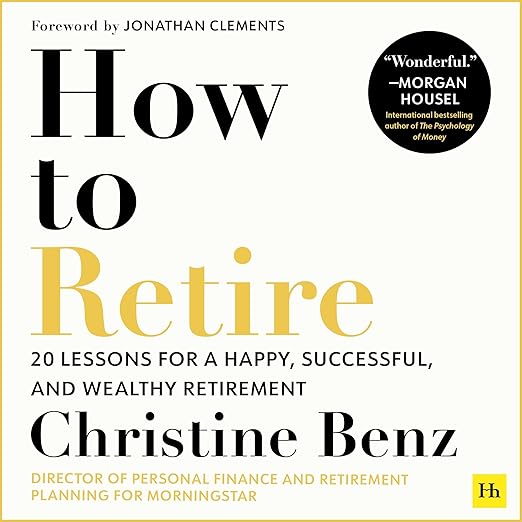
My mother retired two years ago and spent the first six months asking me variations on the same question: now what? She had a pension, some savings, a house paid off, the financial mechanics were in place, but nobody had prepared her for the identity question that retirement raises for people who have structured their lives around work. She read several retirement books, most of which told her how to manage withdrawal rates and Social Security timing but said very little about how to spend the hours she now had without anyone telling her what to fill them with. I thought about her often while listening to Christine Benz’s How to Retire.
Benz is a longtime Morningstar columnist and podcaster who has spent decades thinking seriously about retirement. Her approach here is not to position herself as the single authority on the subject but to convene a panel of twenty people who know different aspects of it better than she does. Each expert is given one lesson, one thing they believe most contributes to a successful retirement, and the book is organized around those twenty lessons. The format is genuinely unusual for the personal finance genre, and it is one of the things that makes this audiobook worth the ten and a half hours.
Twenty Experts, One Honest Question Each
The range of contributors is the book’s greatest strength. On the financial side, Wade Pfau addresses retirement income styles, William Bernstein discusses portfolio organization for in-retirement cash flows, and David Blanchett examines how spending patterns actually change across the retirement years, spoiler: not in a straight line, and not in the ways most people assume. These are heavyweight names in retirement finance, and Benz draws out specific, actionable lessons from each rather than generic overview material.
The softer-side contributors are equally impressive. Ramit Sethi addresses how to spend in ways that optimize happiness rather than minimize expenditure. Laura Carstensen, a Stanford psychologist whose research focuses on aging, discusses the value of relationships in later life. And Jordan Grumet, a hospice physician, contributes a lesson about living without regret that reviewers single out as particularly affecting. One reviewer describes the book as prompting her to borrow several of the interviewees’ own published works from the library, high praise for an interview collection, and evidence that Benz has chosen her contributors well.
What Benz Gets Right About the Identity Question
The most common complaint about retirement books is that they treat retirement as a financial event that happens to have some lifestyle implications, when in reality it is a major identity transition that happens to have financial mechanics. Benz clearly understands this and structures the book to address both dimensions with equal seriousness. The transition from a working life where your days are structured by external obligation to a retired life where you must construct that structure yourself is treated here as a genuine challenge requiring real thought, not a problem that resolves itself once the income side is managed.
Reviewer feedback on this aspect is unusually consistent. Multiple readers describe wishing the book had existed earlier, before they retired, before their spouses retired, before the period when the practical questions gave way to the existential ones. The framing of retirement not just as financial preparation but as preparation for a fundamentally different relationship with time and purpose is what makes this audiobook genuinely useful rather than merely informative.
Laurel Lefkow Navigating Twenty Distinct Voices
The audiobook format presents a specific challenge for a book built around twenty interviews. Each chapter has its own expert, its own focus, and its own level of technical density. Narrator Laurel Lefkow handles this with consistent professionalism, keeping the material accessible without oversimplifying it. The chapters that deal with more technical financial concepts, sequence of returns risk, withdrawal rate methodology, the mechanics of Social Security optimization, are delivered with enough clarity that listeners without financial backgrounds can follow the argument. The more conceptual chapters, on happiness, relationships, and the shape of a meaningful later life, have a slightly different cadence that Lefkow calibrates appropriately.
Who Should Listen and Who Might Want to Skip
How to Retire is useful at virtually any stage of the retirement planning process, though it is most immediately actionable for people within ten years of retirement on either side. Early-career listeners may find some of the specificity less relevant, and deep-in-retirement listeners may already have practical answers to some of the questions the book raises. The combination of financial rigor and quality-of-life substance is unusual in this genre and makes it worth the investment of time even for listeners who have already read extensively in the retirement space. The PDF companion included in the Audible edition adds additional value for those who want to work through the specifics.
Frequently Asked Questions
Is How to Retire aimed at people about to retire, or does it cover earlier planning stages too?
The book addresses both, though its most specific advice is most immediately applicable to people within roughly ten years of retirement in either direction. Christine Benz and her contributors cover everything from pre-retirement portfolio positioning to in-retirement spending and late-life relationship quality, so the relevance depends on where you are in the process.
Does the twenty-expert format feel fragmented, or does the book hold together as a coherent whole?
Most reviewers find it holds together well. Benz provides connective framing between the expert chapters, and the progression from financial mechanics to quality-of-life considerations gives the book a clear arc. Some chapters will be more relevant to individual listeners than others, but the format means those chapters can be revisited without needing to re-read the whole book.
Is the financial content appropriate for listeners without a professional finance background?
Yes. Benz structures each expert’s contribution around a single teachable lesson rather than comprehensive technical treatment, and narrator Laurel Lefkow delivers the more complex financial concepts with enough clarity that general listeners can follow the argument without prior expertise.
Does How to Retire address the psychological and identity dimensions of retirement, or is it primarily about money?
Both, with genuine balance. Several contributors specifically address the non-financial challenges, including how to structure time meaningfully without work, how to spend in ways that produce happiness rather than just security, and how relationships become more important as other sources of identity recede. This balance is what reviewers consistently cite as the book’s distinguishing quality.