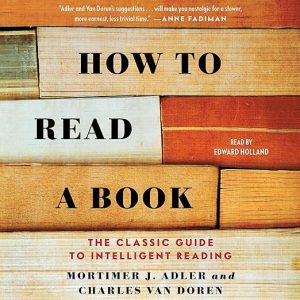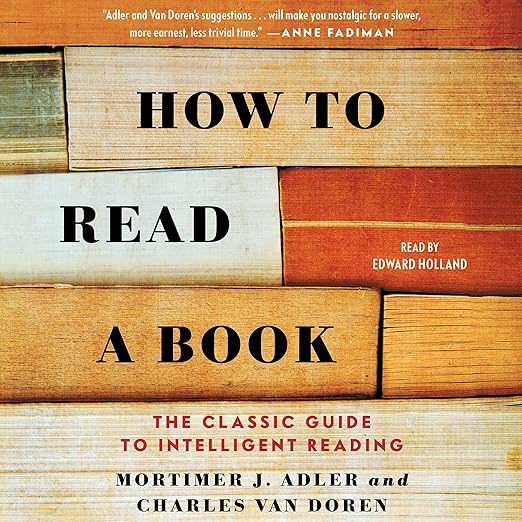
Mortimer J. Adler and Charles Van Doren's audiobook How to Read a Book arrives in its Audible edition narrated by Edward Holland, running fifteen hours and twenty-six minutes, a runtime that is itself a kind of argument. This is a book that believes reading is a skill, not an innate ability; that what most people call reading is actually only the most elementary level of a practice that can be developed through specific techniques; and that the gap between competent reading and truly analytical engagement with a text is almost never discussed in schools or universities. The case for that argument has been made since 1940, when the book first appeared, and it has remained in print ever since, which is better evidence of its continuing relevance than any claim a back-cover endorsement could make.
Four Reading Levels, From Elementary to Syntopical
The structure Adler and Van Doren build is hierarchical in a way that initially surprised me when I first encountered it. They identify four levels of reading: elementary, inspectional, analytical, and syntopical. Most people who consider themselves strong readers operate at the inspectional level, skimming, surveying, using structure to navigate. Analytical reading, by contrast, requires understanding not just what an author says but what their argument is, what terms they are using with specific precision, what propositions they are actually advancing, and whether the reasoning that connects those propositions is sound. Syntopical reading, reading multiple texts on the same subject in deliberate conversation with each other, is the highest level and receives its own full section of the book.
The 1972 revision Adler and Van Doren produced is the version most editions carry today, and it expanded significantly on the original to add chapters on reading specific genres: practical books, imaginative literature, plays, poetry, history, science, mathematics, philosophy, and social science works. Each of these genres makes different demands on the reader, and the strategies that work for a novel fail with a work of philosophy. That genre-specific breakdown is one of the most practically useful sections in the book, and Holland's narration handles the shifts between descriptive and prescriptive registers well throughout the full fifteen hours.
Holland Sustains Authority Across Dense Technical Passages
Edward Holland is a reliable narrator for dense nonfiction, and fifteen hours of this material requires someone who can sustain authority and clarity without losing the listener during the more technical sections. Holland's delivery is clean and appropriately measured. He does not editorialize or inject personality that would sit awkwardly against Adler and Van Doren's somewhat formal academic prose. The audiobook format for this particular title raises an obvious question: is it strange to listen to a book about how to read rather than reading it? In practice, the argument translates well to audio. The analytical reading techniques Adler describes apply equally to active listening as a form of engagement with an author's argument, and some sections, particularly those on identifying an author's key terms and propositions, are actually easier to process in audio than in a rapid reading pass through dense academic text.
One reviewer who came to the book wishing they had encountered it fifteen years earlier captures something real about its timing: this is a book that rewards being encountered while you are still actively building your reading practice rather than after you feel you have already settled into how you engage with a text. The audiobook version extends that access to people who consume most of their intellectual content through audio rather than print, making the framework more widely available than the demanding 400-page physical book might otherwise reach.
Reading List Skews Toward Western Canonical Works
The book's scope is ambitious and its tone is at times unmistakably mid-century American academic, confident in a way that can feel occasionally presumptuous about which books are worth reading carefully and which are not. The recommended reading list at the end reflects a particular canonical tradition, and listeners will notice the absence of non-Western texts. Adler's definition of what constitutes a "great book" is not universal, and while the reading techniques themselves are largely genre-agnostic, the examples and illustrations throughout are drawn from a fairly narrow set of Western philosophical and literary works.
At fifteen hours, this is one of the longer nonfiction audiobooks in the education-and-learning category. Listeners who want the core of Adler's framework rather than the complete treatment should be aware that the book is genuinely dense throughout and does not have extensive filler to skip. The chapters on syntopical reading are the most demanding and may require returning to rather than consuming in a single session.
Systematic Framework for Readers Who Want Depth
Students at any level who want to read more carefully rather than merely faster will find this audiobook directly applicable. Academics, writers, and intellectually serious general readers who want a systematic framework for engaging with difficult texts will get substantial value from the full fifteen hours. Those looking for speed-reading techniques should know that Adler is explicitly skeptical of speed as a goal; the book argues for reading at the appropriate speed for the material rather than for maximizing throughput above all else. Anyone who has felt they were getting something from a difficult book but not quite enough will find Adler and Van Doren's framework offers a useful vocabulary for diagnosing exactly what kind of active reading engagement was missing from the encounter.
A Few Questions About How to Read a Book
Is it strange to listen to How to Read a Book as an audiobook rather than reading it?
Less strange than it sounds. Adler's framework for analytical engagement, identifying key terms, following propositions, evaluating arguments, applies as well to active listening as to reading. Some listeners find certain sections, particularly those on identifying an author's argumentative structure, are actually easier to absorb in audio than in a fast reading pass through dense prose. The irony of the format is real but not disqualifying.
What makes this audiobook different from a general reading improvement guide?
Adler and Van Doren build a hierarchical four-level framework, elementary, inspectional, analytical, syntopical, that most reading guides do not have. The specificity of the analytical reading level, which includes identifying the author's key terms, propositions, and the soundness of the connecting arguments, gives this a precision that motivational reading advice lacks. It is more diagnostic than encouraging.
At fifteen hours, is this audiobook worth the full runtime?
If reading carefully matters to you, yes. The book is dense throughout, Adler does not pad, so there is no easy shortcut through the fifteen hours. The genre-specific chapters on how to read imaginative literature, philosophy, history, and science are among the most practically useful, and the full syntopical reading section requires the earlier framework to make sense. The runtime is earned.