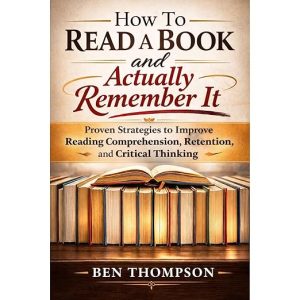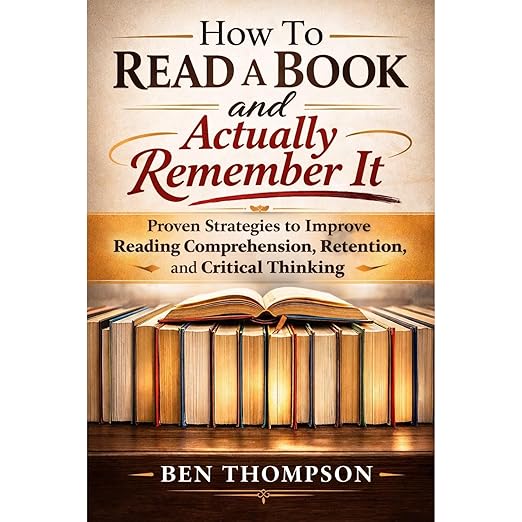
Ninety-five minutes is not much time in which to repair a lifelong habit, and this audiobook does not pretend otherwise. How to Read a Book and Actually Remember It runs an hour and thirty-five minutes and promises 'fourteen precise interventions', each one aimed at a specific place where understanding leaks away before it can turn into memory. That works out near seven minutes per intervention. Taken as a checklist rather than as a course, it holds together.
Let me be direct about the evidence sitting on this listing, because it is close to nonexistent. An independent press published the recording in February 2026, a single rating of three stars is attached to it, and no written review has been posted at all. Narration is credited as Virtual Voice, which means synthetic speech rather than a human performer. Anyone buying this is buying on the strength of the description, and should go in knowing that.
Fourteen Interventions Treat Reading as a Method Problem
The diagnosis is the strongest part and it is stated in the first lines: 'This is not a memory problem. It is a method problem'. That reframe does a lot of work. It moves the reader away from the useless conclusion that they have a bad memory and toward the far more tractable conclusion that they have never been taught what to do while reading, which is true of almost everyone who was taught to read as a child and never revisited it.
From there the fourteen interventions follow a sensible arc. Preparation before opening the book, so that arguments land on ground that has been made ready. A reading posture that hunts for the central claim rather than waiting to be handed it. A case against the highlighter, which the description argues is working against you. Then extraction: moving what you wrote in the margin somewhere it can link up with everything else you have read.
Two ideas here have the longest shelf life: review timing and the commonplace book. Spacing a revisit at the right interval is the difference between recognizing a passage and being able to use it, and keeping a commonplace turns years of scattered reading into what the copy calls 'a personal archive of usable intelligence'. Neither idea originates here, and the book makes no claim that they do.
That is my overall verdict on it. Nothing in this system is novel, and the value on offer is compression: the useful parts of several longer books about reading, arranged in order, in the time it takes to drive across a city. Judged against that modest promise it is competent. Judged as an original contribution to how anybody thinks about reading, it is not one, and it does not say it is.
Ninety-Five Minutes Compresses Several Longer Reading Books
The compression is the whole argument for buying it. Books about reading have a habit of running three hundred pages, which is a slightly absurd demand from a text whose thesis is that you already read too much without retaining it. Ninety-five minutes is proportionate to the problem, and the structure means you can act on one intervention before the next arrives.
Its target reader is clearly defined too, and it is not the speed-reading market. The description says outright that this is for people who want to read better rather than faster, who buy nonfiction with real intention and want a return on it. That narrowing is a good sign. Books in this space usually try to be everything, and this one has picked a lane and stayed in it.
One tension is impossible to ignore, and I mean it as an observation rather than a complaint. A book about marking pages, retrieving annotations and building a written archive is being delivered in the one format where you cannot mark anything or turn back to it. The instructions are perfectly clear in audio. Executing them requires a notebook, a phone or an app open beside you, so plan for that before you press play rather than after.
Synthetic Narration Deserves a Deliberate Decision
The byline is the first thing to weigh. The listing credits the author as Thompson, with no given name and no biographical note. The description mentions cognitive psychology as a foundation, and a surname alone gives you nothing to check that against, no other titles to compare, and no way to establish what expertise sits behind the fourteen interventions. That may not matter to you. It should at least be visible before you buy.
Scope is the second. Fourteen interventions plus a spaced-review schedule plus a commonplace-book system, all inside ninety-five minutes, means every single element arrives as a summary. You will finish knowing what to do and having practiced none of it. Treat this as an index of techniques to research properly elsewhere, and it earns its running time. Treat it as sufficient instruction and it will not deliver.
Response so far tells you almost nothing. One person has rated it, awarding three stars, and nobody has written anything at all. A single middling rating is not a verdict and I would not read it as one, but it is also the only signal available, and it points at lukewarm rather than delighted. With a February 2026 publication date, that picture may look entirely different in a year.
Finally, the synthetic narration deserves a deliberate decision rather than a shrug. Machine-generated reading is a different listening experience from a performed one, and instructional material with numbered lists is roughly the friendliest possible use of it. Even so, anyone who has not spent time with the format should sample this before committing, because tolerance for it varies enormously between listeners.
This Audiobook Audits Habits More Than It Teaches
This suits people who already read a fair amount of nonfiction and are frustrated at how little of it stays, students who were never taught a system, and anyone who has looked at a shelf of highlighted books and realized they cannot summarize one of them. It also works as a refresher for readers who once kept notes and have let the practice lapse.
Anyone wanting depth on the underlying cognitive science will be disappointed, as will readers who already run a working commonplace or note-taking system, and listeners who dislike synthetic narration. It is also unsuited to anyone hoping to read faster, which the description explicitly rules out as a goal.
Treat it as a ninety-five minute audit of your own reading habits rather than as an education in reading, and it is worth the time. The diagnosis is sharp, the sequence is sensible, and the price of testing it is one evening. Just accept that the actual work happens after the recording stops, in whatever system you build for yourself.
- Narration: Credited to Virtual Voice, so this is synthetic speech rather than a performed reading; sample it if the format is new to you.
- Themes: Reading retention, annotation systems, spaced review, commonplace books
- Mood: Brisk, instructional, quietly impatient with bad habits
- Verdict: A competent compression of familiar advice, worth ninety-five minutes and no more than that.
Good to Know
What does Virtual Voice mean on this audiobook?
It indicates synthetic narration generated by software rather than a recording made by a human performer. Instructional nonfiction with numbered sections is among the easier material for the format to handle, but the listening experience is noticeably different from a performed reading, so try a sample before committing.
Does the audiobook help if you already take notes on what you read?
Less than it would help someone starting from nothing. The strongest material concerns getting annotations out of margins and into a connected system, and the timing of review. If you already run a commonplace book or a note archive, most of this will be confirmation rather than instruction.