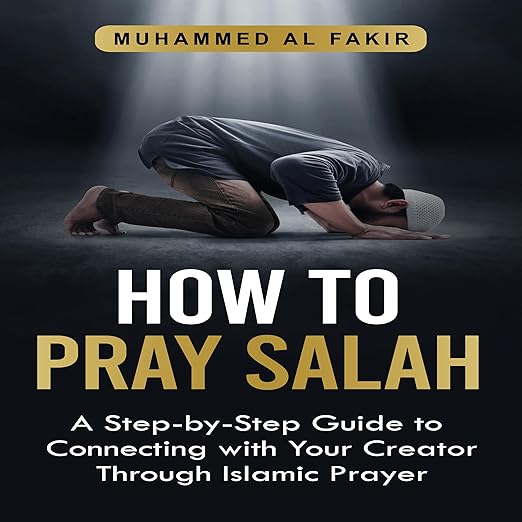
Quick Take
- Narration: Emad Salim brings appropriate gravity and clarity to the instructional material, making the Arabic terms and movement sequences accessible to English-speaking listeners.
- Themes: Islamic prayer practice, spiritual discipline, connection to the divine
- Mood: Clear and instructional, approached with genuine reverence
- Verdict: A practical, unpretentious guide to Salah that works equally well for new Muslims, people studying Islam, and observant Muslims wanting a solid refresher.
At seventy-five minutes, How to Pray Salah does not waste your time. It does not need to. Muhammed Al Fakir has written a practical guide to Islamic prayer that is dense with useful information and light on filler, and Emad Salim’s narration moves through the material at a pace that serves comprehension rather than performance. I listened to this in a single sitting, which is exactly how a book of this length and focus invites itself to be encountered.
Salah is one of the five pillars of Islam and is performed five times daily by observant Muslims worldwide. For anyone outside the tradition, or recently entering it, the mechanics and meaning of Salah can seem opaque. Al Fakir’s approach is to demystify without trivializing. He begins with preparation, the ritual purification of Wudu, and walks through the physical positions of prayer with enough specificity to be genuinely instructive while consistently returning to what those positions mean spiritually. The significance of every move in Salah, as the synopsis puts it, is not an empty promise. The book explains why the prayer takes the form it does, not just what that form is.
Our Take on How to Pray Salah
The most useful element of this recording is its attention to common mistakes. Al Fakir devotes space to what goes wrong in Salah practice and how to correct it, which transforms the book from a purely descriptive guide into something actionable. One reviewer who used it as a refresher described it as straight to the point and easy to absorb in fifteen minutes of focused listening. That reviewer found what they needed: a reliable orientation to material they partly knew. New Muslims or curious non-Muslims will need to spend more time with the material and may benefit from returning to specific sections.
The book also covers Special Salawat, including Taraweeh prayers performed during Ramadan and Salat al-Eid, the prayer associated with the two major Islamic festivals. This goes beyond the basic five daily prayers and gives the recording additional depth for listeners who want a more complete picture of Islamic prayer practice.
Why Listen to How to Pray Salah
The case for audio over print here is partly about accessibility and partly about context. Learning a physical practice from an audio guide requires a different kind of attention than reading, but it also allows the listener to move through the prayer positions with the narration running rather than having to keep glancing back at a page. Emad Salim’s clear pronunciation of Arabic terms, including the specific phrases recited during each position of Salah, means listeners can hear what correct recitation sounds like rather than approximating from a transliteration.
One reviewer gifted the book to a newly converted friend, which points toward another use case: this is a practical resource for someone in the early stages of conversion who needs to learn the mechanics of daily prayer before they can make it a habit. At 4.7 stars across 131 ratings, the audience has found it reliable for this purpose.
What to Watch For in How to Pray Salah
The short runtime means the coverage is necessarily introductory. A reviewer noted it is best suited for adults rather than children, finding that younger readers did not follow the explanations as readily. This is worth keeping in mind if you are looking for something to use with a child who is learning to pray. The conceptual framing assumes a reader who can engage with abstract ideas about spiritual connection, and the language is calibrated for that audience.
Audio also presents an inherent limitation for instructional content that is partly physical. The book does include a PDF companion, available in the Audible library, which suggests the publishers understood that some learners will need a visual reference alongside the narration. Listeners who are visual learners or who need to see diagrams of prayer positions should download the PDF before working through the audio.
Who Should Listen to How to Pray Salah
New converts who need a reliable, respectful, and practical introduction to Salah will find this the most immediately useful resource. Observant Muslims seeking a refresher, particularly on less frequently performed prayers like Taraweeh, will get value from the concise treatment. Non-Muslims studying Islam as part of interfaith work or general religious education will find it an accessible entry point. Children learning to pray for the first time are better served by resources designed specifically for younger audiences.
Frequently Asked Questions
Does this audiobook cover both the physical movements and the spiritual meaning of Salah or is it purely instructional?
Both. Al Fakir explains what each position and recitation means spiritually, not just the mechanics of how to perform them. The book consistently moves between the physical and the spiritual dimensions of the prayer.
Is there a PDF companion and does the audio work without it?
Yes, a PDF is included and available in the Audible library alongside the audio. The narration is designed to work on its own, but visual learners or those who need diagrams of prayer positions will find the PDF a useful supplement.
Does the book cover only the five daily prayers or does it address other forms of Islamic prayer?
It covers both. In addition to the standard daily prayers, Al Fakir addresses Special Salawat including Taraweeh (Ramadan prayers) and Salat al-Eid (festival prayers), which gives the book more scope than a purely basic introduction.
How does Emad Salim handle the Arabic recitations in the narration?
Salim narrates the Arabic terms and phrases clearly, which allows listeners to hear correct pronunciation rather than approximating from a printed transliteration. This is one of the practical advantages of the audio format for this kind of instructional content.