Quick Take
- Narration: Cramer reads his own work with the same kinetic energy he brings to Mad Money, fast-talking and urgent, which suits the material perfectly.
- Themes: Stock market investing, wealth-building psychology, growth vs. income stocks
- Mood: Energetic and instructive, like a one-on-one session with a very caffeinated mentor
- Verdict: A genuinely useful primer for anyone too intimidated to open a brokerage account, delivered with Cramer’s signature urgency.
I finished the last hour of this one on a Tuesday morning, sitting at my desk with a coffee that had gone cold because I kept stopping to take notes. That says something. I am not a finance person by training; my background is in literature and editorial work, not earnings reports and sector rotation. But Jim Cramer has spent two decades trying to drag people like me into the conversation about investing, and this audiobook is one of his more focused attempts at doing exactly that.
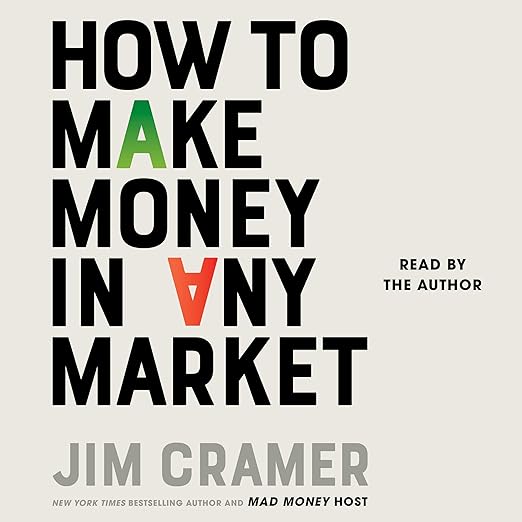
Cramer narrates it himself, which is the only real option for a book like this. If you have ever caught five minutes of Mad Money, you know the voice: urgent, instructive, occasionally overwrought, but never dull. He brings that same energy here, and for a subject that can easily tip into soporific territory, it works. The book came out of a very specific moment: twenty seasons of Mad Money, a role as co-host of Squawk on the Street, and what feels like genuine frustration that most Americans still treat the stock market as something that happens to other people.
What Cramer Is Actually Arguing
The core thesis is deceptively simple: the stock market is not the exclusive domain of Wall Street professionals, and the fear that keeps ordinary people out of it costs them real money over the course of a lifetime. Cramer wants to dismantle that fear methodically. He walks through how to think about growth stocks versus income stocks, how to evaluate a company’s fundamentals without getting lost in jargon, and how to maintain a position when the market turns volatile. These are not revolutionary ideas in the investment literature; anyone who has read The Intelligent Investor or anything by Peter Lynch will find some familiar ground here. But Cramer is not writing for people who have already read Lynch. He is writing for people who have never opened a brokerage account because they are convinced they will lose everything they have.
That distinction matters. The book is calibrated for beginners, and it stays at that level with remarkable discipline for someone who has spent decades deep in market analysis. Reviewer Bee noted being up over thirty percent after applying Cramer’s methodologies over the course of a year, and while individual results will obviously vary enormously, that kind of testimonial points to the practical utility of what he is laying out.
Where the Book Earns Its Skeptics
The four-star review from Chris Bentsen is worth taking seriously. Bentsen identifies two specific places where Cramer’s historical claims do not hold up: the assertion that markets always recover within a couple of years after a crash ignores the twenty-five years the market spent underwater after the Great Depression, and the sixteen flat years of the Dow between 1966 and 1982. He also takes issue with Cramer’s dismissal of cyclical stocks like Caterpillar and Deere, which have produced strong returns for patient investors. These are legitimate critiques, not nitpicks. Cramer is an optimist about the market’s long-term trajectory, and that optimism sometimes leads him to understate how brutal the intermediate-term can be, especially for someone who needs their money back within a decade. If you listen to this with those caveats in mind, you will get considerably more out of it than if you take every claim at face value.
The Listening Experience Itself
At just over ten hours and forty minutes, this is a book you can reasonably complete in a week of commuting, and the self-narration is one of its genuine advantages. There is no distance between the ideas and the person who developed them. Cramer’s cadence is fast, and he sometimes speaks in the same shorthand he uses on television, which can be slightly disorienting if you are completely new to market terminology. But he generally circles back to define his terms, and the overall arc of the book is clear. The structure moves from foundational psychology around fear and investing, through specific frameworks for stock selection, and ends with advice calibrated to different market conditions. It is not a book you need to pause and reread in the way that a denser work demands. You can listen at a normal pace and absorb most of what Cramer is offering.
Who Should Listen and Who Should Think Twice
If you have been meaning to start investing for years but keep finding reasons not to, this audiobook will do more to get you started than most of what is on the market. Cramer’s tone is relentlessly encouraging without being dishonest about risk, and his frameworks are concrete enough to act on. If you are already an experienced investor with a developed methodology, you will find the material too basic to change your practice, and some of the historical oversimplifications may actively irritate you. Reviewer Iryna noted the advice felt practical rather than boring, and that description captures the book’s positioning well. For the investor who has a 401(k) they barely understand and has never bought an individual stock, this is a reasonable place to start building a framework for thinking about the market. Approach it as an introduction, not a final word.
There is also a structural quality to this audiobook worth noting. Cramer does not simply deliver a monologue; the book is organized in a way that builds systematically from psychological groundwork through analytical frameworks and into market-specific strategies. That architecture is visible in the listening experience, and it distinguishes this from the looser, more conversational financial books that crowd the same shelf. Whether you come to Cramer as a Mad Money devotee or as someone who has never watched a minute of financial television, the book holds together as a coherent argument from beginning to end.
Frequently Asked Questions
Does Jim Cramer narrating his own book add value or become grating over ten hours?
It adds value. His voice carries the same urgent, instructional energy as his television work, which keeps the material moving. Some listeners who find his on-screen persona too intense may want to sample the first chapter before committing.
Is this book appropriate for someone who has never invested at all, or does it assume prior knowledge?
It is aimed squarely at beginners and people who are intimidated by the stock market. Cramer defines his terms and builds from basic psychology around fear before moving into specific stock-selection frameworks.
Are the criticisms in some reviews about Cramer’s historical market claims significant enough to undermine the book?
They are worth knowing about. Cramer’s optimism occasionally leads to oversimplified historical claims, particularly around market recovery timelines. The core framework remains useful, but treating his historical examples as gospel would be a mistake.
How does this book compare to Cramer’s earlier works like Mad Money or Real Money?
This is a tighter, more focused effort than some of his earlier books. It reads less like an extension of his television brand and more like a genuine attempt to synthesize decades of investing experience into actionable guidance for ordinary people.