Quick Take
- Narration: Melissa Kay Benson handles the wide cast of characters and the tonal shifts between policy analysis and personal testimony with steady, empathetic clarity.
- Themes: for-profit medicine, patient advocacy, systemic corruption in American healthcare
- Mood: Investigative and urgent, with moments of genuine moral outrage grounded in reporting
- Verdict: One of the more important healthcare exposés of recent years, and a blueprint for understanding what happens when profit motive colonizes essential medical care.
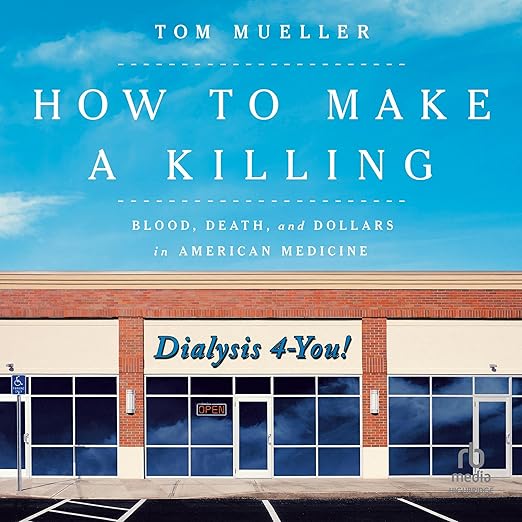
I came to How to Make a Killing already carrying some knowledge of the American dialysis industry, having read press coverage of DaVita and Fresenius over the years. I thought I understood the broad shape of the story. Tom Mueller’s book corrected that assumption within the first hour. What I had understood as a policy problem, Mueller documents as something closer to a deliberate and sustained project: the systematic conversion of a lifesaving medical technology into one of the most profitable and least accountable sectors of American medicine, at direct and measurable cost to patient welfare.
Mueller opens with a history that is genuinely extraordinary. Sixty years ago, a small group of visionary doctors and engineers achieved something that had never been done before: they built a machine capable of replacing a failing kidney, keeping patients alive through a process that would have killed them within days otherwise. The first dialysis programs were run largely by non-profit medical centers, often with waiting lists managed by ethics committees because the technology was scarce. What happened next, Mueller argues, is the original sin of for-profit American medicine: the technology was scaled, commercialized, and handed to corporations whose primary obligation was to shareholders rather than patients.
Our Take on How to Make a Killing
This is investigative journalism at a high level. Mueller’s cast of characters is as vivid as any in the genre. There is the unpaid activist living in a south Georgia trailer park who has spent years documenting involuntary patient discharges, fighting on behalf of people who are dependent on a system that can eject them from treatment if they become inconvenient. There are the industry insiders who describe executives arriving at employee rallies dressed as musketeers and Star Wars characters, exhorting their staff to more aggressive billing. There are the nephrologists who describe being marginalized within the very specialty they trained for because the financial incentives of the corporate model made their clinical judgment an obstacle.
The dialysis patient population is overwhelmingly low-income, disproportionately Black, and almost entirely dependent on Medicare funding. Mueller documents with precision how this particular combination, a captive patient population with guaranteed federal payment, created conditions for extraction that simply would not have been possible in a more competitive or consumer-driven market. Patients cannot choose to stop dialysis. They cannot easily switch providers. They cannot shop around. The result, Mueller argues, is not just poor outcomes but outcomes that are measurably worse in the United States than in comparable countries with different payment models.
Why Listen to How to Make a Killing
Melissa Kay Benson is an excellent narrator for this material. She manages the tonal complexity of a book that is simultaneously a policy argument, an investigative report, and a human story about people in genuine medical jeopardy. When the book shifts from policy history to first-person testimony from patients and whistleblowers, Benson adjusts her register accordingly without making the shift feel mechanical. The result is an audio experience that remains engaging across its nearly nine hours.
The international comparisons are among the book’s most valuable passages. Mueller spends real time on what dialysis looks like in Germany, Japan, and other countries with different regulatory frameworks, and the contrast is stark. German patients, one reviewer noted, access dialysis through a fundamentally different system of non-profit providers. American patients receive treatment from corporations that are among the most profitable in healthcare, and die at significantly higher rates. The structural comparison Mueller makes is not an argument for a specific political solution, but it is an argument that the current American arrangement is not inevitable.
What to Watch For in How to Make a Killing
Mueller argues that dialysis is a microcosm for American healthcare as a whole, and the final chapters move toward this broader argument with some ambition. Whether that pivot works will depend on how much the reader is already convinced by the dialysis case. The dialysis material is thoroughly reported and difficult to dispute. The broader healthcare argument is necessarily more schematic, since Mueller cannot document the entire system with the same granularity. Readers who are already familiar with the American healthcare policy literature may find the concluding chapters less revelatory than the core reporting.
The whistleblower stories are the emotional heart of the book, and some of them are genuinely difficult listening. Mueller does not sensationalize these accounts, but he does not soften them either.
Who Should Listen to How to Make a Killing
This is essential listening for anyone interested in American health policy, healthcare economics, or investigative journalism as a craft. It is also profoundly useful for dialysis patients, their families, and anyone who works in the healthcare system and wants to understand the structural incentives shaping clinical decisions. The book is accessible enough for general readers with no prior background in healthcare policy, and sufficiently detailed to be genuinely useful to specialists.
If you are looking for a book that presents a balanced defense of the current for-profit dialysis system, this is not that book. Mueller’s reporting is thorough and his argument is clear. Whether you find his policy conclusions persuasive is a separate question, but the documented facts he presents are difficult to argue with.
Frequently Asked Questions
Does How to Make a Killing focus only on dialysis, or does it cover other areas of American healthcare?
The core reporting is specifically about the dialysis industry, but Mueller uses it as a case study to make arguments about for-profit medicine more broadly, particularly in the final sections of the book.
How current is the reporting? When was the primary research conducted?
The audiobook was released in October 2023, and the reporting draws on research conducted in the years leading up to that, including the history of the industry from the 1960s through the present.
Does Melissa Kay Benson’s narration work well for a book with heavy policy and medical content?
Yes. She handles the technical material with clarity and the personal testimony sections with appropriate warmth, which keeps an otherwise dense subject from becoming dry or clinical.
Does Mueller offer solutions or is this primarily a diagnostic book?
Primarily diagnostic. Mueller documents the problem in depth and points to international comparisons as evidence that alternative models exist, but he does not advocate for a specific legislative or policy remedy.