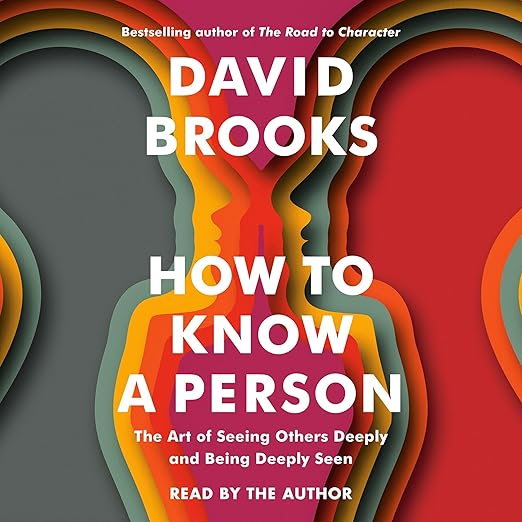
Quick Take
- Narration: David Brooks narrates his own work with the measured, thoughtful delivery of someone who has spent decades speaking on radio and television, which is an asset here.
- Themes: human attention and connection, the art of being truly seen, moral social skills
- Mood: Reflective and warm, with an urgent undertone
- Verdict: Brooks at his most personal and practically useful, arguing for a skill our culture has systematically undermined.
I was halfway through my morning commute when David Brooks, narrating his own book, used the word illuminator. He defined it as someone who sees people not through the lens of type or category but with a gaze that is tender, generous, and receptive. I sat with that for a moment longer than the rest of the commute, which is roughly what Brooks hopes his readers will do throughout this book: pause, absorb, and consider what it would mean to actually practice what he is describing.
How to Know a Person is the most plainly personal book Brooks has written. Coming after The Road to Character and The Second Mountain, it reflects the ongoing public project of a writer who has acknowledged living through significant personal failure and trying to understand what went wrong. The subject here is the fundamental act of seeing another person, which Brooks argues is both rarer than it should be and more learnable than we assume. He narrates the seven-plus-hour audiobook himself, which turns out to be the right decision.
Our Take on How to Know a Person
Brooks draws from psychology, neuroscience, philosophy, theater, and education to build what he calls an integrated approach to human connection. The organizing question is simple: what kind of attention do you need to pay someone in order to actually know them? The answers are practical without being reductive. Brooks identifies specific conversation patterns, listening habits, and ways of asking questions that move people from surface contact to genuine encounter.
The distinction between illuminators and diminishers runs through the book as its central organizing image. Illuminators are those who make others feel seen and enlarged; diminishers are those who, through inattention or projection, make others feel small or invisible. Brooks is not describing personality types but practices, and the book’s argument is that the gap between the two is bridgeable through intentional attention.
Why Listen to How to Know a Person
Because Brooks narrating his own work adds a dimension that transcends the text. His pauses are considered. When he quotes someone who made him feel genuinely seen, the quality of attention in his voice is itself demonstrating what the book is arguing for. One reviewer wrote that the book reads like having a spiritual advisor, and while that may be overstating it, the experience of listening to Brooks working through these ideas with evident sincerity is distinct from passive self-help consumption.
The book also arrives at a moment when its argument feels structurally necessary. Brooks frames the erosion of relational attention as connected to broader social fragmentation, and the case he makes, that seeing another person is itself a moral and political act, is more compelling than it might sound in summary.
What to Watch For in How to Know a Person
Brooks tends toward the learned reference, drawing on Kahneman’s dual-process thinking, developmental psychology, and philosophical traditions of attention. Listeners who came in hoping for a practical workbook may find the conceptual scaffolding denser than expected. That said, the reviewers who found it most useful were those who engaged with it as what it is: a synthesis of ideas about human connection, not a twelve-step program.
The book is also unapologetically idealistic. Brooks believes the skill of seeing people can be taught and that its widespread practice would remedy real social harm. Some listeners will find that optimism energizing; others will find it naive given how entrenched the patterns he is arguing against have become.
Who Should Listen to How to Know a Person
This book will resonate most with listeners who have had the experience of feeling genuinely unseen and have wondered why it is so rare to feel understood. It is also useful for therapists, educators, managers, parents, and anyone who has a professional or personal stake in the quality of their attention to other people. Less rewarding for listeners who want immediate tactical outputs; the book builds toward practical guidance through extensive conceptual framing that you have to engage with to benefit from.
Frequently Asked Questions
Why does David Brooks narrate his own book, and does it work?
Brooks narrates the audiobook himself, and the choice is clearly intentional given that the book is about the quality of human attention. His measured, reflective delivery demonstrates the very practices he is describing. Reviewers found it both persuasive and engaging, with one comparing it to the experience of a thoughtful spiritual advisor rather than a self-help narrator.
What is the illuminator versus diminisher distinction?
Brooks’s central organizing image is the difference between people who make others feel seen, enlarged, and valued (illuminators) and those who, through inattention or projection, make others feel invisible or reduced (diminishers). He argues these are not fixed personality types but learned practices that can be developed with intention.
How practical is this book versus how conceptual?
More conceptual than a typical self-help title, though practical guidance is present throughout. Brooks draws heavily on psychology, neuroscience, and philosophy to build his argument before arriving at specific conversation and listening techniques. Reviewers who engaged with the conceptual framing found the practical sections more actionable as a result.
How does this compare to Brooks’s previous books like The Road to Character?
How to Know a Person is more interpersonally focused and arguably more personal than The Road to Character. Where that book examined individual moral development, this one examines relational practice, the specific act of attending to another person. Readers who appreciated Brooks’s character-focused moral writing will find this a natural continuation.