At a Glance
- Read by: KC Davis reads her own work, and that self-narration adds authenticity the material actively requires, particularly in the vulnerability of the personal passages.
- At its heart: Shame and self-compassion, ADHD and mental health, reframing domestic labor
- Vibe: Warm and permission-giving
- Short version: KC Davis's audiobook shifts the frame so completely that listeners find themselves extending grace to themselves they did not know they were withholding.
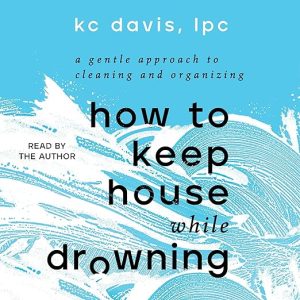
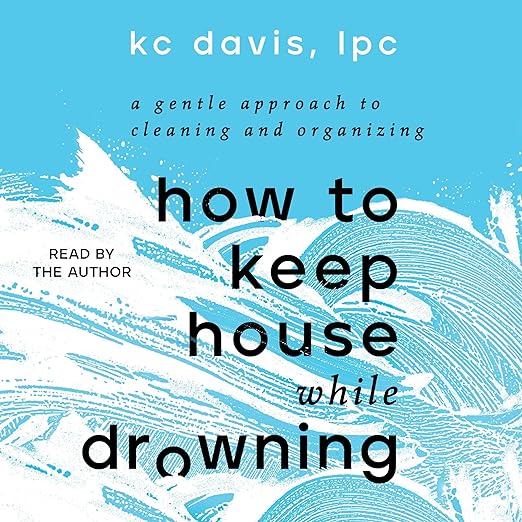
KC Davis's title states its own problem plainly: can you keep a house while you are drowning? The honest answer she offers in this audiobook is that the question is backwards. Keeping a house is not the thing you do to stop drowning. For many people, it is one of the first things that becomes impossible when they already are. That reframe, simple on its surface, is the structural foundation of How to Keep House While Drowning, which Davis reads herself at three hours and fifteen minutes. Listeners who have described this audiobook as something they cried through, or returned to during their lowest periods, or shared with a partner who did not understand why the dishes kept piling up, are responding to that reframe. Davis gets to the reason people struggle with domestic maintenance before she says a word about cleaning schedules.
Your Home Is Supposed to Work for You
Davis is a therapist by training, and she brings a clinical framework to material that most domestic organization books approach with cheerful productivity advice that implicitly assumes the reader's problem is a lack of the right system. The distinction is significant. She begins not with techniques but with the shame cycle that makes those techniques collapse: the more overwhelmed you feel, the less able you are to start, the more evidence accumulates that you cannot cope, the more shame compounds. Her approach is to interrupt that cycle not by providing a better system but by changing the relationship to what the mess means in the first place. The one-line version of that reframe is that messiness is not a moral failing. But Davis understands that most people who struggle with home maintenance do not actually believe that statement in the places where belief lives, even when they can affirm it abstractly. The audiobook is the work of getting that belief to a location where it can actually change behavior.
The concept she returns to most clearly is that you do not work for your home; your home works for you. That inversion restructures the entire conversation. A pile of unfolded laundry is not evidence that you failed the laundry; it is evidence that the laundry has not served you yet. A chaotic kitchen is not proof of inadequacy as a parent; it is information about what you had capacity for this week. Those reframes sound small in summary but their effect on listeners, particularly those managing ADHD, postpartum depression, chronic illness, or compounding life stress, is described consistently in reviews as something approaching relief.
Davis Brings Her TikTok Voice to Audio
Self-narration carries a risk when a professional author reads their own work, but Davis handles it well. Her voice carries the same energy she brings to her social media presence through her TikTok account, @domesticblisters, where the content that became this book first found its audience: direct, warm, genuinely non-judgmental. The personal passages about her postpartum depression after her second child, the seven months she did not fold a single piece of laundry, and the specific moment of realization that changed her relationship to her own home carry a different weight in her own voice than they would in a professional narrator's rendering. Davis inhabits those passages rather than performing them.
The practical sections of the audiobook are specific and immediately applicable in ways that distinguish them from the aspirational advice that fills most home-management content. Davis covers how to stagger tasks within an existing daily routine, how to use quick cleaning bursts rather than dedicated sessions that require clearing a block of time, how to prioritize function over appearance, and how to understand chores as acts of care toward your future self rather than as obligations that reflect your worth. Crucially, she is not describing a system that requires a reorganized life to implement. She is describing modifications that fit inside an already overwhelmed existence, which is the only context in which this kind of advice can actually reach the people who need it most.
Not a Cleaning Schedule, More a Mindset
Listeners expecting a conventional home organization audiobook will need to recalibrate quickly. Davis is not offering a decluttering method or a cleaning schedule optimized for maximum efficiency. The audiobook is lighter on tactical specificity than some listeners will want and heavier on the psychological substrate beneath those tactics. If you want a room-by-room cleaning plan with time estimates and before-and-after benchmarks, this audiobook functions as an introduction to a different conversation rather than the answer to the tactical question.
The audiobook is designed specifically for people whose difficulty with home maintenance connects to mental health, neurodivergence, chronic illness, or exhaustion. Davis names ADHD, anxiety, depression, and fatigue as conditions that make conventional cleaning advice fail not because the advice is wrong but because it was not written for the conditions it is being applied to. Listeners who do not identify with those experiences may find the permission-giving tone less necessary. Those who do will likely feel seen in ways that are genuinely rare in the home and lifestyle genre.
Built for Parents Whose Systems Keep Failing
This audiobook is for anyone who has tried a cleaning system and had it fail, not because the system was poorly designed, but because the conditions of their life made sustained implementation impossible. It is for people who feel shame about their homes and want to understand where that shame came from before deciding whether it deserves any continued authority over them. Parents of young children navigating the impossible arithmetic of domestic labor with inadequate support will find this audiobook practically and emotionally useful in equal measure. Listeners who want a quick, compassionate recalibration of their relationship to their living space, rather than a comprehensive organizational system, will find Davis's three-hour audiobook delivers exactly that, and many will find themselves returning to specific passages when the overwhelm returns, as it will.
Frequently Asked Questions
Is this audiobook specifically for people with ADHD, or will it help someone dealing with more general overwhelm?
Davis addresses ADHD explicitly as one of several conditions that make conventional domestic advice fail, but the framework applies broadly to anyone whose home maintenance struggles have a mental health, fatigue, or life-circumstance dimension. The permission-giving approach is not condition-specific.
Does KC Davis narrating her own audiobook genuinely add to the experience?
Meaningfully so. The personal passages about her postpartum depression and the specific moment of realization that changed her relationship to domestic labor carry different weight in her own voice. Self-narration was the right call for material this autobiographically grounded and emotionally immediate.
At only three hours, does this audiobook cover enough ground to be worth the investment?
The short runtime reflects the book's own philosophy about not padding things unnecessarily. Reviewers consistently describe returning to it multiple times rather than treating it as a one-time listen, which suggests the value is in re-accessibility as much as in initial content.
How does this audiobook balance practical cleaning advice with the psychological framework?
It leans toward psychological reframing rather than tactical instruction. Davis provides specific methods for staggering tasks and cleaning in quick bursts, but the central argument is about changing your relationship to domestic labor and to the shame attached to imperfection rather than optimizing how you perform the tasks.