Quick Take
- Narration: Rich Miller delivers the dense philosophical content in a measured, authoritative tone that suits the material without dramatizing it.
- Themes: Faith vs. reason, the limits of apologetics, atheism and intellectual honesty
- Mood: Provocative and analytical, occasionally wry
- Verdict: A genuinely unusual book that will challenge both sides of the faith debate, written with surprising fairness from an atheist who once stood on the other side.
I came across this one after finishing a more conventional apologetics title and feeling vaguely unsatisfied by the way it handled counterarguments. There is a particular kind of intellectual dishonesty that creeps into faith defense literature when the author refuses to seriously engage with the strongest objections. John W. Loftus, a former Christian minister turned atheist, has no patience for that approach. I listened to the opening chapters while walking around my neighborhood on a gray Tuesday morning, and by the time I was home I had already marked several timestamps to revisit.
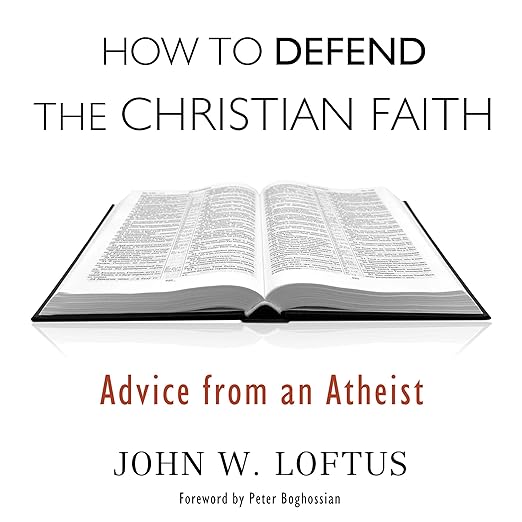
What makes this audiobook immediately striking is the premise: it is the first full-length guide to Christian apologetics written by an atheist, for Christians. Loftus is not trying to dismantle faith from the outside. He is, at least on the surface, trying to help Christian defenders understand where their arguments fail before they deploy them against educated skeptics. That framing is clever, and whether you find it generous or subversive will depend on where you stand.
Our Take on How to Defend the Christian Faith
Loftus structures his critique across three broad territories: preparation, specific defensive strategies, and the intellectual landscape that modern apologists must navigate. His own background as a former preacher gives him unusual access to the insider logic of Christian apologetics, and he uses that knowledge to identify the arguments that have become stale or counterproductive. The claim that many approaches which worked in an earlier age no longer resonate in today’s educated West is one he develops with some care, pointing to the ways scientific discovery and naturalistic thought have shifted the baseline of the conversation.
Reviewers have called the premise ingenious, and I think that is fair. Whether the execution fully matches the concept is another matter. Loftus can be sharp and incisive when he is at his best, but some sections feel like they are covering ground more familiar to readers of his earlier work, particularly Why I Became an Atheist. The writing is thorough rather than elegant, and that occasionally slows the listening experience.
Why Listen to How to Defend the Christian Faith
The value here is in the specificity. Loftus is not making broad cultural arguments about religion’s decline. He is going method by method, argument by argument, pointing to what works, what does not, and why. For Christians who take apologetics seriously and want to understand the actual weaknesses in their intellectual arsenal before encountering a formidable critic, this is genuinely useful. Rich Miller’s narration is competent and consistent, keeping things intelligible through passages that could easily become impenetrable in less careful hands.
For atheist listeners, the book functions as a kind of annotated field guide to the strongest arguments on both sides. Loftus assumes his atheist position throughout, which means the advice to Christians is always at least partly edged with critique. Whether that makes the book more or less honest depends on your tolerance for that kind of double register.
What to Watch For in How to Defend the Christian Faith
The writing style, flagged by more than one reviewer, can feel clunky compared to more polished writers on this subject. Jerry Coyne’s Faith vs. Fact was mentioned in comparison, and the contrast in prose fluency is real. This is a book of ideas rather than a book of sentences, and if you are primarily drawn to audiobooks for the pleasures of language, you may find yourself impatient at times. The sixteen chapters are densely packed, and some listeners may need to pause and sit with specific arguments rather than letting them wash past.
There is also the question of intent. Loftus is an atheist writing for a Christian audience, and that creates an unusual kind of friction throughout. Some Christian readers have found the book genuinely useful and honest. Others will feel the frame is performative, that the advice is a delivery mechanism for critique. Both readings are defensible, which is part of what makes this a richer audiobook than the average entry in either genre.
Who Should Listen to How to Defend the Christian Faith
Christians who are serious about apologetics and willing to stress-test their arguments against a formidable critic will find this essential. Atheists who want a comprehensive tour of where apologetics succeeds and fails will find it equally worthwhile. Casual listeners looking for an accessible introduction to the faith-and-reason debate should probably start elsewhere. At just under eleven hours, this is a full-commitment listen that rewards slow, attentive engagement.
Frequently Asked Questions
Is this book hostile to Christianity, or does it engage fairly with the faith?
Loftus is openly atheist, but reviewers across the spectrum note that he engages with Christian arguments seriously rather than dismissively. His stated goal is to help Christian apologists improve their case, and he accomplishes that even as he makes clear he finds the underlying claims unconvincing.
Do I need to read Loftus’s earlier book Why I Became an Atheist first?
No, this book stands independently. That said, some reviewers note overlap in arguments and style between the two titles. If you have already read Why I Became an Atheist, expect familiar territory in places.
Is Rich Miller’s narration a good fit for this kind of dense philosophical content?
Yes. Miller reads with a steady, clear delivery that works well for argument-heavy material. He does not add artificial drama, which is the right call for a book that relies on the weight of ideas rather than narrative momentum.
At nearly eleven hours, is the pacing consistent throughout?
The book runs long for its content density. Some chapters are tighter than others, and listeners should expect uneven pacing. The sixteen chapters are organized into three parts, so pausing between sections rather than listening straight through is a reasonable approach.