Quick Take
- Narration: Ross Cameron narrating his own book gives it the quality of a direct conversation, informal and authoritative in the way a mentor briefing you would be.
- Themes: Risk management, the psychology of trading discipline, the gap between theory and practice
- Mood: Candid and grounding, like a cold shower for anyone who has romanticized day trading
- Verdict: Unusually honest about failure rates and the specific personality traits that make day trading viable, which is exactly what most books in this space refuse to do.
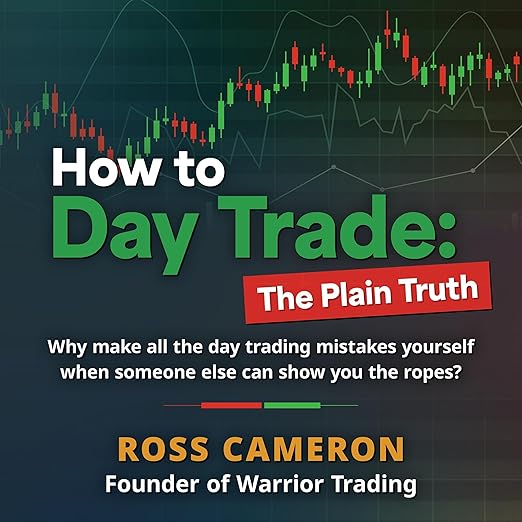
I do not day trade. My interest in finance runs more toward the structural and historical, and I have always been skeptical of anything that promises a route to extraordinary returns through individual skill in a domain dominated by algorithms and institutional players. That skepticism is part of why I found How to Day Trade: The Plain Truth more interesting than I expected. Ross Cameron is selling the opposite of the usual sales pitch, and that is genuinely unusual in a genre where every author claims to have unlocked something the market has not yet priced in. This is a book built on the premise that most people who attempt day trading will fail, and that understanding why is the more useful starting point than the usual promise that you could be next.
Cameron is a well-known figure in the retail day trading space, the founder of Warrior Trading, and someone who has documented his trading publicly for years. He opens by acknowledging that he turned an initial investment of $583 into more than $10 million, and then immediately states that his results are not typical. In a book about day trading, starting with a disclaimer about your own success story is either an act of unusual intellectual honesty or very clever positioning. Having listened to the whole thing, I think it is mostly the former. The book consistently pushes against the genre conventions that would make it more commercially appealing and less truthful.
The Twenty Guardrails and What They Are Actually Protecting
The structural spine of the book is Cameron’s twenty specific guardrails, rules he developed over years of trial and error that saved him from the kinds of catastrophic mistakes that end most retail day traders’ careers before they become profitable. Reviewers described the book as covering core principles such as risk management, position sizing, discipline, and understanding market behavior, and that summary is accurate but understates the specificity. Cameron is not teaching general financial wisdom. He is describing the precise behavioral constraints that kept him solvent long enough to develop skill, which is a fundamentally different kind of teaching.
The most striking guardrail is the daily loss limit. Cameron caps his daily loss and steps away from the screen the moment he hits it, no exceptions. He frames this not as advice but as a survival mechanism: the minimum behavioral discipline without which skill development is impossible because you run out of capital before you can learn from your mistakes. That framing is useful because it treats psychological discipline not as a character virtue but as a functional requirement of the game. A reviewer who complimented the book as a companion to Cameron’s YouTube videos noted that it gives his basic search criteria, which took a lot of trial and error to discover, and some examples of student success.
Cameron Narrating His Own Work
The decision to have Cameron read this himself is the right call. He is not a trained voice actor, and the production has the slightly informal quality of someone more comfortable at a whiteboard than in a recording booth. But that informality serves the material. The book is designed to feel like a candid conversation with someone who has made the mistakes and is telling you about them without editorial softening. Reviewers described it as easy to listen to from an author who knows what he is talking about, and the self-narration contributes directly to that sense of directness and earned authority.
One reviewer described him as verbalizing complex concepts in a way that actually clarified them, which is the specific talent that makes a practitioner a useful author rather than just an interesting one. His YouTube following provides built-in context for his voice and approach, and one reviewer explicitly described the audiobook as a good companion to watching Cameron’s YouTube videos. That pairing is probably the ideal consumption pattern for the material.
The Honest Assessment of Who Should Not Day Trade
What Cameron does that most trading books refuse to do is explicitly describe who should not be in this game. He is honest about failure rates in retail day trading, about the amount of capital required to sustain losses during the learning curve, and about the specific personality characteristics, particularly the ability to sit with a loss limit and not override it, that separate the people who eventually become profitable from those who do not. A reviewer who found the lack of nuance on entries, holding periods, and exits disappointing was reading the book correctly. Cameron is not writing a comprehensive technical manual. He is writing a psychological and practical primer for people at the very beginning of the journey.
What Experienced Traders Will and Will Not Find Here
Cameron is addressing beginners explicitly, and experienced traders who come to this book expecting technical elaboration on entries, position management, and exits may be disappointed. One reviewer noted that they would like to see more on getting in, how long to stay in, and when to exit. Cameron covers these basics but at a level of generality that reflects the book’s intended audience. He is not writing a comprehensive trading system manual. He is writing a psychological and structural orientation for people who do not yet know what they do not know, and that distinction matters. Experienced traders looking for nuanced technical development should look at other resources in Cameron’s Warrior Trading ecosystem.
Available as a free audiobook on Audible, this is a more useful starting point than most of what occupies the day trading self-help space, precisely because it does not pretend the path is easier than it is. If you are curious about day trading and want an honest assessment before committing time and capital to it, this is a better investment of four hours than most alternatives in this category.
Frequently Asked Questions
Is this book for complete beginners or for traders who already have some experience?
It is aimed primarily at beginners and those considering day trading who want an honest assessment of what they are getting into. Experienced traders will find the material foundational rather than advanced. Cameron is explicit that the technical depth comes later and that this book covers the psychological and structural prerequisites.
Does Cameron’s claim of turning $583 into $10 million make this book’s advice suspect?
Cameron himself addresses this directly, stating immediately that his results are not typical. The book is specifically designed to avoid implying that his outcome is reproducible. His argument is that the guardrails he developed are what kept him in the game long enough to develop skill, not that the results themselves are the goal or the norm.
What are the twenty guardrails Cameron discusses in the book?
Cameron does not share the complete list publicly outside the book, but they include rules around daily loss limits, position sizing, stock selection criteria including his five pillars, and specific behavioral constraints designed to prevent the most common ways retail traders blow up their accounts early. The full list is explained with context in the audiobook.
How does this compare to other day trading books in terms of honesty about risk?
More honestly than most. Reviewers consistently noted that Cameron does not glamorize the lifestyle or promise that anyone can succeed with the right system. The book explicitly addresses who is not suited for day trading and what the real failure rates look like, which is unusual in a genre that tends toward optimistic sales pitches.