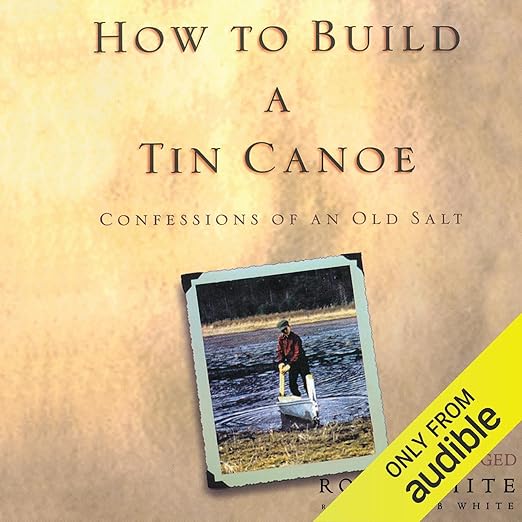
Robb White's voice in this audiobook is something I wasn't expecting. I came in anticipating practical boatbuilding lore, the kind of measured technical narration you'd find in a woodworking manual read aloud. What I got instead was closer to sitting on a dock in the Gulf of Mexico with a man who built his first vessel from the tin roof of an abandoned chicken coop and never quite stopped being that curious, reckless, water-obsessed kid. White narrates his own memoir, and the difference between a trained voice actor and an authentic original voice has never been clearer to me than it was over these five hours and forty-nine minutes.
The book is billed as a Southern raconteur's memoir about wooden boats and a life lived on the water, and that description is both accurate and wildly insufficient. White grew up exploring the Gulf of Mexico, never attended formal boatbuilding school, and yet produces vessels that connoisseurs seek out. But the real subject of this audiobook is a particular kind of American freedom, the freedom of the self-taught person who measures competence not by credentials but by whether the boat floats and whether the story holds.
Candid, Uproarious Writing of the Best Sort
Robb White's self-narration is the core asset here, and it comes with the full flavor of his personality intact. His voice carries the unhurried cadence of someone who has never felt the need to impress anyone, which paradoxically makes everything he says more compelling. The humor is dry and wry, delivered without a wink. When he describes how to survive rampaging monkeys or offers techniques for stopping a turtle from eating your boat, he does so with the same tone he'd use to explain a hull joint, which is exactly what makes the book so disarming. One reviewer called it 'candid, uproarious writing of the best sort,' and that captures it well. White knows what he knows because he has been there, and listening to him tell it, you believe every word.
This is not a how-to audiobook in any conventional sense. The title is wry misdirection, a classic Robb White move. You will not walk away knowing how to build a tin canoe. You will, however, walk away knowing something about what it means to build a life around a craft you love without apology or credential. That is a more useful thing than most instructional content provides.
The Southern Raconteur Mode White Embodies
The listening experience rewards patience and a willingness to follow wherever White leads. His tales unspool across decades and geographies, from bayou marshes to the open Gulf, from encounters with difficult clients to lessons absorbed from failures that would have stopped a less stubborn man. The structure is loose by design, the memoir format allowing him to move between periods of his life without obligation to chronological order. For listeners accustomed to tightly plotted nonfiction, this can take some adjustment. For those who love oral storytelling traditions, particularly the Southern raconteur mode that White embodies, it feels exactly right.
Reviewers consistently mention wanting to give copies of this book to friends who love boats. That impulse makes sense not just because of the subject matter but because of the quality of the companionship on offer. White is, at root, an entertainer of the old school, someone whose presence is a gift in itself. Listening to him narrate his own life is the closest most of us will get to spending an afternoon on the water with him.
A Recording Bracing Enough to Call a Tonic
Listeners who arrive expecting rigorous memoir structure or a clear narrative arc may find the looseness frustrating. The book meanders, doubles back, and detours into anecdote without warning. That is by design, but it is not for every taste. The humor is also very specific: deadpan, self-deprecating, and built on a foundation of knowledge that White never explicitly displays but always assumes. If you are not at least marginally interested in wooden boats, waterways, or Gulf Coast culture, some of the pleasure may not translate.
The production is also notably simple. White narrates without studio polish, and the rawness of the recording is part of the charm, but it is worth knowing in advance that this is an intimate, unadorned listen rather than a high-production audiobook experience. One review described it as a 'tonic,' and that word is apt: something bracing, a little astringent, good for you in ways that are hard to quantify.
What White accomplishes in this audiobook that so few oral memoirs manage is the creation of a genuine sense of place. The Gulf of Mexico is not a backdrop here; it is a character with its own rhythms, its own hazards, and its own rewards. His descriptions of marshes and tidal channels and the particular light of early morning on the water carry the authority of someone who has spent decades paying attention. That specificity, grounded in decades of real observation, is what elevates the book from entertaining tall tale collection to something with lasting value as a document of a particular Southern life and a particular relationship to craft.
Barry Hannah and Larry Brown, for Comparison
Anyone who grew up near water and remembers the specific pleasure of fixing things with whatever was at hand will feel immediately at home in this audiobook. It is also a strong choice for listeners who love first-person oral history, particularly the kind where a remarkable person tells their own story without interference from a ghost writer or narrative consultant. Fans of Southern American literature will find resonances with writers like Barry Hannah or Larry Brown, though White's register is more cheerful and his orientation more practical. Skip it if you need a tightly structured narrative or genuinely want boatbuilding instruction. Embrace it if you want a few hours of exceptional company.
How does the self-narration affect the audiobook listening experience?
Significantly and positively. White's voice carries the exact personality of his prose, unhurried, dry, and confident without being boastful. It's one of the cases where a self-narrated memoir outperforms what a professional voice actor could have provided.
Is the audiobook appropriate for listeners who have no interest in boats?
Possibly. The boat-building and water-life content is the backdrop, but the real subject is a particular kind of American self-reliance and storytelling. Fans of oral memoir traditions may enjoy it even without nautical interest.
Is this audiobook connected to any other works by Robb White?
Robb White (the boatbuilder, not to be confused with the novelist of the same name) is known primarily for his wooden boats and the cult following they attract. This memoir stands alone as his signature written work.