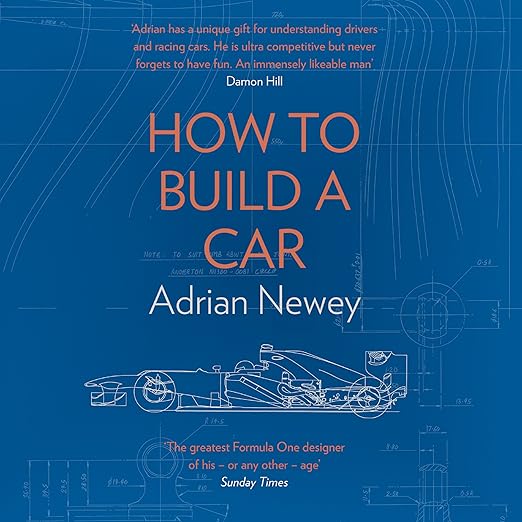
Adrian Newey sketched his first race car design at twelve years old, years before he would go on to design machines for Mario Andretti, Ayrton Senna, and Sebastian Vettel. How to Build a Car is his audiobook memoir of the thirty-six years between that early sketch and a shelf of Formula One championships, narrated by Richard Trinder across just over twelve hours.
Rather than moving strictly chronologically, Newey organizes the book around the cars themselves, using each design as a way into the drivers, teams, and races that shaped his career, from early open-wheel racing in America through decades at the top of Formula One. It is an unusual structure for a memoir, closer to an engineer's logic than a storyteller's, moving by object rather than by year, and it mostly pays off because Newey has genuinely fascinating material to hang it on, both technical and personal.
Trinder Handles Senna's Death With Restraint
Damon Hill's blurb calls Newey ultra competitive but never forgetting to have fun, and that tension between obsessive technical focus and real warmth toward the people he has worked with runs through the whole book. Richard Trinder's reading keeps pace with dense aerodynamics and engineering explanation without flattening the human stories, particularly the account of Ayrton Senna's death during Newey's time at Williams in 1994, which listener reviews single out as one of the book's most affecting passages and which Trinder handles with restraint rather than manufactured drama.
The print edition includes never-before-seen technical drawings, and the audiobook obviously cannot reproduce those pages. For most listeners that will not matter much, since Newey's verbal explanations of how a car actually works are detailed enough to follow without diagrams in front of you, walking through concepts like downforce and weight distribution in plain, patient language. Readers who want to study the drawings alongside the narration, though, should plan to have the print book on hand too, since the two editions are clearly meant to complement each other.
Newey's reputation within Formula One circles is close to mythic: rival team principals and engineers alike have described him as the sport's most consequential designer of the last four decades, responsible for championship-winning cars across several different constructors rather than one dominant era tied to a single team. That reputation gives the memoir real stakes beyond any one season's story, since Newey essentially narrates the evolution of Formula One aerodynamics itself through his own career, one regulation change and one clever workaround at a time.
A Driver Roster Built From Working Relationships
The driver roster alone is a reason to listen: Mario Andretti, Nigel Mansell, Alain Prost, Damon Hill, David Coulthard, Mika Hakkinen, Mark Webber, Sebastian Vettel, and Max Verstappen all appear as people Newey designed for and worked alongside for years, not just names dropped for credibility in a single anecdote each. Listener reviews describe the mix of technical and tactical detail as genuinely rare in a motorsport memoir, praising how much real insight into team life, internal politics, and car design comes through alongside the expected racing stories and podium moments.
The book also works well as a long listen for anyone who already spends hours behind the wheel, whether commuting or on a road trip, given how much of Newey's own life has been spent thinking about vehicles at speed. That overlap between subject matter and listening context is a small but real pleasure specific to the audiobook format, one the print edition cannot quite offer in the same way.
One reviewer notes, almost as an aside, that the book originally came out in 2017, a useful reminder that this covers Newey's career only up to that point rather than his most recent seasons designing dominant cars for later teams. That is not a flaw exactly, since the thirty-six years covered are already dense with material, but it does mean listeners hoping for his latest Formula One work, or a fully updated account of his most recent career chapter, should adjust expectations accordingly before buying.
Slow Going Without at Least Casual Interest
This is a genuinely technical book, and listener reviews are consistent on that point: expect real detail on aerodynamics and car design, not just paddock gossip and driver rivalries. Newey explains his subject with clarity and evident enthusiasm, but the density is real, and at over twelve hours, listeners without at least a casual interest in how Formula One cars actually work may find long stretches of it slow going compared to a more anecdote-driven sports memoir.
The emotional register also shifts more than a typical sports memoir might lead you to expect. Newey does not shy away from the sport's tragedies alongside its triumphs, and the Senna material in particular sits with real weight rather than being treated as a brief somber interlude before quickly returning to lighter material and the next technical breakthrough.
Kin to Biographies of Single-Minded Inventors
Formula One fans are the obvious audience, but this also rewards motorsport engineering students and biography readers drawn to obsessive technical genius narratives more broadly, in the vein of biographies about other single-minded inventors and designers. Skip it if you want pure racing drama without the aerodynamics, or if the sport itself does not interest you at all beyond a passing awareness of it: this is not a memoir that works on personality alone, and it asks real patience from a casual listener.
Does this audiobook require an engineering background to follow the technical sections?
No, but listener reviews note the technical detail on aerodynamics and car design is substantial, so a genuine interest in Formula One helps more than in a typical sports memoir.
How current is the material in this audiobook: does it cover Adrian Newey's most recent Formula One work?
The book was originally published in 2017, so listeners should expect the story to run through Newey's career up to that point rather than his most recent seasons.
Does the audiobook include the technical drawings and illustrations from the print edition?
No, the never-before-seen drawings mentioned in the book description are part of the print edition and are not reproduced in the audio narration.
Is How to Build a Car more about racing drama or engineering detail?
Both, but listener reviews consistently point to the engineering and aerodynamics explanations as the standout material, not just paddock stories.