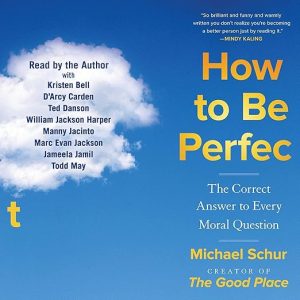
Nine performers are named in the description of this audiobook and exactly one appears in the narrator field, which is the single strongest reason to choose the recording over the page. Michael Schur, creator of The Good Place and cocreator of Parks and Recreation, reads his own guide to living an ethical life across nine hours and thirteen minutes for Simon & Schuster Audio. The description lists the rest: Kristen Bell, D'Arcy Carden, Ted Danson, William Jackson Harper, Manny Jacinto, Marc Evan Jackson, Jameela Jamil and Todd May, appearing as guests. Only Schur is credited where credits are recorded.
The rating on this listing cannot be right, and it is worth saying so plainly. The page shows 4.6 from two ratings. Two whole-star grades can only average 1.0, 1.5, 2.0 and so on up to 5.0, so 4.6 is not a value two ratings can produce. Meanwhile five written responses sit underneath a counter that says two. Something in the aggregation is broken here, which means the score tells you nothing and the written responses are the only evidence on the page worth reading.
Our Take on How to Be Perfect
Schur's premise is that moral philosophy is usable and that most of us avoid it because it arrives badly packaged. He starts with questions engineered to be easy, including whether he should punch his friend in the face for no reason, then escalates: whether great art survives its terrible creators, how much money to give to charity, why bother being good when nobody is watching. Deontology, utilitarianism, existentialism and ubuntu get explained along the way. The comic framing is a delivery mechanism rather than a hedge, and the underlying account of the positions is straight.
Self-narration by a comedy writer is a real production argument here, not a default. Schur wrote jokes intended for performers with timing, and the manuscript is built on rhythms that a neutral reader would flatten: parenthetical asides, mock-outraged escalations, footnote-shaped digressions. Jolshan, at four stars, comes at this from an unusual angle, noting familiarity with Schur's speaking voice from a podcast and finding that "this book had his same style and humor". Anthony W. Shallin's five-star note assesses the experience in three sentences: "Entertaining and educational. Fun to listen to. I didn't want it to end." Among the visible responses, that is the closest anyone comes to grading the delivery itself.
What surprised me is how much weight the book puts on failure. Schur keeps returning to the fact that trying to be good reliably produces embarrassment, inconsistency and self-justification, and he treats that as the normal condition rather than as a problem to be solved before you begin. The chapter structure reflects it: each question gets a philosophical apparatus, then a demonstration of how the apparatus breaks against an ordinary afternoon. Comedy is what makes that bearable. Without it the same material would read as a catalog of ways you are falling short, which is precisely the register that keeps most people away from ethics in the first place.
Why Listen to How to Be Perfect
Take the cast seriously as a reason. A philosophy primer performed partly by the ensemble that acted out its ideas across four seasons of television is a genuinely unusual object, and the guest appearances are advertised as a feature of this audio production specifically. Whatever your view of celebrity narration in general, here the performers have a demonstrated relationship with the material rather than an agency booking, and that changes what the reading can do with a dialogue or a thought experiment.
Accessibility is the other draw, and the responses converge on it. David Ellis describes hearing about the book on a podcast, specifically the chapter asking whether you really have to return your shopping cart, and treats that act as "the lowest bar, minimum possible thing that humans can do to make the lives of other humans better". That is what Schur does throughout: he finds the smallest available moral decision and shows you the entire apparatus of ethics sitting behind it. Nine hours spent that way leaves you with vocabulary rather than with conclusions.
What to Watch For in How to Be Perfect
Depth is the recurring reservation, and it comes from the most measured response on the page. Jolshan grants that Schur "makes digestible philosophical quandaries relatable and poignant for the average reader" but adds that "a few chapters could have been fleshed out a bit", landing on "a perfect beach weekend read". That is fair. This is an introduction that respects you, not a survey that will equip you to argue with a philosopher. Listeners who have read moral philosophy before will recognize most of the terrain and enjoy the company more than the instruction.
The comedy calibration deserves a mention too, because it is not neutral. Timeless Optimist arrived from The Good Place and describes diving into the book on that basis, later buying a physical copy to annotate; the other long response opens with an affectionate joke about a role Schur played on a different show. In both cases, prior fondness for his television work is the doorway. If that voice grates on you, nine hours of it read by the person who invented it will not improve matters, and the ethics underneath will not be enough to carry you.
Consider the shape of the argument as well, since it is less neutral than a survey would be. Schur is not presenting the schools of moral philosophy and stepping back; he has preferences, and by the later chapters they show. Virtue ethics gets a warmer hearing than strict utilitarian accounting, and the book's closing position is recognizably the one his television work has always argued: that people improve slowly, in company, by trying and apologizing. I happen to find that persuasive. A listener who does not should know it is coming rather than mistaking it for the consensus of the field.
Who Should Listen to How to Be Perfect
Start here if moral philosophy has always sounded like homework, if you loved The Good Place and want the reading behind it, or if you want a serious subject handled by someone with no interest in sounding serious. It also suits listening with other people in the car, since the chapters pose questions that generate arguments. Look elsewhere if you want rigor, primary texts, or a survey that treats comedy as an obstacle. The cast list is the argument for this edition, and it is a good one.
Quick Take
- Voice: Michael Schur reads his own book; the description names eight further performers as guests, none of whom appear in the credit field
- Big ideas: Applied ethics for ordinary decisions, deontology and utilitarianism and ubuntu explained, comedy as a teaching method
- Atmosphere: Funny, generous, unexpectedly sincere
- Worth it?: The best first book on moral philosophy for people who suspect they would hate moral philosophy.
Who narrates the How to Be Perfect audiobook?
Michael Schur reads his own text. The description additionally credits eight further voices as guest appearances in this production, drawn from the cast of the television series he created, though none of them appears in the listing's narrator field. If the ensemble is why you are buying, the description is the only place it is documented.
Do you need to have watched The Good Place before this audiobook?
No, though it plainly colors the experience. Schur explains deontology, utilitarianism, existentialism and ubuntu from scratch, beginning with deliberately absurd questions and working toward genuinely hard ones. Viewers of the show will recognize the sensibility and several voices; newcomers lose references rather than arguments.
Why does the listing show 4.6 from only two ratings?
It cannot be accurate. Averages drawn from a pool that small can only land in half-star steps, so the displayed figure is not a value two grades could produce between them. Five written responses also sit beneath a counter reporting two ratings. Read the comments and disregard the number entirely.