Quick Take
- Narration: Melanie Taylor delivers Fleming’s sardonic, urgent voice with controlled heat, the tone never tips into lecture, which is exactly right for this material.
- Themes: Systemic racism, racial literacy, intersectionality and activist accountability
- Mood: Sobering, galvanizing, occasionally wry
- Verdict: Crystal Fleming’s book is one of the sharpest entry points available for listeners who want honest, scholarship-backed analysis of American racial politics without the usual hedging.
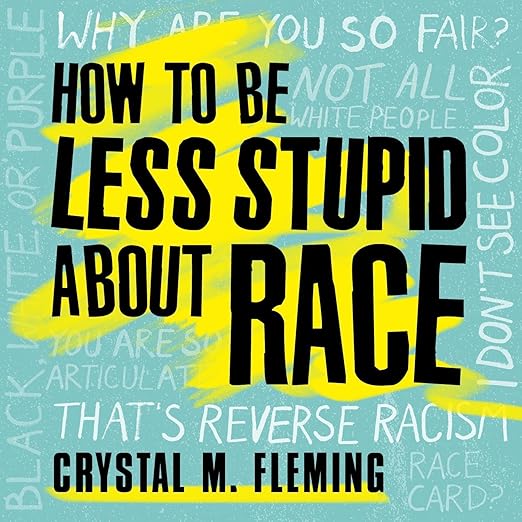
I started this one on a Tuesday evening after a day spent reading the news, the kind of news cycle that leaves you cycling between rage and exhaustion without landing anywhere useful. A sociologist writing a book called How to Be Less Stupid About Race and actually meaning it, rather than performing irreverence for a book jacket, felt like exactly the company I needed. I pressed play and did not stop until the commute home the next morning.
Crystal M. Fleming is a queer Black millennial college professor and researcher, and she writes from that specific position with complete clarity about what that position means. She is not pretending to write from nowhere. That honesty is one of the first things that distinguishes this audiobook from the crowded shelf of race-and-society titles that have proliferated over the past decade.
The Case Against Comfortable Ignorance
Fleming’s central argument is not subtle: most Americans, across racial lines, have been systematically miseducated about race, and that miseducation is itself a feature of white supremacy rather than an accident. She draws on critical race theory, interdisciplinary scholarship, and her own experience as a researcher to show how racial ignorance gets reproduced in classrooms, pop culture, media, and political discourse. The book does not treat “both sides” with false equivalence. It locates a problem, names it, and then builds the case with evidence.
What keeps this from feeling like a lecture is the voice. Fleming is funny. Not in a deflecting way, but in the way that people who have been watching absurdity long enough develop a dry, precise wit about it. One reviewer called it “breezy,” and that word is almost right, what I would say is that the writing moves, that it never gets stuck under the weight of its own seriousness, even when the subject matter demands gravity. Melanie Taylor’s narration matches this register well. She has enough warmth to carry the anecdotal sections and enough precision to make the analytical arguments land without sounding like a textbook.
What the Scholarship Actually Says
Fleming integrates interdisciplinary research in a way that is genuinely accessible without being dumbed down. She covers how systemic racism operates institutionally rather than just individually, which is the distinction that most “national conversations about race” manage to avoid. One reviewer noted the book is “short on data” in certain stretches, pointing readers toward cited works like Ibram X. Kendi’s Stamped from the Beginning for deeper statistical grounding. That is a fair point: this audiobook is not a comprehensive data review. It is a conceptual and rhetorical clearing of the ground, identifying what questions to ask and what frameworks actually explain what we see.
For listeners coming from academic backgrounds, some passages will cover familiar terrain. But the synthesis matters. Fleming is pulling together strands from sociology, history, cultural studies, and her own research into a single, coherent, listenable argument. At seven hours and forty-four minutes, it is dense without being exhausting.
The Personal Inside the Political
One of the things that reviewers keep returning to is that this book changed something in them. Multiple readers describe confronting their own biases, including their own racial biases as people of color, in ways they did not expect. Fleming is deliberate about this: she is not writing only to white audiences, and she is not positioning this as a guide for white people to follow while everyone else waits. The framework she presents is intersectional, meaning it accounts for the ways race, gender, sexuality, and class overlap in producing specific forms of oppression and specific blind spots.
Her own identity as a queer Black woman is woven through the analysis rather than segregated into a personal section. This gives the book a texture that purely academic treatments of race often lack. She is writing as someone who lives inside the systems she analyzes, which adds a layer of credibility that no amount of citation can fully replicate.
Who This Is For and Who Should Know the Limits
This is the right audiobook for listeners who feel broadly aware that racism is a structural problem but want a clearer conceptual vocabulary for explaining how and why. It is also genuinely useful for people who think racism is primarily a matter of individual prejudice, if they will listen, and that is a significant if. Fleming is not gentle about the inadequacy of that framework, but she is not contemptuous either. She is trying to get people to think differently, and the book is constructed to move them rather than simply to condemn them.
Listeners looking for a policy roadmap or a deep statistical treatment of racial disparities in specific domains will need to supplement this with other reading. Fleming gestures toward a road map for action but does not build it in detail. That is not a failure of the book, it is a signal about what this book is for. It is a clearing operation. It prepares the ground. What you build on that ground is up to you.
Available as a free audiobook on Audible with a trial, this is a title worth keeping in your library well past the first listen.
Frequently Asked Questions
Does Crystal Fleming’s book require prior knowledge of critical race theory to follow?
No. Fleming writes for a general audience and explains key concepts as she introduces them. Familiarity with CRT will deepen the listening experience but is not a prerequisite.
Is this audiobook primarily aimed at white listeners, or does it speak to listeners of all racial backgrounds?
Fleming explicitly writes across racial audiences. She addresses how systemic racism produces racial ignorance in everyone, including people of color, and her framework is intersectional rather than positioned as a guide for white readers alone.
How does Melanie Taylor’s narration handle the book’s shifts between personal anecdote and sociological analysis?
Taylor navigates the tonal shifts cleanly. The breezy, sardonic sections land with the right lightness, while the analytical passages carry enough weight without becoming monotonous over the nearly eight-hour runtime.
Several reviews mention the book is convincing but depressing, is there any sense of hope or forward movement?
Yes. Fleming explicitly frames the book as a call to action and offers a road map for translating knowledge into social change. The tone is honest about the scale of the problem but not fatalistic about the possibility of addressing it.