Quick Take
- Narration: Chris Abell reads with measured academic authority, the delivery suits Stokes’s philosophical precision without being dry.
- Themes: Epistemology of scientific knowledge, moral foundations in a naturalist worldview, self-consistency as a philosophical demand
- Mood: Dense, rigorous, and genuinely challenging
- Verdict: A philosophically serious challenge to atheist epistemology, but listeners without background in philosophy of science will find it significantly harder going than the title implies.
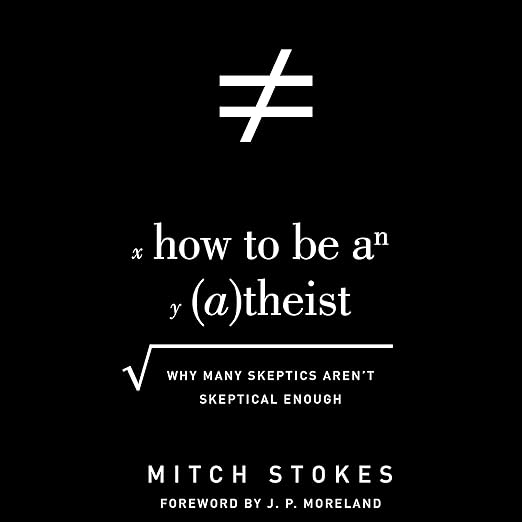
I finished How to Be an Atheist during a week when I had been listening to a lot of popular science, the kind of audiobook that speaks with absolute confidence about what science has proven and what it has not. Mitch Stokes’s book arrives as a deliberate counterweight to that confidence, and the first few chapters felt like cold water. That discomfort is, I think, the point.
Stokes trained under Alvin Plantinga and Peter van Inwagen at Notre Dame, two of the most formidable analytic philosophers working in the philosophy of religion, and then earned an MA at Yale under Nicholas Wolterstorff. That pedigree matters because it means How to Be an Atheist is not popular apologetics dressed up in academic clothing. Stokes argues with genuine philosophical precision, and he is taking aim at genuine philosophical positions, not strawmen.
Our Take on How to Be an Atheist
The book’s central move is to turn atheism’s epistemological standards against itself. Atheists, Stokes argues, correctly insist on skepticism toward religious claims, but they apply a radically different standard of scrutiny to two things they hold equally dear: science and morality. The book examines each in turn.
The science section draws on the problem of underdetermination, which holds that in principle multiple theories can explain the same data, making scientific theory selection depend on factors beyond the data itself. This is standard philosophy of science, not a fringe position. Stokes uses it to argue that the confidence with which many atheists treat scientific consensus as settled truth is epistemologically inconsistent with their own stated skepticism standards. One reviewer came away from this section believing in moral subjectivism, which suggests the argument lands with force even when it redirects rather than converts.
Why Listen to How to Be an Atheist
Chris Abell narrates with the kind of measured, academic delivery that this content requires. He does not make the philosophy more accessible than it is, which would be a disservice, but he reads clearly and without the condescension that sometimes inflects apologetics narration. At under seven hours, the book is densely packed enough that a second listen or a print companion will reveal things that a single audio pass misses.
The book’s strength is that it does not require agreement with theism to be worth reading. Stokes is not arguing that God exists; he is arguing that the epistemological foundations of confident atheism are shakier than their proponents acknowledge. That argument is interesting regardless of where you start, and it is made more carefully here than in most popular treatments of the same territory.
What to Watch For in How to Be an Atheist
One reviewer flagged this honestly: without background in physics or philosophy of science, significant portions of the book will be opaque. That is not an exaggeration. Stokes assumes fluency with concepts like underdetermination, Bayesian reasoning, and the is-ought gap. Listeners who find those terms unfamiliar will spend considerable mental energy on the conceptual scaffolding rather than the argument itself.
The book is also written from an explicitly Christian theist perspective, and Stokes’s critique has a direction. He is arguing that atheism is self-undermining, not that it is wrong because Christianity is right, but the argument is not neutral. Readers should understand what that direction is before starting. This is not a balanced survey of atheist and theist epistemology; it is an argument made by one side.
Who Should Listen to How to Be an Atheist
This book is best suited for listeners with some background in analytic philosophy or philosophy of science who want a serious engagement with the epistemological foundations of naturalism. Atheists who are confident in their positions and curious about the strongest philosophical objections to them will find it more valuable than those looking to have those positions validated. Christian apologists looking for rigorous academic ammunition will find Stokes well within their tradition’s current best arguments. General listeners curious about the atheism-theism debate but without philosophical background should start somewhere more introductory, this book will frustrate rather than illuminate without that foundation.
Frequently Asked Questions
Is How to Be an Atheist actually written for atheists, or is it aimed at Christian apologists?
The title is ironic, the book is written by a Christian philosopher who argues that atheists are not skeptical enough of their own beliefs. It is structured as an address to atheists, but its intended effect is to demonstrate internal inconsistencies in atheist epistemology. Christian apologists will find it useful; atheists who read it charitably will find it challenging.
What background knowledge does a listener need to get full value from this audiobook?
Philosophy of science basics, underdetermination, theory-ladenness of observation, Bayesian epistemology, help considerably. Ethics fundamentals, particularly the distinction between moral realism and moral subjectivism, are also relevant to the second half. Listeners without this background will follow the broad argument but miss the precision of the details.
How does this compare to other philosophical challenges to atheism, like Plantinga’s own writings?
Stokes is explicitly working in Plantinga’s tradition but writing for a broader audience. Plantinga’s own works, Warranted Christian Belief, for example, are more technically demanding. Stokes is a useful bridge between Plantinga’s academic philosophy and the general informed reader, though the gap between this book and truly popular philosophy is still significant.
Does the book address the moral argument for God’s existence, or only epistemological questions?
Stokes focuses primarily on epistemological questions, whether atheists can consistently maintain their stated skeptical standards, rather than traditional arguments for God’s existence. The morality section examines whether a naturalist worldview can ground objective moral claims, which is adjacent to the moral argument but not identical to it.