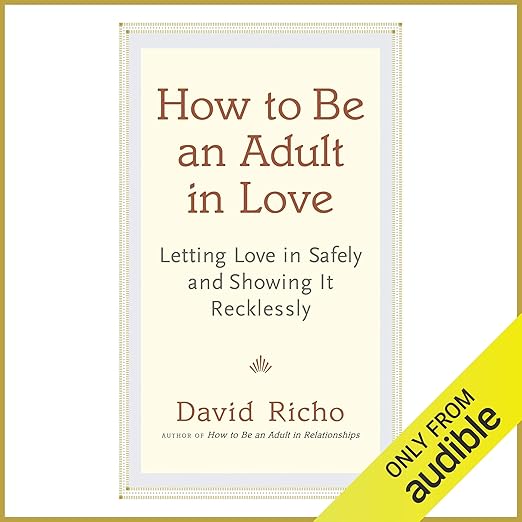
Quick Take
- Narration: Tom Pile brings a calm, steady quality that several listeners specifically mention as calming and reassuring, well matched to Richo’s contemplative material.
- Themes: Mindful loving, Buddhist-informed relationships, emotional maturity and the five A’s framework
- Mood: Warm and unhurried, like a long conversation with a therapist who has genuine faith in your capacity to grow
- Verdict: A thoughtful, practically grounded guide for anyone willing to sit with the question of what loving well actually requires.
I picked this up during a period when I was thinking hard about what I actually believe adult relationships should look like. Not what the culture tells you they should look like, not what anxious attachment or love bombing discourse says, but what the daily texture of mature love involves. I had read around in the Buddhist-adjacent self-help space before, and I was skeptical. That space can tend toward the vague and the affirming: warm without being useful. David Richo surprised me.
The book opens with a disarmingly simple claim: most of us think of love as a feeling, but love is better understood as a way of being present. That reframing, which Richo unfolds over eleven and a half hours, is the spine of everything that follows. The five A’s are Attention, Acceptance, Appreciation, Affection, and Allowing. They are not a checklist so much as a vocabulary for noticing what mature love looks like when it is actually happening, and what it is missing when it is not.
Our Take on How to Be an Adult in Love
What Richo does well, and what separates this from a great deal of relationship self-help, is that he keeps the focus relentlessly on the self rather than on the partner. The question the book implicitly asks on every page is not why the other person is not loving you correctly, but whether you are capable of giving and receiving this kind of love. That shift in orientation is subtle but it changes everything. Richo draws on Buddhist mindfulness without turning the book into a Buddhist text; the concepts are integrated rather than flagged, which makes them feel like practical tools rather than metaphysical premises you have to accept before the advice applies. The section on allowing, described as letting life and love be just as they are with all their ecstasy and ache without trying to take control, is among the most useful things I have encountered in this genre.
Why Listen to How to Be an Adult in Love
Tom Pile’s narration is a genuine asset here. Multiple listeners in their reviews note specifically that his pace and delivery feel reassuring and calm, and that is the right word: calm. Richo’s prose is itself measured and precise, and Pile honors that without adding warmth he does not have permission to manufacture. The eleven-hour runtime means the book has space to develop its ideas across many different relationship contexts, not just romantic partnerships but friendships, family dynamics, and the relationship one has with oneself. That breadth keeps the listening experience from feeling narrow, even when the core concepts are relatively compact.
What to Watch For in How to Be an Adult in Love
This is a book that benefits from being returned to. One longtime reader mentions having read it and reread it for years, finding it grows as they grow. That rings true. The five A’s framework is simple enough to memorize and dense enough to spend years actually practicing. New listeners should be aware that the track breaks in the audiobook version have been flagged by several listeners as oddly placed, which can be mildly disorienting during long listening sessions. The content itself is well organized, but the chapter navigation in this production is imperfect. It does not diminish the experience significantly, but it is worth knowing if you plan to revisit specific sections.
Who Should Listen to How to Be an Adult in Love
This audiobook rewards listeners at a particular kind of crossroads: returning to relationships after a difficult period, questioning whether the way they give and receive love is actually working, or simply curious about what a more grounded, less anxious approach to intimacy might look like. It is not for listeners who want clinical attachment theory or concrete tactical advice about dating. And it requires a willingness to sit with the premise that mature love begins not with finding the right person but with becoming a more loving one. Those who can meet it on those terms will find it genuinely useful.
Frequently Asked Questions
Do you need to be practicing Buddhism to get value from this book?
No. Richo draws on Buddhist mindfulness concepts, particularly the practice of present-moment attention, but the book is not a Buddhist text and does not require any prior interest in or commitment to Buddhist practice. The ideas are used as practical tools and are explained in accessible, secular terms.
Is this primarily aimed at people in romantic relationships, or does it address other kinds of love?
Both. While romantic love is the central context, Richo explicitly applies his five A’s framework to friendships, family relationships, and one’s relationship with oneself. The book treats the capacity for mature love as a general quality of character rather than something specific to romantic partnership.
How does the audiobook’s track structure hold up for navigation?
Several listeners have noted that the chapter breaks in this production are oddly placed and do not align well with the book’s natural sections. The content itself is well-organized, but if you plan to use the audiobook as a reference to return to specific sections, the navigation can be frustrating.
How does this compare to other David Richo titles?
Listeners who have read multiple Richo books consistently describe this as his clearest and most accessible. His other works are sometimes noted as more challenging; this one is praised for being concise and practical while maintaining the depth that characterizes his broader body of work.