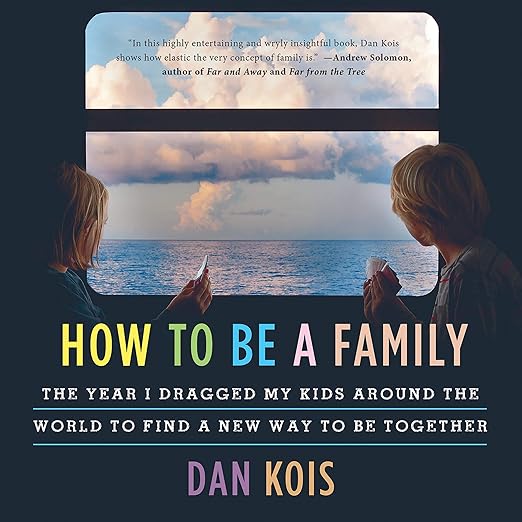
The premise of How to Be a Family sits at the intersection of travel memoir and parenting crisis, which is a well-populated genre. The D.C. suburbs father who takes his family abroad to escape the busyness and distractedness of American life has appeared before. What Dan Kois does differently is bring his journalism background to the question rather than just his feelings about it. He interviews scholars, public officials, and neighbors at each stop. He is trying to understand why the places he visits work the way they do, not just to experience them.
I listened to this while working on some tedious afternoon tasks, which is exactly the kind of half-attention that a memoir narrated by its author with genuine comedic timing can sustain. Kois reads his own work with the same energy his writing carries: quick, warm, honest about his failures, and clearly enjoying the absurdity of what he put his family through. One reviewer who described loving his culture writing for years found the book exceeded already high expectations.
The Verdict, Briefly
The four locations Kois and his family visit, New Zealand, the Netherlands, Costa Rica, and small-town Kansas, are not arbitrary. Each was chosen to test a specific hypothesis about how different environments shape family life. New Zealand for outdoor culture and physical confidence. The Netherlands for cycling infrastructure and institutional trust. Costa Rica for a different relationship to nature and community. Kansas for slowness and the knowledge that comes from a town where everyone knows your name.
His daughters, Lyra and Harper, are rendered with real affection and specificity. Witty, solitary, and extremely online Lyra is a phrase that will resonate with any parent of an older child in the 2010s. The interplay between the two girls, their distinct personalities, and their different responses to the disruption of the experiment gives the book its emotional texture. Reviewers who are parents themselves generally find this the strongest material in the memoir.
What Makes How to Be a Family Worth Hearing
Kois is unusual among travel memoirists in that he is not performing enlightenment. He does not return from each location transformed in the ways he expected. The book is honest about what the experiment cost, the logistical chaos, the marital strain that he handles somewhat elliptically (a reviewer notes he seems to be censoring the details of how the trip affected his relationship with his wife, and that that is okay), the ways in which the family took its problems with them wherever it went. That honesty, combined with his willingness to laugh at himself first, keeps the memoir from tipping into self-satisfaction.
The journalism sections are a genuine asset. When Kois interviews a Dutch public official about cycling infrastructure or talks to a Costa Rican neighbor about community, these conversations are reported rather than impressionistically rendered. They give the memoir an analytical backbone that elevates it above pure personal narrative.
What Gives Us Pause
The book is not without its critics, and their objections are worth knowing. One reviewer describes it as yet another book about a family who takes a year off in search of answers and finds the same overgeneral assumptions and blanket statements that the genre tends to produce. Another finds it boring and repetitive, arguing that after the enormous disruption of the experiment, the family comes home without meaningful answers to the questions that drove it. These are fair observations. The memoir ends in a more ambiguous place than many readers will expect, and whether that ambiguity feels honest or unsatisfying depends on what you want from the genre.
The privilege dimension of the exercise is present but not always fully interrogated. Taking a year to live in four countries with two children is not available to most American families. Kois is aware of this but his awareness is not always as thorough as the question deserves.
Should You Listen to How to Be a Family?
Parents who have wondered whether their family's busyness and disconnection is structural rather than individual, and who are curious about how other cultures organize family life, will find this genuinely interesting. Fans of literary travel writing who appreciate journalistic rigor alongside personal narrative will be well-served. Readers who have followed Kois's work at Slate will find the memoir consistent with his public voice.
Listeners who want travel memoir to deliver clear lessons or transformational arcs will find the ending underwhelming. The book asks good questions and does not arrive at satisfying answers, because Kois is honest enough to admit that a year abroad did not solve what it was intended to solve. That honesty is either the book's main virtue or its central problem, depending on what you came for.
Key Details
- Narration: Kois narrates his own memoir, and his self-deprecating warmth carries the material well, he is quickest to laugh at his own mistakes, which reviewers specifically note.
- Themes: Family dynamics vs. cultural environment, privilege and parenting, the limits of manufactured change
- Mood: Warm and journalistically observant, with an honest current of domestic tension underneath
- Verdict: A funny, thoughtful family travel memoir that asks real questions about how much our environment shapes us and arrives at answers more complicated than its premise suggests.
A Few Questions About How to Be a Family
Does this book give an accurate picture of the countries the Kois family visits?
Kois supplements his personal impressions with interviews with local experts, public officials, and residents, which gives the country sections more grounding than typical expatriate memoir. A reviewer who lived in the Netherlands for twenty-five years found his critiques rang true while also noting his romanticization. The portraits are journalistic but filtered through an American family's specific experience, which means they are partial rather than comprehensive.
Is the humor consistent throughout or does the book become more serious as it progresses?
The humor runs throughout, though the book's emotional register deepens over time. Kois narrates with genuine comedic timing and is consistently self-deprecating about his own missteps and expectations. Reviewers consistently note that he is quickest to laugh at himself, which keeps the lighter tone from feeling like avoidance of the harder questions the memoir raises.
Why does the family go to Kansas as well as three international destinations?
Kansas represents a different kind of alternative to the D.C. suburban lifestyle Kois is critiquing: a small town where everyone knows everyone, where life moves more slowly, and where community is organized differently. The Kansas sections are often considered the book's most surprising, because the insights about family and community there are as substantial as anything the international locations provide.