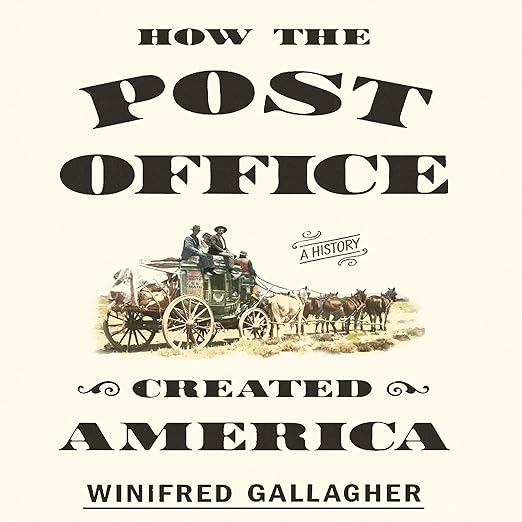
Quick Take
- Narration: Tavia Gilbert brings professional clarity and a warm authority to Gallagher’s dense historical argument, making ten-plus hours of institutional history genuinely listenable.
- Themes: Democratic infrastructure, the politics of information, American identity and communication
- Mood: Scholarly but accessible, with a building sense of how much has been overlooked
- Verdict: An unexpectedly compelling history of a taken-for-granted institution that reframes how you understand the early United States.
I will admit that the premise of this book did not immediately strike me as the most riveting way to spend ten hours. The history of the postal service. I put it on during a long drive, expecting something pleasant but forgettable. By the time I reached the third chapter, I had pulled over twice to make notes. Winifred Gallagher has written something genuinely surprising: an institutional history that reads like an argument for rethinking how American democracy actually got built.
The central claim of the book is that the Post Office was not simply an early government service but rather the foundational infrastructure of American democratic culture itself. Gallagher traces this from 1775, when the founders established the postal system before they had even finalized the Declaration of Independence, forward through two centuries of expansion, crisis, and transformation. That sequencing, the postal system before the founding documents, is the kind of detail that stops you cold.
Our Take on How the Post Office Created America
Gallagher’s argument is that the postal system was the mechanism by which 13 quarrelsome colonies were knit into a single body politic. The mandate to deliver news and information to every citizen, not just the wealthy, was a radical idea in a world where European powers carefully controlled the flow of political information. The Post Office was designed to be democratic in the most literal sense: it was how ordinary people found out what was happening and participated in the public conversation of the nation. Gallagher makes a persuasive case that this communication infrastructure, and not just the legal or military structures we typically emphasize, is what gave American democracy its particular shape.
The narrative arc extends through the development of post roads and postal villages, the role of the mail in enabling the great migration westward, the postal system’s position as America’s first major civilian employer to hire women and African Americans, and ultimately to the system’s decline in the face of digital communication. That long view gives the book a quality that pure political histories sometimes lack: a sense of how ordinary people’s daily lives were shaped by institutional decisions made far above them.
Why Listen to How the Post Office Created America
Tavia Gilbert is one of the more reliable voices in nonfiction audio, and she is well-suited to this material. Her narration manages the dual challenge of keeping dense historical argument moving while giving the more colorful episodes room to breathe. At just under eleven hours, this is a substantial listen, but the pacing is well-managed. Reviewers who describe themselves as not natural history readers report finding the book absorbing, which speaks to both Gallagher’s writing and Gilbert’s reading. The combination of a clear thesis, vivid historical anecdote, and competent narration makes for exactly the kind of nonfiction that works extremely well in audio format.
What to Watch For in How the Post Office Created America
The final chapters, which address the postal system’s decline and the question of its future role, have a slightly different register than the earlier historical material. Gallagher has clear views about the value of the institution and is not shy about expressing them, which gives the conclusion an advocacy quality that some listeners will find bracing and others will find uncomfortable. Whether you read the current state of the Post Office as a policy failure, a technological inevitability, or both will shape how you receive the final argument. The historical sections before that point are, by contrast, admirably even-handed.
Who Should Listen to How the Post Office Created America
This is an excellent choice for listeners who are curious about the infrastructure of democracy and want something that goes beyond the usual founding narratives. American history readers who think they know the broad outlines of the early republic will find here a perspective that reorients the familiar material. It is also genuinely useful for anyone thinking about the relationship between communication infrastructure and democratic culture in the digital era. The parallels Gallagher draws between the early postal system and contemporary debates about information access are not labored, but they are hard to miss.
Frequently Asked Questions
Is this book primarily political history, or does it cover social and economic dimensions too?
Gallagher explicitly frames the Post Office as a political, social, economic, and physical force in American development. All four dimensions are present throughout the book, not just the legislative and administrative history.
How much of the book covers the modern postal service versus the historical development?
The majority of the book covers the period from 1775 through the early twentieth century. The modern era and the question of the Post Office’s future occupy the final portion of the book, perhaps the last fifteen to twenty percent.
Does Tavia Gilbert’s narration handle the names, dates, and policy detail clearly?
Yes. Gilbert is experienced with complex nonfiction and manages the density of historical detail without losing narrative momentum. Reviewers consistently praise the narration as clear and authoritative.
Do I need prior knowledge of American history to follow the book’s argument?
No. Gallagher provides enough context that the book functions as a standalone history. Readers with existing knowledge of the founding period will have a richer background, but the book is not written for specialists.