Quick Take
- Narration: Barrett Whitener delivers Thomas Woods’s scholarly argument with the authority and measured pace the material requires; academic history in audio handled exactly right.
- Themes: The Church’s role in science and universities, correcting historical revisionism, medieval civilization
- Mood: Authoritative and somewhat polemical, more confident than neutral
- Verdict: A well-researched corrective to reductive secular narratives about the medieval Church, though readers should be aware of its apologetic framing from the outset.
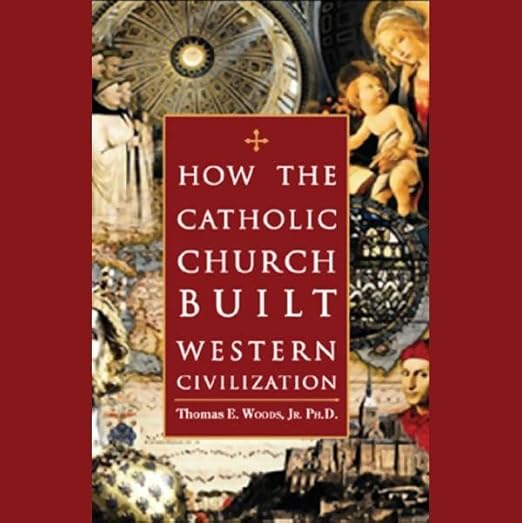
I studied medieval literature as part of my degree, which meant spending a fair amount of time in proximity to medieval history and the Church’s role in it. The standard secular university treatment of this material leans heavily on a particular narrative: the Church suppressed science, burned heretics, and generally stood in the way of human progress until the Enlightenment arrived to rescue reason from faith. Thomas E. Woods Jr. has spent considerable energy arguing that this narrative is historically inaccurate, and this audiobook is his most comprehensive attempt at the case. He is not wrong about the inaccuracies. But readers should know from the first chapter that this is an argument, not a dispassionate survey.
The book was published in 2005 and has found a consistent readership across two decades, which is notable for a work of popular history. Its 4.7 rating across nearly 850 reviews reflects genuine reader satisfaction. Woods is a prolific author and a professor, and his scholarly apparatus is visible throughout; he cites sources, acknowledges counterarguments, and builds his case methodically rather than rhetorically. This is not a polemical screed. It is a considered argument, and it deserves to be engaged as such.
The Science Chapter and What It Corrects
Woods devotes significant space to the relationship between the Catholic Church and the development of natural science, which is where the most common misconceptions cluster. The chapter on Catholic contributions to astronomy is particularly strong; reviewer Vital specifically praised its handling of the Church’s actual response to Copernicus and heliocentric theory, which was considerably more complex and supportive than the popular shorthand of Galileo’s trial suggests. Woods makes the case that the fundamental assumption underlying modern science, that nature operates according to rational laws discoverable through investigation, is itself a product of the Church’s theological conviction that a rational God created a rational universe. This is a legitimate historiographical argument made by secular historians as well as Catholic ones, and Woods handles it with appropriate care.
The chapter on the founding of universities is similarly grounded in fact that often surprises listeners unfamiliar with medieval history. The university as an institution was a medieval invention, and its early development was inseparable from Church patronage and theological purpose. Reviewer bookscdsdvdsandcoolstuff, writing in 2009, noted that for anyone who has kept even tangentially abreast of medieval studies, the facts are not surprising; but their importance lies in making them accessible to the general reader who has encountered only the popular version of this history.
What Barrett Whitener Brings to the Material
Whitener’s narration is steady and authoritative without becoming stiff. At seven hours, this is a moderately dense academic history, and Whitener manages the balance between scholarly rigor and accessible delivery competently. The book is organized thematically, science, universities, economics, law, art, and the chapters function as self-contained arguments that Whitener presents cleanly. The material does not have the dramatic pull of narrative history, and Whitener makes no attempt to impose drama where Woods has not placed it. This is the right call. The book’s authority comes from its evidence, not its affect, and a narrator who tried to make the material more exciting would reveal its limits rather than its strengths.
The Honest Limits of a Selective Argument
Reviewer Justin Robinson, writing from Canada, described it as an intriguing look that works for Christians and non-Catholics alike, and that framing is accurate with one qualification: Woods’s argument is strongest when it is correcting demonstrably false claims about the Church’s historical record. It is less persuasive when it moves from correction toward celebration. The Church’s record is not uniformly positive, and Woods’s focus on institutional achievement means that the significant harms, the Inquisition, the treatment of Jews and heretics, the abuses of power that drove the Reformation, are not given equivalent attention. That selective focus is appropriate given the book’s stated purpose, but readers who want a complete picture should supplement this with other sources.
Two Decades On and Why the Argument Still Matters
In 2025 and 2026, the popular narrative about religion and science has not fundamentally changed from what it was when Woods published this book. The same oversimplifications circulate on social media, in popular history documentaries, and in the cultural water supply generally. That durability of the myth is exactly why a book like this continues to find readers: the corrective is still needed, and Woods provides it in a format that is accessible to anyone willing to follow an argument for seven hours. As reviewer James E. Egolf noted, writing as a non-Catholic, the case Woods makes is compelling that Western civilization could not have thrived without the achievements of the Catholic Church over two thousand years. Whether you accept that framing entirely or hold it at some analytical distance, the factual material is worth knowing, and the audiobook format makes it available to listeners who would never sit down with a monograph on medieval institutional history.
One dimension of the book that deserves separate mention is its treatment of economic history. Woods devotes a chapter to the argument that the roots of modern free-market economics lie in the moral philosophy developed by the School of Salamanca in sixteenth-century Spain, a group of Dominican scholars who worked out fundamental concepts of price theory, just exchange, and property rights within a Catholic theological framework. This is a less well-known argument than the science chapter, but it is in some ways more interesting, because it challenges the standard narrative in which modern economics developed entirely in opposition to religious thinking. Reviewer Vital noted the book’s capacity to correct false information that dominates the internet and modern textbooks; the economics chapter is perhaps the best example of that corrective function, addressing a gap in popular knowledge that most listeners will not have known existed.
Frequently Asked Questions
Is this audiobook suitable for non-Catholics, or does it assume the listener already holds Catholic beliefs?
Woods argues from historical evidence rather than faith claims, and several reviewers noted that the book works for non-Catholics and even non-Christians. The argument is about institutional history. That said, the selection of evidence is shaped by an apologetic purpose that attentive listeners will notice.
How does Barrett Whitener handle a seven-hour academic history without losing listener engagement?
He keeps the pacing measured and the delivery clear, letting the quality of the evidence carry the engagement. This is not a book where narration provides the excitement; the material does the work, and Whitener serves it rather than competing with it.
Does the book address the Galileo affair and the Inquisition, or does it avoid the most controversial aspects of Church history?
Woods engages with the Galileo affair directly, arguing that the popular version significantly distorts what actually happened. The Inquisition receives less attention. The book’s focus is on the Church’s constructive contributions, and the counterarguments are largely left to other sources.
Has the scholarship in this 2005 book been superseded by more recent work in medieval history?
The core arguments have not been fundamentally overturned. The historiographical case for the Church’s role in the development of science and universities is mainstream in medieval studies, even if Woods’s framing is more celebratory than most academic treatments. The book remains a useful popular summary of that scholarship.