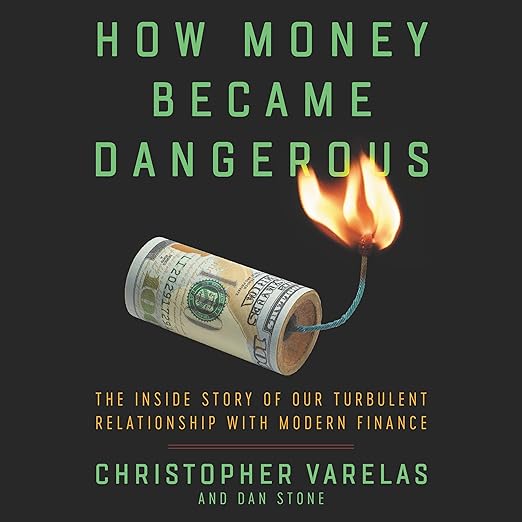
Quick Take
- Narration: Roger Wayne delivers Varelas's insider anecdotes with appropriate authority and a conversational ease that keeps nearly fifteen hours of financial history engaging.
- Themes: the dehumanization of Wall Street, the gap between financial insiders and ordinary Americans, the case for structural reform
- Mood: Illuminating and occasionally infuriating, told with the confidence of someone who was in the room
- Verdict: A surprisingly personal and entertaining history of how American finance lost its relationship with Main Street, strongest when Varelas lets the anecdotes do the argument.
I started How Money Became Dangerous expecting another Big Short-adjacent polemic and got something considerably more interesting: a memoir-inflected history from someone who was actually inside the rooms where the decisions were made. Christopher Varelas spent decades at the highest levels of investment banking, from the Salomon Brothers trading floor to the center of the technology boom, and this book is his attempt to account for how a financial system that once served ordinary Americans became something most of them could no longer understand or trust.
Roger Wayne narrates, and he is the right fit. Varelas writes with what one reviewer called a great turn of phrase and genuine humor, and Wayne delivers that register, conversational and authoritative without being condescending, throughout nearly fifteen hours of material that could have become exhausting in less capable hands. The pairing of an insider voice with a narrator who keeps the anecdotes moving rather than dwelling makes the runtime feel manageable.
Our Take on How Money Became Dangerous
The book's structure moves chronologically through the transformation of American finance from the 1980s onward. Varelas traces the journey from the crime-ridden LA jewelry district of his early career through the Salomon Brothers trading floor, through the municipal bankruptcies of Orange County and Stockton, California, through the technology boom, building a case for how financial complexity became a kind of weapon against the public it was ostensibly designed to serve. The argument is not that Wall Street is populated by villains. It is more unsettling than that: the system dehumanized itself by degrees, through incentive structures and abstraction, until the human consequences became invisible to the people making the decisions.
Why Listen to How Money Became Dangerous
What makes this book work as an audio experience is the anecdotes. A reviewer who compared it favorably to Barbarians at the Gate and Liar's Poker described finishing the book in one sitting and noted its potential to influence the next generation of financiers. Another described it as an inside view from a top-level financial executive whose firsthand involvement in events like the Orange County bankruptcy gives the narration weight that purely academic finance books cannot match. The humor is real: Varelas earned multiple descriptions of laugh-out-loud moments from readers who were not expecting to find the subject funny. Wayne delivers those moments without overplaying them.
What to Watch For in How Money Became Dangerous
One reviewer's critique cuts to a genuine tension in the book: because Varelas is an insider, he struggles to paint a fully unflattering picture of the industry he spent his career in. The same reviewer noted that the book sugarcoats some of what the industry did to the American economy in the twentieth century's closing decades. That is a fair observation. This is not Michael Lewis writing from the outside with prosecutorial intent. It is someone who made a career inside the machine trying to explain how the machine works and why it went wrong, and those two positions create some friction. Listeners who want harder critiques of Wall Street will find this more sympathetic to finance than they might prefer.
Who Should Listen to How Money Became Dangerous
This is a strong listen for anyone who wants to understand the history of American finance from the 1980s through the early 2000s through the perspective of a thoughtful participant. Readers who loved Liar's Poker or The Big Short and want more insider texture will find plenty here. Business school listeners and finance professionals looking for historical context and genuine moral reflection on the industry will also find it rewarding. Listeners seeking a more confrontational or journalistic account of Wall Street wrongdoing should look elsewhere, as Varelas is ultimately invested in arguing that the system can be salvaged rather than indicting it wholesale. That measured, reform-minded position is both the book's core limitation and its most distinctive contribution to the ongoing conversation about what genuine financial reform from within the industry could actually look like.
Frequently Asked Questions
How does How Money Became Dangerous compare to Liar's Poker or The Big Short as an account of Wall Street?
It is more memoir-inflected and less adversarial than either of those books. Varelas writes from inside the industry rather than from the outside looking in, which gives his anecdotes authenticity but also means the critique is more measured. Readers who loved the prosecutorial energy of Lewis's work may want to calibrate expectations.
Do I need a finance background to follow the material?
No. Varelas writes for a general audience and explains industry mechanics through personal stories rather than technical exposition. The book is explicitly framed as accessible to readers who are not in the financial sector, and multiple reviewers from outside finance found it enlightening.
Does the book cover the 2008 financial crisis?
The book covers the broader transformation of American finance through the technology boom and its aftermath, touching on structural forces that contributed to 2008. It is not specifically a book about the crisis but about the longer arc of financialization that made the crisis possible.
At nearly fifteen hours, does How Money Became Dangerous sustain its momentum?
Most reviewers found it sustaining, with the anecdote-driven structure preventing the material from becoming dry. Roger Wayne's narration keeps the pace moving. The final section, which makes the case for reforming Wall Street culture, is more prescriptive and less narrative-driven than the earlier chapters.