Quick Take
- Narration: Pollak’s self-narration is a natural fit, he’s a professional impressionist and storyteller, and the anecdotes land with the timing of someone who has workshopped them live; the Walken, Nicholson, and Falk impressions are performed in full.
- Themes: Hollywood friendship and rivalry, comedic apprenticeship, the shape of a versatile mid-tier career
- Mood: Breezy and candid, like a long conversation with someone who’s been in every room
- Verdict: A Hollywood memoir that earns its affection through genuine humility and a talent for the vignette rather than manufactured revelation.
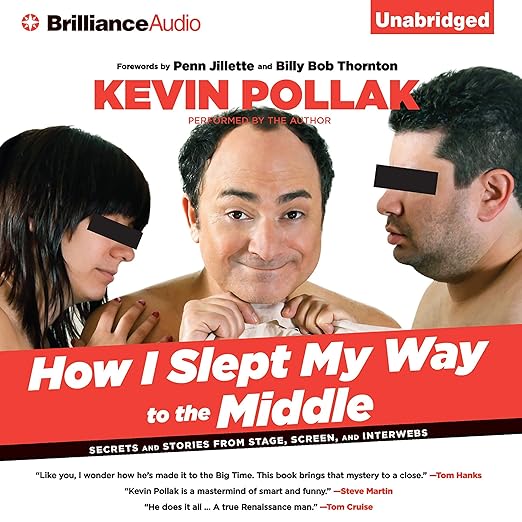
I put this on during a long drive and arrived at my destination having entirely forgotten I was supposed to feel tired. That is the particular skill of Kevin Pollak as a storyteller: he is relentlessly listenable in a way that his film career, impressive as it is, only partially communicates. The comedic timing that made him a standout in A Few Good Men and The Usual Suspects operates at full speed when he is narrating his own life, and How I Slept My Way to the Middle is the best possible format for it.
The title sets expectations accurately. This is not the memoir of someone who became the biggest star in any room. It is the memoir of someone who became one of the most reliable people in those rooms, who built a career on being genuinely excellent in ensembles, and who had the good fortune to do so while surrounded by people whose stories he was smart enough to watch closely and remember precisely. The Audie Award Finalist recognition for Humor in 2014 reflects the audiobook’s particular quality: this material is funny in a way that print would only partially capture.
Watching Don Rickles Work From the Floor Up
The comedy club years, watching Rickles and Cosby and Carson from the floor up, establish the memoir’s most useful frame. Pollak is honest about what he absorbed and how he absorbed it. The business of comedy, the mechanics of the Tonight Show couch strategy, the calculus of when to say no in order to say yes to something better, is covered with the clarity of someone who has thought carefully about craft. His decision to decline his first Tonight Show stand-up invitation because he knew he would make a larger impact sitting on the couch next to Johnny is the kind of move that reads as either delusional or prescient, and Pollak is smart enough to acknowledge it could have been either.
Comedy Central’s designation as one of the Top 100 Stand-Up Comedians of All Time gives the career context that the modest title somewhat obscures. This is not a minor figure reflecting ruefully on roads not taken. This is someone who was consistently in proximity to the most significant entertainment figures of the last four decades, paying close attention and finding ways to be useful.
The A-List Vignette Structure
The book’s architecture is vignette-driven, and reviewers consistently identify this as its strength. How he brought John Belushi to his knees. The Paul Reiser incidents, which apparently happened twice and apparently merited separate chapters. The Larry King bamboozle. The Warren Beatty near-fatality. The Robert De Niro girlfriend detail, which arrives in the synopsis with the confidence of someone who knows it is the most arresting item in a list. And then Rip Torn, described in terms that suggest genuine conviction, which Pollak delivers in narration with the specificity of an unresolved Hollywood experience.
One reviewer draws a comparison to David Niven’s The Moon Is a Balloon and Bring On the Empty Horses, which is the most useful frame I have encountered for this book. Niven, like Pollak, was a figure of considerable talent and charm who existed in proximity to larger stars and documented those adjacencies with affection and precision. The comparison is not overreach. Pollak writes about people he admired in the way Niven wrote about people he admired: generously, specifically, and without the resentment that sometimes colors memoirs by performers who feel undervalued.
The New Media Section and What It Reveals
The final portions cover his emergence as what the synopsis calls a new media entrepreneur, and his Kevin Pollak’s Chat Show predates many of the long-form interview formats that now dominate podcast culture. This section is less gripping than the Hollywood anecdotes, partly because it lacks the cast of legends and partly because internet history ages less gracefully than showbiz history. But it reflects something genuine about how Pollak has understood his own career: as a series of pivots toward formats that reward the specific skills he possesses rather than chasing the formats that happen to be culturally dominant.
The 8 hours and 4 minutes pass without obvious drag. The structure is loose enough to feel conversational while still maintaining the forward motion of a career narrative. This is not a literary memoir. What there is, in abundance, is a very skilled entertainer performing his own life story in the format in which he is most comfortable.
Who Should Listen and Who Should Skip
Listen if you enjoy Hollywood memoir with genuine comedy experience behind it, if you are interested in the mechanics of a long and varied entertainment career, or if you find the behind-the-scenes texture of film and television more compelling than the films and television themselves. The impressions are in here and they are done properly.
Skip if you are looking for a book with literary ambition or for revelatory industry criticism. Pollak is not interested in burning bridges or delivering verdicts on the industry. He is interested in telling good stories, and in this format, that is more than enough.
Frequently Asked Questions
Does Pollak actually perform his famous impressions during the narration, or does he just describe them?
He performs them. The Walken, Nicholson, and Falk impressions appear within the narration as they arise in context. This is a significant reason why the audiobook format is superior to the print version for this particular material.
How much of the book deals with specific film projects like The Usual Suspects and A Few Good Men?
There are chapters on several major projects, but the focus is always on the human dynamics and behind-the-scenes texture rather than craft analysis. Fans of those films will find new angles on them without the book becoming a film-by-film commentary.
The title suggests self-deprecation, is the book actually humble or is it false modesty?
Genuinely humble by Hollywood memoir standards. Pollak consistently frames his success in terms of timing and proximity to greatness rather than innate genius. Reviewers note this reads as authentic rather than performed.
Is the Rip Torn material given extended treatment or just used as a punchline?
It functions partly as a running joke and partly as a genuine character study of someone Pollak clearly found baffling. The detail and persistence of the Torn material across several chapters suggests it occupies a specific place in his catalog of unresolved Hollywood experiences.