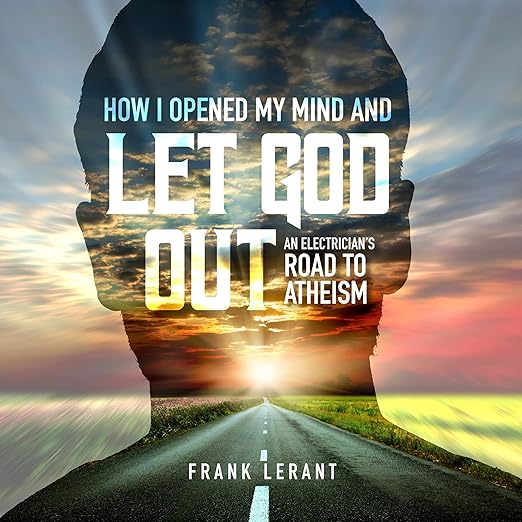
Quick Take
- Narration: Frank Lerant narrating his own work gives the book an unmistakably personal quality, conversational, sometimes circling, but never detached.
- Themes: Deconstruction of monotheism, philosophical inquiry into faith and reason, the social function of organized religion
- Mood: Intellectually combative but not hostile, like a long conversation with a friend who has done more research than you
- Verdict: A genuinely conversational case for atheism that avoids the condescension common to the genre, though listeners seeking rigorous academic philosophy will want to supplement it.
What struck me first about How I Opened My Mind and Let God Out is its origin story. Frank Lerant did not set out to write a book. He spent six months in a debate with a religious fundamentalist at work, which led to years of personal research, which eventually produced this. That biographical arc matters, because it shapes everything about how the book sounds. This is not an academic dismantling of theology. It is a record of one person’s intellectual journey, which makes it more honest in some ways and less rigorous in others.
The audiobook is notable for the fact that Lerant narrates his own work. That choice is either a feature or a limitation depending on what you bring to it. He does not have a trained narrator’s delivery, but he has something that professional narrators cannot manufacture: the quality of a person who actually lived through the thinking the book describes.
Our Take on How I Opened My Mind and Let God Out
The book’s ambition is to pick apart the three great monotheisms, Christianity, Islam, and Judaism, using their own texts, world history, philosophy, and thought experiments. Lerant moves through these with the enthusiasm of someone who found something hidden in plain sight and cannot believe more people haven’t noticed. At its best, this produces passages that are genuinely illuminating. Reviewer “Amazon Customer” noted expecting the book to be “preachy and lacking in dimension” but finding instead that it “covered a lot of topics I hadn’t ever read about” and was “so much more nuanced than that.” That is a meaningful endorsement from someone who went in skeptical.
One reviewer with a theological background noted after finishing that while they did not come away having abandoned belief in a higher power, the book left them “reconsidering a lot of ingrained beliefs.” That outcome, reshaping rather than replacing, seems to reflect what the better atheist-oriented books actually accomplish, and Lerant deserves credit for producing something with that kind of reach.
Why Listen to How I Opened My Mind and Let God Out
The self-narration is genuinely the right call here. Lerant’s delivery is conversational to a fault, which means the ideas arrive the way they might in an extended dialogue rather than in a lecture. Reviewer Sheena observed that “you get to know the author from a perspective where you don’t feel that he is here to ‘save you’ or to force you to any change,” and the narration creates exactly that quality. There is no evangelical fervor in how Lerant reads his own material, which is notable for a book about leaving evangelical certainty behind.
At seven hours, the runtime gives Lerant room to develop his arguments across multiple religious traditions without feeling rushed. The pacing is loose in the way that personal essays are loose: it follows thought rather than outline, which means some sections are more tightly argued than others. For listeners who prefer linear argumentation, this can feel discursive. For listeners who find formal nonfiction stiff, this will feel alive.
What to Watch For in How I Opened My Mind and Let God Out
Reviewer Judy T offered a useful framing: the book is “well worth reading, whether one is a believer in God and the Bible or not.” That is the right spirit in which to approach it. But listeners should know that Lerant’s research, while genuinely broad, is that of an autodidact rather than a scholar. Reviewer S recommended pairing the book with works by Thomas Aquinas, C.S. Lewis, and Eleonore Stump for anyone wanting the counterarguments developed to equal depth, and that is sound advice. Lerant represents one side of a conversation that is richer with more voices.
The book’s tone is declarative without being contemptuous, which sets it apart from some atheist writing that tends to treat believers as simply uninformed. Lerant seems genuinely curious rather than dismissive, which is a harder position to maintain across seven hours than it sounds.
Who Should Listen to How I Opened My Mind and Let God Out
This is best suited for listeners who are already questioning organized religion and want company in that process rather than a textbook guide through it. It works well for people who have found Christopher Hitchens and Richard Dawkins too strident or too academic, and want something that sounds more like a neighbor who has been doing a lot of reading. Committed religious believers who approach the book in an open spirit will find it thought-provoking even where they disagree. People who want rigorous academic theology or philosophy should look elsewhere. Lerant’s strength is accessibility and sincerity, not scholarly depth.
Frequently Asked Questions
Does Frank Lerant’s self-narration hurt the audiobook’s listenability?
It depends on your expectations. He is not a polished narrator, and his delivery is conversational and occasionally repetitive. But there is an intimacy to a person narrating their own intellectual autobiography that works in the book’s favor overall.
Which religions does the book focus on, and does it treat them equally?
Lerant examines all three Abrahamic monotheisms, but Christianity receives the most attention, which reflects both the author’s background and his primary audience. The treatment of Islam and Judaism is less detailed by comparison.
Is this book hostile toward religious believers, or can a believer get something from it?
Multiple reviewers who identify as believers found the book valuable without abandoning their faith. Lerant’s tone is genuinely inquisitive rather than contemptuous, which makes engagement across belief positions more possible than in much atheist-oriented writing.
How does this compare to more famous atheist texts like Dawkins or Hitchens?
It is less rigorous academically and less combative in tone than either. Lerant is closer to a personal essay than a philosophical polemic. Listeners who found Dawkins or Hitchens alienating in style may find Lerant more approachable; those who found them too mild will want more than Lerant offers.