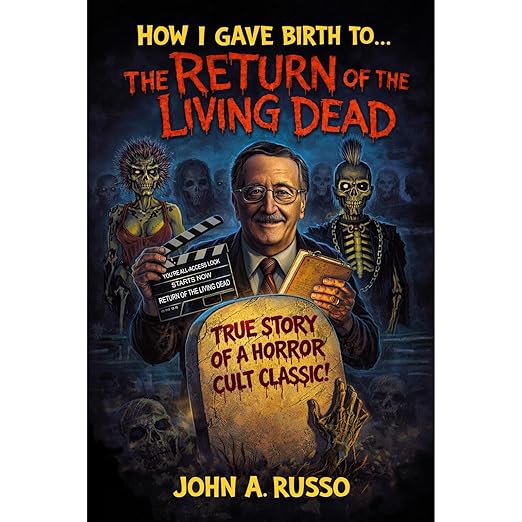
Pittsburgh's low-budget horror scene changed cinema forever in 1968, when a handful of independent filmmakers with almost no money made Night of the Living Dead and accidentally invented the modern zombie. The How I Gave Birth to the Return of the Living Dead audiobook is co-creator John A. Russo's own account of what happened next: a thirteen-year fight through studio politics, legal disputes over who owned the right to keep telling undead stories, and even a financing deal that briefly involved Frank Sinatra's organization before falling apart, all in pursuit of what eventually became The Return of the Living Dead.
The most interesting thing this short memoir does is explain a split that shaped horror movies for the next fifty years. After Night of the Living Dead, Russo and his co-creator George Romero went separate creative directions, a divide that eventually produced two entirely different zombie franchises from the same original film, Romero's own Dead series on one side, and Russo's path toward Return of the Living Dead on the other. Listeners who grew up on one franchise without knowing much about the other will likely find this the most genuinely illuminating part of the whole book.
Reviewer Dale C calls Russo one of horror's unsung masters and praises how the book covers the full arc from Night of the Living Dead's inception through Return's eventual release, describing Russo as full of entertaining stories that he puts to paper very well. That assessment lines up with the synopsis's own framing: colorful stories, industry insights, and personal reflection rather than a dry production history.
The commercial zombie genre that eventually produced The Walking Dead, World War Z, and dozens of other franchises traces its DNA directly back to the creative choices Russo and Romero made on that first film and the split that followed. Understanding that single, low-budget Pittsburgh production as the actual root of an entire modern entertainment category, rather than just one influential old horror movie among many, reframes how significant Russo's account of his own thirteen-year follow-up struggle really is. Russo's decades in the industry, stretching from that first Pittsburgh production through his own later production work, give him a genuinely wide lens on how independent horror filmmaking actually operates behind the scenes.
A Synthetic Voice for Warmly Conversational Stories
This is delivered through Virtual Voice, Amazon's AI narration, and the fit here is more uneven than it would be for purely instructional nonfiction. Russo's book is explicitly personal, colorful anecdotes, candid industry battles, one-on-one recollections of specific studio meetings, and that kind of warmly conversational memoir writing depends heavily on vocal warmth and timing to land its personality. A synthetic voice reading Russo's own war stories about near-miss Hollywood deals and bizarre industry encounters is a real trade-off worth knowing about going in, even though the underlying content holds up well on its own.
One genuinely interesting piece of trivia worth knowing before listening: Night of the Living Dead famously fell into the public domain almost by accident, after the distributor changed the film's title and neglected to include the required copyright notice on the new prints. That small, real error is a large part of why the film became so culturally ubiquitous, endlessly rebroadcast and referenced for free, and it is exactly the kind of behind-the-scenes detail this memoir seems built to deliver.
Firsthand memoirs from independent filmmakers who lived through this specific, chaotic era of genre filmmaking, before major studios treated horror as a reliable commercial category, are genuinely rare, since most of the people involved in scrappy 1970s and 80s productions never wrote their stories down at all. That rarity is part of what gives a short, self-published account like this one real value beyond its runtime, even filtered through a synthetic narrator.
One Detailed, Enthusiastic Review to Go On
At just one hour and twenty-three minutes, this is a short listen by any measure, and prospective buyers should calibrate their expectations accordingly: this is a focused personal account of one specific creative journey, not a comprehensive history of the zombie genre or an academic film study. Given the short runtime, the flat pacing of Virtual Voice narration is less likely to become fatiguing than it might over a much longer memoir.
Only one listener review is currently attached to this title, a small sample to judge reception by, though that single review is detailed and enthusiastic. Horror fans specifically interested in Pittsburgh's independent film scene or in the Romero-Russo split will get real value here even from a short runtime, since the material is dense with specific, verifiable industry history rather than padded out with generalities.
Prospective listeners should also know this arrives from a small or self-published imprint rather than a major audiobook publisher, consistent with its short runtime and Virtual Voice narration. That production scale does not diminish the credibility of Russo's own firsthand account, he lived every part of the story he is telling, but it does mean the polish and pacing choices available to a bigger-budget audio production simply were not part of how this one was made.
A Case Study in Financing Outside the Studios
Horror history enthusiasts, independent filmmaking fans, and anyone who has ever wondered why two seemingly unrelated zombie movie franchises trace back to the same 1968 film are the clearest audience for this one. Reviewer Dale C's enthusiasm suggests genre fans specifically will get the most out of Russo's firsthand insider account.
Skip this if you want a broad overview of zombie cinema history rather than one filmmaker's specific account of a single, hard-fought creative journey. For horror completists and Night of the Living Dead devotees, though, this short audiobook delivers a level of firsthand detail that a general history could not.
It is also worth a listen for anyone interested in independent film financing specifically, since Russo's account of chasing funding, including the brief and ultimately failed connection to Frank Sinatra's organization, doubles as a candid case study in exactly how difficult it was to finance genre film outside the studio system in the 1970s and 80s. That is a more specific and useful lens than horror history alone suggests.
At a Glance
- Narrator: Virtual Voice's flat AI delivery is a real trade-off against this warmly personal memoir's colorful, conversational material.
- Subjects: independent horror filmmaking, the Romero-Russo creative split, zombie genre origins
- Tone: Candid, nostalgic, and dense with real industry detail
- Bottom line: A short, genuinely illuminating listen for horror history fans, worth trying despite the synthetic narration's limits.
Before You Listen
Does the audiobook explain the split between John A. Russo and George Romero after Night of the Living Dead?
Yes, this creative and legal split, which eventually produced two separate zombie franchises, is a central thread of Russo's account and likely the book's most broadly illuminating detail.
How long is the How I Gave Birth to the Return of the Living Dead audiobook?
About one hour and twenty-three minutes, a short, tightly focused listen built around one filmmaker's specific thirteen-year creative journey rather than a comprehensive genre history.
Is Virtual Voice AI narration a good fit for this memoir audiobook?
It is a mixed fit. The short runtime limits fatigue, but Russo's warmly personal, anecdote-driven writing depends on vocal timing that synthetic narration cannot fully replicate.
Do I need to have seen Return of the Living Dead or Night of the Living Dead before listening?
No, though familiarity helps. Russo's account is self-contained enough to follow without having seen either film first, since he explains the key context as he goes.