Quick Take
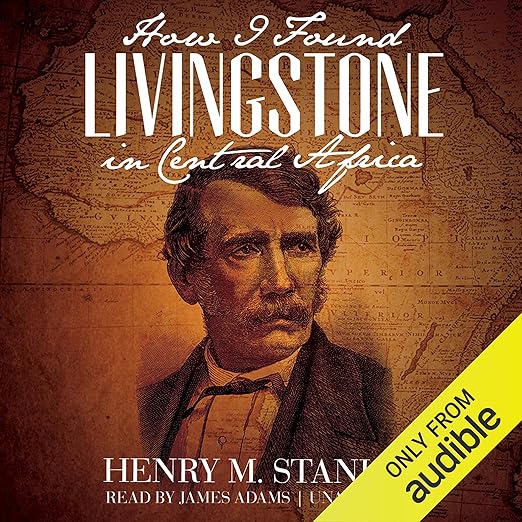
- Narration: James Adams delivers Stanley’s 19th-century prose with measured authority, handling the period verbosity without losing the underlying urgency of the expedition.
- Themes: Imperial-era exploration, journalistic obsession, colonial encounter
- Mood: Expansive and archaic, occasionally exhausting but historically rich
- Verdict: Essential primary-source listening for anyone serious about Victorian-era African exploration, with the caveat that Stanley’s worldview requires active critical engagement.
I was halfway through a long Saturday walk when James Adams’s voice brought Stanley’s opening dispatches from Zanzibar alive in my ears, and I stopped moving entirely. There is something profoundly strange about listening to a nineteenth-century journalist narrate his own obsession in real time. Henry Morton Stanley did not write this as history. He wrote it as journalism filed from the edge of the known world, and that urgency survives the century and a half between his pen and our headphones.
How I Found Livingstone in Central Africa was published in 1872, based on Stanley’s 1871 expedition commissioned by the New York Herald. His editor George Gordon Bennett sent him with a simple and nearly impossible brief: find David Livingstone, who had been missing for years and was variously presumed dead, in distress, or simply avoiding contact. What Stanley produced was not just a travel narrative but a document of encounter, endurance, and a particular kind of imperial ambition that cannot be extracted from the text without distorting it beyond recognition.
Our Take on How I Found Livingstone in Central Africa
The range of listeners who have come to this recording reflects the text’s strange durability. One reviewer called it an educational account of nineteenth-century Africa. Another arrived via a television expedition that retraced Stanley’s route and found the original so compelling they needed to hear it firsthand. Both responses get at something real: this is a book that rewards multiple registers of interest. You can approach it as adventure narrative, as anthropological document, as journalism history, or as a case study in what the Victorian explorer projected onto the continent he traversed.
At nearly sixteen hours, it is long. The 19th-century verbosity noted in reviews is genuine. Stanley’s prose is dense, digressive, and occasionally interminable in passages that catalogue tribal customs, river measurements, and the precise inventory of trade goods. But those passages are also where the text becomes irreplaceable as a historical document. The detail that makes it slow also makes it specific. This is not compressed retrospective memoir; it is the contemporaneous record of a man trying to make sense of what he is seeing in real time.
Why Listen to How I Found Livingstone in Central Africa
The famous meeting, when it comes, is almost anticlimactic in the text. The line everyone knows, the presumptuous greeting that became a cultural shorthand for centuries of exploration rhetoric, arrives in context as a small, almost embarrassed moment between two men who have both traveled enormous distances to stand in a village on the shores of Lake Tanganyika. Stanley handles it with a curious formality that reads, on close attention, as self-consciousness. He knew it would be quoted. He wrote it accordingly.
James Adams is a judicious narrator for this material. He does not romanticize the prose or impose false drama onto Stanley’s driest passages. He reads the period diction as period diction, which means listeners comfortable with 19th-century prose rhythms will find him excellent, and listeners expecting modern thriller pacing will struggle. The audio format actually helps with the more verbose sections, since Adams’s measured delivery gives the dense paragraphs room to breathe in a way that reading silently can feel suffocating.
What to Watch For in How I Found Livingstone in Central Africa
Stanley’s characterizations of the African peoples he encounters are filtered entirely through a lens of imperial presumption. He describes nations and individuals with the taxonomic certainty of someone who believes his own civilization is the measure of all others. Modern listeners will find this uncomfortable in ways that go beyond mere historical distance, and they should. The text is simultaneously a firsthand source of enormous value and an argument for why Africa was misrepresented by the very explorers who claimed to be illuminating it. Engaging with that tension is part of the work of listening here. Treating it purely as adventure narrative flattens something that deserves more careful attention.
Who Should Listen to How I Found Livingstone in Central Africa
Historians of empire, students of 19th-century journalism, and readers with genuine appetite for primary-source travel writing will find this recording essential. Those looking for a light adventure listen or who are unfamiliar with Victorian prose conventions will find the runtime and density considerable obstacles. If you have ever wondered what the actual journey behind the famous quotation looked like, this is the only place to find out in Stanley’s own words, and that alone makes it worth the commitment.
Frequently Asked Questions
Is this an abridged recording of Stanley’s original account, and does that affect the experience?
This Blackstone Audio recording runs nearly sixteen hours, which suggests it is either complete or very lightly abridged. The experience of the full text matters here because Stanley’s value as a source lies in his specificity, and the longer passages of ethnographic observation are part of what makes it a genuine historical document rather than a condensed adventure story.
How does narrator James Adams handle Stanley’s 19th-century prose style?
Adams reads the period diction straight, without modernizing the rhythm or imposing dramatic emphasis. This is the right call for the material, though listeners accustomed to more dynamic narration may need to adjust. His measured approach gives the denser passages room to settle rather than rushing through them.
Is prior knowledge of David Livingstone necessary to appreciate this account?
No, though basic familiarity with Livingstone’s reputation as an explorer and missionary helps contextualize why finding him was considered so important. Stanley provides enough background in the text itself that a complete newcomer can follow the stakes.
Should listeners be prepared for Stanley’s colonial perspective, and how does it affect the listening experience?
Yes, absolutely. Stanley’s characterizations of African peoples are written through an imperial lens that is pervasive rather than incidental. The text requires active critical engagement rather than passive consumption. That does not diminish its historical value, but it does mean the listen is more demanding than the adventure framing might suggest.